

What Is an Upender Machine and How Does It Improve Manufacturing Efficiency?
Picture this: You are a factory manager overseeing a bustling metal processing plant. Your team struggles daily with manually rotating heavy coils and molds. Each lift risks worker safety. Each slow turn delays shipments. The costs of injuries and inefficiencies keep mounting. This scenario is all too common in industries relying on manual material handling. But what if there was a machine designed specifically to solve these problems? That is where the upender machine comes into play.
An upender machine is a specialized industrial device that safely rotates or repositions heavy loads like coils, molds, or pallets from one orientation to another. It improves manufacturing efficiency by automating high-risk manual tasks, reducing handling time, minimizing product damage, and enhancing workplace safety. These machines use hydraulic or mechanical systems to tilt, turn, or flip loads up to 50 tons, seamlessly integrating into production and packaging lines. 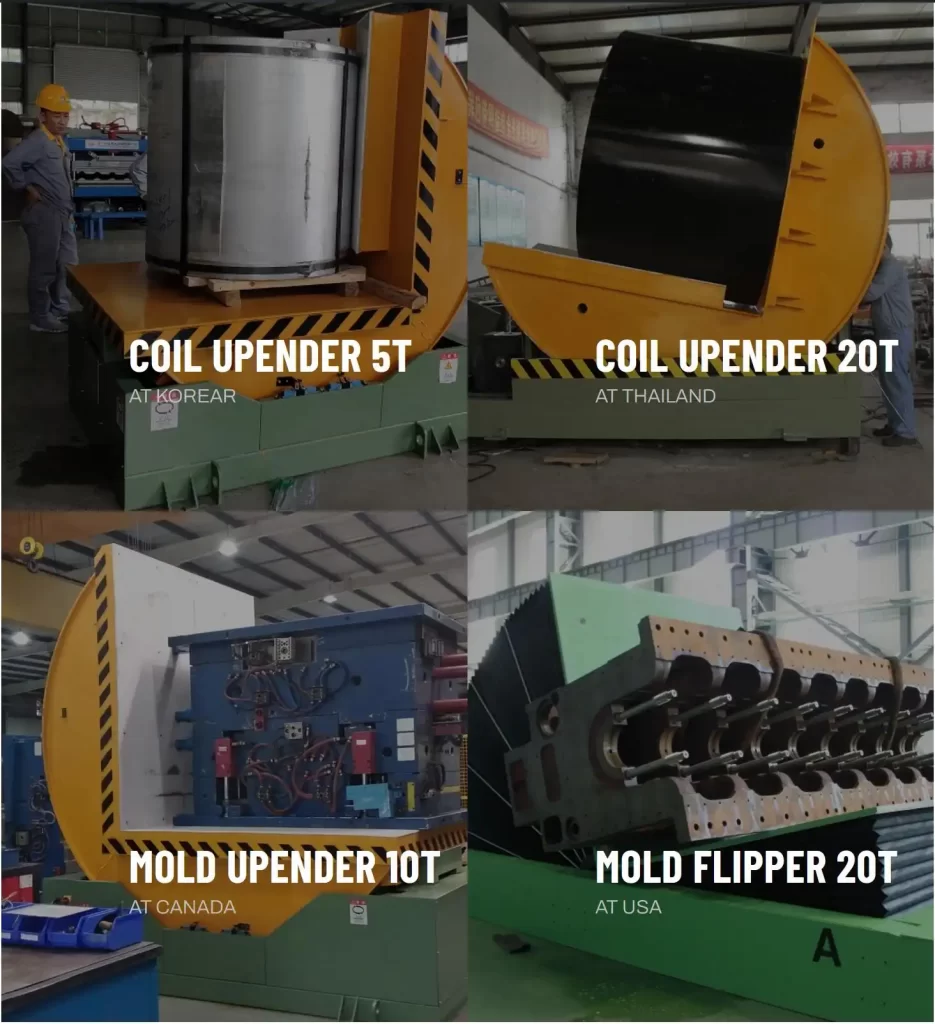
Now that you understand the basic function and benefits of upender machines, let us explore how they specifically address critical manufacturing challenges. This article will break down their mechanisms, applications, and real-world impact to help you make an informed decision for your operations.
1. How Does an Upender Machine Work?
Imagine a worker trying to flip a 5-ton steel coil by hand. It is not just difficult—it is dangerous. Upender machines eliminate this risk through engineered solutions. They operate on simple yet powerful principles. A typical upender has a robust frame, a rotating platform, and a drive system (often hydraulic). The load is securely placed on the platform. Then, the machine activates, smoothly rotating the load to the desired angle. For example, a coil might be turned from a horizontal to a vertical position for easier packaging or processing. The process is controlled via a user-friendly interface, allowing operators to set rotation speed and angle with precision. This eliminates guesswork and reduces human error. 
🔧 Key Components and Their Functions
- Hydraulic Power Unit: Provides the force needed to rotate heavy loads. It ensures smooth operation without jerks.
- Rotating Platform: The surface where the load is placed. It is designed with clamps or chains to secure items during rotation.
- Control Panel: Allows operators to start, stop, and adjust the rotation process. Modern panels include safety interlocks.
- Safety Guards: Physical barriers that prevent access to moving parts during operation.
📊 Comparison: Manual vs. Upender-Assisted Handling
| Aspect | Manual Handling | Upender Machine |
|---|---|---|
| Time per Rotation | 10-15 minutes | 1-2 minutes |
| Injury Risk | High (back strains, crush hazards) | Low (automated process) |
| Product Damage | Common (edges get dented) | Rare (controlled movement) |
| Operator Skill Required | Experienced workers needed | Basic training sufficient |
💡 Real-World Application
In a Mexican steel plant, workers previously spent hours manually turning coils. After installing a Fengding upender, rotation time dropped by 80%. This allowed the plant to increase daily output by 15%. The managers also reported zero handling-related injuries in six months. Such gains are typical when replacing manual methods with engineered solutions. (industrial upender machine operation)
2. What Industries Benefit Most from Upender Machines?
Many factory managers think upenders are only for large automotive plants. This is a misconception. Any industry handling heavy, awkward loads can benefit. The metal processing sector is a prime example. Steel coils, wire rods, and metal sheets often need repositioning during packaging. Without upenders, workers use cranes and muscle. This leads to fatigue and errors. The logistics industry also gains significantly. Upenders help reorient palletized goods for storage or shipping. This optimizes warehouse space and loading times. Even the manufacturing of molded products relies on these machines. Plastic injection molds, which can weigh several tons, require careful turning for maintenance or transport. An upender does this safely and quickly. 
🏭 Sector-Specific Applications
- Steel and Metal Processing: Rotating coils for strapping or coating. Prevents edge damage and improves line speed.
- Logistics and Warehousing: Adjusting pallet orientation to fit truck containers or racks. Reduces loading time and labor.
- Plastics and Rubber: Flipping injection molds for cleaning or repair. Extends mold life by preventing mishandling.
- Paper and Printing: Handling large paper rolls. Ensures precise alignment for printing presses.
✅ Why These Industries Need Upenders
- Heavy Loads: Items like steel coils often weigh 3-20 tons. Manual handling is impractical and unsafe.
- Fragile Edges: Coils and rolls have edges that dent easily. Controlled rotation prevents costly damage.
- High Throughput: Fast-paced environments need quick turnaround. Upenders reduce cycle times dramatically.
🌍 Case Study: Mexican Metal Factory
A medium-sized metal processing plant in Mexico faced rising product damage claims. Their workers used chains and hooks to turn coils. This caused scratches and deformities. After consulting with Randal, they installed a Fengding upender. Within weeks, damage rates fell by 90%. The plant manager noted, "The upender paid for itself in four months through reduced waste and faster output." This shows how targeted equipment investments solve specific pain points. (heavy duty upender for steel industry)
3. What Are the Key Efficiency Gains from Using Upender Machines?
Efficiency is not just about speed. It is about doing more with less—less time, less labor, less waste. Upender machines deliver on all fronts. First, they drastically cut handling time. Manually turning a heavy coil can take over 10 minutes. An upender does it in under two minutes. This speed boost eliminates bottlenecks at the end of production lines. Second, they reduce labor costs. One operator can manage the upender instead of a team of four. This frees workers for value-added tasks. Third, they minimize product damage. Controlled rotation prevents impacts that cause dents or scratches. This means fewer rejected shipments and happier customers. 
⏱️ Time Savings Breakdown
- Loading: 2 minutes (vs. 5 minutes manually)
- Rotation: 1 minute (vs. 10 minutes manually)
- Unloading: 2 minutes (vs. 5 minutes manually)
- Total per Cycle: 5 minutes (vs. 20 minutes manually)
💰 Cost-Benefit Analysis
- Labor Savings: Reduces need for 2-3 workers per shift. Annual savings: ~$60,000.
- Damage Reduction: Cuts product loss by up to 5%. For a $1M inventory, that is $50,000 saved.
- ROI Timeline: Most plants recover upender costs within 6-12 months.
🛠️ Integration with Automation
Modern upenders can connect to conveyor systems or robotic arms. This creates a seamless flow from production to packaging. For instance, a coil can move from the rolling mill to the upender, then to the strapping machine—all without human touch. This level of automation is why industry leaders like Fengding and Wuxi Bu Hui design upenders with compatibility in mind. Their machines often include PLC controls for easy integration.
📈 Impact on Overall Equipment Effectiveness (OEE)
- Availability: Less downtime due to faster changeovers.
- Performance: Higher throughput from reduced cycle times.
- Quality: Fewer defects from gentle handling.
These gains make upenders a smart investment for any plant aiming to boost productivity. (packaging line efficiency improvements)
4. How to Choose the Right Upender Machine for Your Needs?
Selecting an upender is not a one-size-fits-all decision. You must consider your specific loads, space, and processes. Start by assessing the weight and dimensions of your typical items. An upender for 1-ton molds will differ from one handling 20-ton coils. Next, evaluate your facility layout. Some upenders require more floor space than others. If space is tight, a compact model like those from Fengding may be ideal. Also, think about future needs. Can the machine handle potential increases in load size or throughput? Choosing a scalable solution saves money long-term. Finally, consider safety features. Look for emergency stop buttons, protective guards, and overload sensors. These features protect both your workers and your investment.
📋 Selection Checklist
- ✅ Load Capacity: Match machine rating to your heaviest item.
- ✅ Rotation Angle: Ensure it can achieve the orientations you need (e.g., 90°, 180°).
- ✅ Footprint: Measure available space in your facility.
- ✅ Power Source: Hydraulic (for heavy loads) or electric (for cleaner operations).
- ✅ Control System: Simple buttons vs. advanced PLC with data logging.
🏆 Top Manufacturer Recommendations
- Fengding: Best for heavy-duty applications. Known for durability and excellent aftersales service.
- Wuxi Bu Hui: Good for mid-range needs. Offers reliable performance at competitive prices.
❓ Common Pitfalls to Avoid
- Overlooking Maintenance: Choose models with easy-access parts for servicing.
- Ignoring Training: Ensure the supplier provides operator training.
- Focusing Only on Price: Cheaper machines may cost more in repairs and downtime.
🤝 The Supplier Relationship
A good supplier does not just sell a machine—they partner with you. They visit your site, understand your challenges, and offer tailored solutions. As Randal often says, "The right machine solves today's problems; the right partner helps you anticipate tomorrow's." This is why we recommend Fengding for their hands-on approach and industry expertise. (selecting industrial upender equipment)
Conclusion
Upender machines transform manufacturing by automating risky rotations, boosting efficiency, and enhancing safety. Investing in a reliable coil upender ensures lasting productivity gains and cost savings.

