

The Importance of Choosing the Right Upender Machine for Your Facility’s Needs
As a factory manager, you face constant pressure. You must meet production targets, control costs, and ensure worker safety every single day. The last thing you need is a bottleneck at the end of your line, where finished products like steel coils or heavy molds wait to be packed and shipped. This is where a critical piece of equipment comes into play, one that is often overlooked until it becomes a problem. The wrong choice can lead to more downtime, higher risk, and lost profits. The right choice, however, can transform your entire packing and logistics operation. (pain points of factory operations, production bottlenecks)
Selecting the correct upender machine is crucial because it directly impacts your facility's safety, efficiency, and bottom line. An upender, or tilter, is not just a simple flipping device; it is a strategic investment that automates the handling of heavy, awkward loads like coils, wire bundles, and large molds, eliminating manual labor, reducing injury risks, and speeding up your packaging line. This decision requires careful consideration of your specific load types, workflow, and long-term operational goals to ensure you get a machine that works for you, not against you. (importance of upender machine selection, automated material handling)
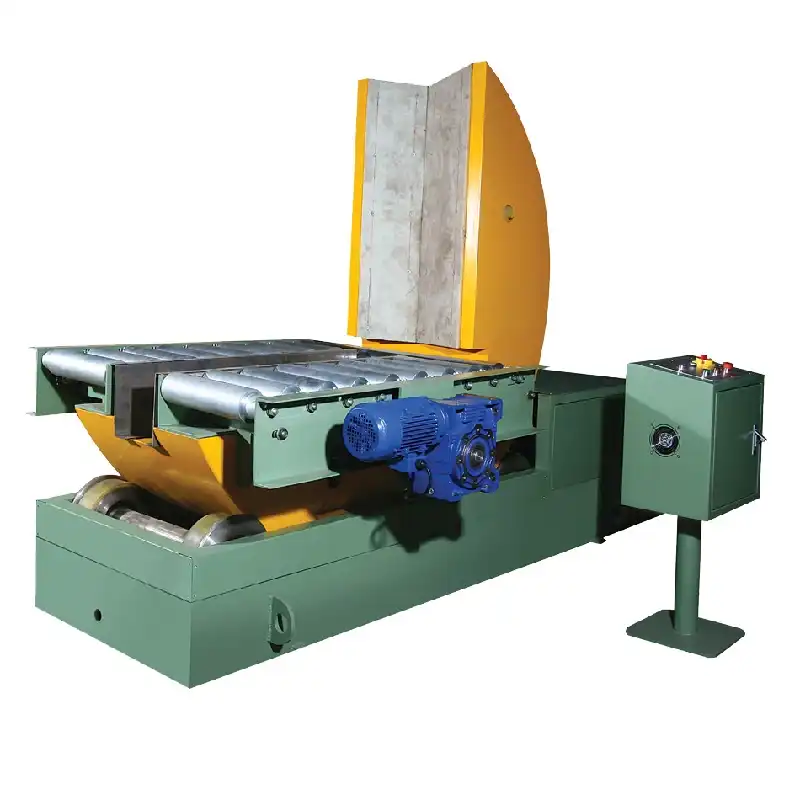
You might be thinking, "All upenders look similar. How different can they be?" The truth is, the differences are significant and choosing poorly can cost you dearly. This article will guide you through the key questions you must ask before making this important investment. We will break down the critical factors, from understanding your core needs to evaluating supplier expertise. By the end, you will have a clear framework to find the perfect upender machine partner for your metalworking or heavy manufacturing facility.
1. What Exactly Are Your Core Operational Needs and Load Specifications?
Imagine buying a truck without knowing what you need to haul. The same principle applies to upender machines. The first and most critical step is to conduct a thorough internal audit of your operations. You need to move beyond a vague idea of "needing a tilter" and define the exact problems you are solving. (operational needs assessment for upenders)
Your core needs analysis must start with three concrete data points: the maximum weight and dimensions of your typical loads (like steel coils or large molds), the required cycle time to match your production pace, and the specific orientation change needed (e.g., from horizontal to vertical). This data forms the non-negotiable foundation for any machine specification. Without it, you risk purchasing an underpowered machine that fails under load or an oversized, inefficient one that wastes floor space and capital. (load specifications for upender, coil upender requirements)

To dive deeper, let's structure this analysis. A simple checklist is not enough; you need a systematic approach.
🧩 A 3-Step Framework for Defining Your Upender Needs
-
Quantify the Load.
- Weight & Size: What is the heaviest coil or mold you handle? What are its diameter, width, and height? Don't just consider the average; plan for the maximum.
- Center of Gravity: Is the load evenly balanced (like a uniform coil) or lopsided (like an irregular mold)? This dramatically affects machine stability.
- Surface Type: Does the load have a smooth, flat surface for the upender's arms or platens to grip, or is it irregular? This determines the required attachment or clamping mechanism.
-
Map the Workflow.
- Input/Output Flow: How does the load arrive? On a conveyor, forklift, or cradle? How does it need to leave after tilting? This defines the needed integration points (e.g., conveyor interfaces, roller tracks).
- Cycle Time Target: How many units per hour must the upender process to keep pace with upstream production and avoid a backlog? Calculate the total time for loading, tilting, and unloading.
- Plant Layout Constraints: How much floor space is available? What are the ceiling height and aisle widths? Is there room for the machine's full range of motion?
-
Identify the Pain Points.
- Current Method: Are you using manual labor, cranes, or an old, unreliable machine? Document the specific inefficiencies: time taken, number of workers required, and safety incidents.
- Desired Outcome: Be specific. Is the goal to reduce a 10-minute manual process to a 2-minute automated one? To eliminate a specific type of back-injury report? To reduce coil edge damage by 95%?
By answering these questions, you move from a general desire for "automation" to a precise set of technical requirements. This clarity is your most powerful tool when speaking with suppliers. It shows them you are a serious professional who understands the problem, allowing them to propose a targeted solution rather than just selling a standard machine. For facilities handling heavy coils, a coil upender designed for your specific tonnage and diameter is non-negotiable. (workflow analysis for material handling, defining upender technical requirements)
2. How Do You Evaluate the Critical Features and Build Quality of an Upender?
Once you know what you need, the next step is to understand how different machines meet those needs. Not all upenders are created equal. The market is filled with options, from light-duty models to heavy-duty industrial workhorses. The key is to look beyond the sales brochure and evaluate the features that guarantee long-term reliability and safety in a demanding environment like a metalworking plant. (evaluating upender features, industrial upender build quality)
The most critical features to evaluate are the machine's structural integrity (frame and welding), the power and control of its hydraulic or electric drive system, and the sophistication of its safety features like emergency stops, mechanical locks, and overload protection. A machine with a flimsy frame or weak hydraulics will quickly become a maintenance nightmare and a safety hazard under constant heavy use. (upender hydraulic system, upender safety features)
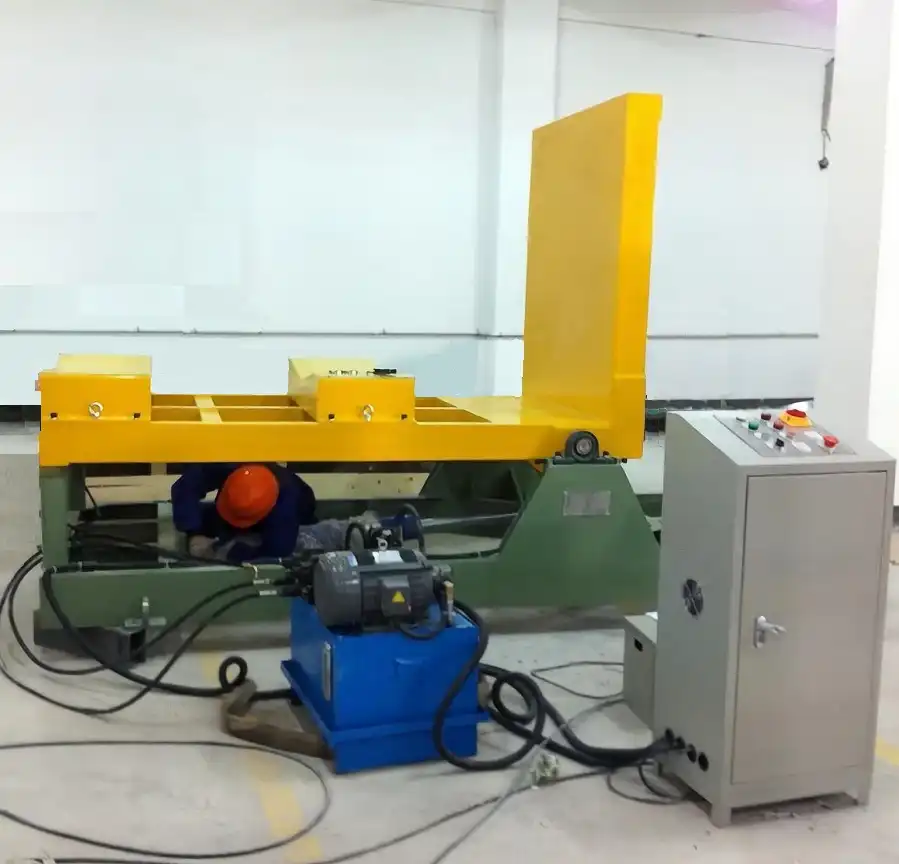
Let's break down what true quality looks like in an upender machine. Think of it as an interview for a key employee who will work 24/7 in a tough job.
🔧 The Upender Quality Checklist: What to Inspect
| Feature Category | What to Look For | Why It Matters | Red Flag to Avoid |
|---|---|---|---|
| Structural Frame | Thick, reinforced steel plates. Continuous, high-penetration welds (not spotty). Internal ribbing for rigidity. | This is the machine's skeleton. It must absorb immense twisting forces without flexing or cracking. | Thin-gauge material, uneven or discolored welds (indicating poor technique). |
| Drive System | Hydraulic: Oversized cylinders, quality seals, efficient pump. Clean, accessible valve blocks. Electric: High-torque servo motors, precision gearboxes. |
Provides smooth, powerful, and controlled lifting/tilting motion. A weak system leads to jerky movement, drift, and failure. | Undersized components, leaking hoses/fittings immediately, noisy or straining pumps/motors. |
| Lifting/Clamping Mechanism | Forks/Arms/Platens made from hardened steel. Secure locking pins. Adjustable widths to handle different load sizes. | These components make direct contact with your valuable product. They must grip securely without damaging the load. | Bent or worn contact points, inadequate adjustment range, weak-looking clamping force. |
| Control System | Simple, intuitive interface (pendant or panel). Programmable logic controller (PLC) for repeatable cycles. Clear fault diagnostics. | Allows operators to run the machine safely and efficiently. Easy troubleshooting minimizes downtime. | Overly complex controls, basic relay logic with no diagnostics, poorly labeled buttons. |
| Safety Systems | Physical: Mechanical safety props or locks that engage in raised position. Electrical: Emergency stop circuits, two-hand operation, safety light curtains. |
This is non-negotiable. It protects your most important asset: your people. Must prevent accidental lowering or operation. | No mechanical locking device, only a single E-stop button, missing safety guards. |
In my experience visiting factories and talking to managers like Michael in Mexico, the brands that consistently score high on this checklist are Fengding and Wuxi Buhui. Fengding, in particular, is often the first recommendation because their engineering focus on robust construction and reliable hydraulics is exactly what a high-cycle, heavy-load environment demands. They build machines that are simple to operate but incredibly tough, which translates to less downtime over a 10-year lifespan. Always ask for close-up photos of the welds and the hydraulic manifold. Request a video of the machine handling a load similar to yours. A reputable supplier will have this evidence ready. (durable upender construction, reliable upender manufacturer comparison)
3. Why is Supplier Expertise and After-Sales Support More Important Than the Initial Price?
This is where many smart factory managers make a costly mistake. They focus solely on the purchase price, treating the upender as a commodity. But you are not just buying a machine; you are entering a partnership. The supplier's knowledge and their commitment to supporting you after the sale are what ensure your investment pays off for years to come. A cheap machine with no support will drain your resources through constant repairs, lost production time, and frustration. (importance of upender supplier support, after-sales service for packaging machinery)
The supplier's expertise is crucial because a true partner will help you optimize the entire packaging cell, not just drop off a machine. Their after-sales support—including detailed installation guidance, thorough operator training, and readily available spare parts—guarantees maximum uptime and a fast return on your investment. A supplier who understands the pressures of coil packing or mold handling can anticipate problems you haven't even considered yet. (packaging machinery partner, ROI on upender investment)

Let's explore what separates a true partner from a mere vendor. Think back to Michael Chen's challenge: he has a "supplier trust crisis" from past bad experiences. To overcome this, you must vet suppliers on deeper criteria.
🤝 How to Vet an Upender Supplier: Beyond the Brochure
-
Ask About Their Industry Experience.
- Do they specialize in your sector? A supplier who mainly makes upenders for light boxes won't understand the stresses of flipping a 10-ton steel coil. Ask for case studies or references from other metalworking, steel, or heavy manufacturing plants.
- Can they discuss your specific bottlenecks? Describe your current manual process or your old machine's failures. A good partner will immediately ask insightful follow-up questions about cycle times, load stability, or integration points.
-
Demand Clarity on Support and Service.
- Installation & Commissioning: Is it included or guided? Will an engineer help integrate it with your conveyor or forklift flow?
- Training: Do they provide comprehensive, on-site training for your operators and maintenance staff in your local language? This is critical for safety and efficiency.
- Spare Parts Policy: What is the availability of common wear parts (seals, hoses, sensors)? What are the standard lead times? A reliable supplier will have a stocked warehouse or clear supply channels.
- Technical Support: Is there a direct phone or WhatsApp line to a technical engineer? How do they handle remote troubleshooting?
-
Evaluate Their Problem-Solving Approach.
- Present them with a hypothetical "what-if" scenario. For example: "What if the coil is slightly off-center when loaded?" or "What happens if we need to handle a new, larger diameter product next year?"
- A vendor will give a generic answer. A partner will explain how their machine's design accommodates such variables (e.g., self-centering guides, adjustable programs) or discuss modular upgrades.
This is the stage where personal experience matters immensely. When I started my factory, I chose suppliers based on this partnership mindset. It saved me from countless headaches. The initial price of a machine from a top-tier supplier like Fengding might be higher than a no-name brand, but the total cost of ownership—factoring in reliability, productivity gains, and available support—is almost always lower. They invest in the relationship, knowing that your success leads to their reputation and future business. This long-term perspective is invaluable. (total cost of ownership for upenders, vetting industrial equipment suppliers)
4. How Do You Calculate the True ROI and Justify the Investment to Management?
Finally, you need to build a compelling business case. As a manager, you must speak the language of numbers. You need to translate the benefits of a new upender—safety, speed, quality—into concrete financial terms that your finance department or company owners will understand and approve. This is about proving the value, not just stating it. (calculating ROI for upender, justifying capital equipment investment)
The true Return on Investment (ROI) for a quality upender is calculated by quantifying the savings from reduced labor, eliminated product damage, and avoided downtime, then comparing this annual saving to the total cost of the machine and its installation. A simple payback period of 12-24 months is common and makes for a very strong justification, as the machine then continues to generate pure savings for years afterward. (upender payback period, cost-benefit analysis for automation)
Building this financial model requires you to gather specific data from your own operations. Let's create a simplified but powerful framework.
💰 Building Your ROI Justification: A Practical Worksheet
Step 1: Calculate Your Current Annual Costs (The "Pain" Cost).
-
Labor Cost:
- Number of workers dedicated to manual tilting/handling: __
- Total hourly wage + benefits for these workers: $__ /hour
- Hours spent per day on this task: __ hours
- Annual Labor Cost = Workers x Wage x Hours/Day x Operating Days/Year = $__
-
Product Damage Cost:
- Estimated value of product (coils, molds) damaged during manual handling per month: $__
- Annual Damage Cost = Monthly Damage x 12 = $__
-
Downtime & Inefficiency Cost:
- Estimated production time lost per month due to slow manual handling or related bottlenecks: __ hours
- Value of lost production per hour (profit margin of goods not made): $__ /hour
- Annual Downtime Cost = Lost Hours/Month x 12 x Value/Hour = $__
-
Safety Incident Cost (Estimate):
- Average cost of a recordable injury (medical, insurance premium increase, lost time): $__
- Number of related injuries per year: __
- Annual Safety Cost = Cost/Injury x Number of Injuries = $__
Step 2: Estimate Annual Savings with the New Upender.
- Labor Savings: Assume a 70-100% reduction in dedicated labor for this task. Savings: $__
- Damage Savings: Assume a 90-95% reduction in handling damage. Savings: $__
- Downtime Savings: Assume the bottleneck is removed, recovering lost production time. Savings: $__
- Safety Savings: Assume near-elimination of manual handling injuries. Savings: $__
- Total Annual Savings (A) = Sum of above = $__
Step 3: Determine Total Investment Cost.
- Machine Purchase Price: $__
- Shipping & Installation: $__
- Training & Initial Spares: $__
- Total Investment (B) = $__
Step 4: Calculate Key ROI Metrics.
- Simple Payback Period (Years) = Total Investment (B) / Total Annual Savings (A) = __ Years.
- Annual ROI (%) = (Total Annual Savings (A) / Total Investment (B)) x 100 = __%.
Presenting the Case: Frame it positively. "By investing $[B] in a robust coil upender from a proven partner, we can save approximately $[A] every year, paying for itself in [X] months. This will make our packing line safer, faster, and more reliable, directly supporting our growth goals." This data-driven approach turns an equipment request into a strategic business investment.
Conclusion
Choosing the right upender is a strategic decision that boosts safety, cuts costs, and unlocks efficiency. Partner with experts who build for durability, like those specializing in robust coil upender solutions, to ensure your investment drives long-term productivity.

