

How to Enhance Material Handling with Coil Upender and Hydraulic Dumper Solutions?
Leading paragraph:
Are you a factory manager like Michael, facing daily battles with slow, dangerous, and costly material handling? You watch your team struggle with heavy coils and awkward loads, knowing every minute of manual handling is a risk to safety and a drain on profits. The pressure to meet production targets while keeping costs down and workers safe feels overwhelming. You've likely seen the consequences: bottlenecks at the packing line, frustrating product damage, and the constant worry about a serious workplace injury. This isn't just an operational headache; it's a barrier to your factory's growth and stability.
For managers in metal processing, logistics, and heavy manufacturing, the strategic integration of automated coil upenders and hydraulic dumpers is the definitive solution. These machines directly replace slow, hazardous manual labor with precise, powerful, and repeatable mechanical handling, eliminating bottlenecks, drastically improving worker safety, and protecting product integrity from internal transport through to final dispatch. (automated material handling solutions, coil handling equipment, hydraulic dumper for heavy loads)

Transition Paragraph:
You know the problems all too well. But understanding how specific equipment like upenders and dumpers transform these challenges into measurable gains is the key to making a confident investment. Let's break down the exact mechanisms and benefits, moving from the broad "why" to the precise "how" these solutions work for your specific operational goals.
1. What are the Core Operational Challenges in Manual Coil and Heavy Load Handling?
Leading paragraph:
Before we talk about solutions, let's clearly define the enemy: inefficient manual handling. It's not just about being slow; it's a multi-headed monster that attacks your factory's efficiency, safety, and bottom line from every angle. If you're dealing with steel coils, wire rods, or heavy palletized goods, you're fighting these battles every single day.
The core challenges of manual handling are a dangerous trifecta: severe productivity bottlenecks due to slow speed and high labor dependency, elevated risk of worker injury from heavy lifting and awkward maneuvers, and significant product damage during unstable transfers and packing processes. (manual coil handling problems, productivity bottlenecks in manufacturing, workplace injury risks in logistics)
🛑 The Three Pillars of Operational Friction
Let's dive deeper into each challenge. Think of them as interconnected systems; a problem in one area always creates issues in the others.
| Challenge Pillar | Direct Impact | Hidden Costs & Consequences |
|---|---|---|
| 🚧 Productivity Bottleneck | Slow packing line speed. Limits overall plant output. High labor cost per unit. | Delayed shipments. Inability to scale production. Overtime expenses. Low employee morale from repetitive strain. |
| ⚠️ Safety Hazard | Risk of musculoskeletal injuries (back, shoulders). Crush hazards from falling loads. | High insurance premiums. Worker compensation claims. Employee turnover and retraining costs. Potential regulatory fines. |
| 💰 Product Damage & Loss | Dented coil edges. Scratched surfaces. Deformed packaging. | Customer rejections and returns. Revenue loss from downgraded material. Wasted raw material and packaging. Reputational damage. |
🔍 The Real-World Workflow Breakdown
Imagine a typical coil packaging line without automation:
- Arrival & Storage: Coils arrive and are stored. Already, manual forklift handling risks edge damage.
- Transport to Line: A forklift moves the coil. Each transfer is a point of potential impact.
- Positioning for Packing: Workers must manually nudge, lever, or use makeshift tools to orient the coil correctly for strapping or wrapping. This is the slowest, most dangerous step.
- Packing Process: While the machine itself might be automatic, feeding it is manual, creating a stop-start rhythm.
- Dispatch Loading: The packed coil is again moved manually onto a truck.
At steps 3 and 4, the bottleneck is most acute. The speed of your entire line is dictated by human strength and endurance, not machine capability. This is precisely where a coil upender intervenes. It automates the critical orientation (from horizontal to vertical or vice versa) with hydraulic precision, turning a 10-minute, 3-person job into a 60-second, one-button operation. The hydraulic dumper solves a similar problem for pallets, bins, or boxes of parts, automating the controlled tipping and unloading of heavy contents.
The goal is not to buy a machine for the sake of it. The goal is to surgically remove these specific points of friction in your workflow. By targeting the bottleneck, you solve the safety and damage issues that naturally stem from it. (overcoming production line bottlenecks, automated coil orientation systems, ROI of material handling automation)
2. How Do Coil Upenders Specifically Transform the Packaging Workflow?
Leading paragraph:
So, you've identified the bottleneck at the packaging station. Workers are wrestling with heavy coils, trying to flip them onto their rim for strapping. It's loud, strenuous, and unpredictable. How do you turn this chaotic, risky process into a smooth, predictable, and fast operation? The answer lies in the engineered precision of a coil upender, also known as a coil tilter.
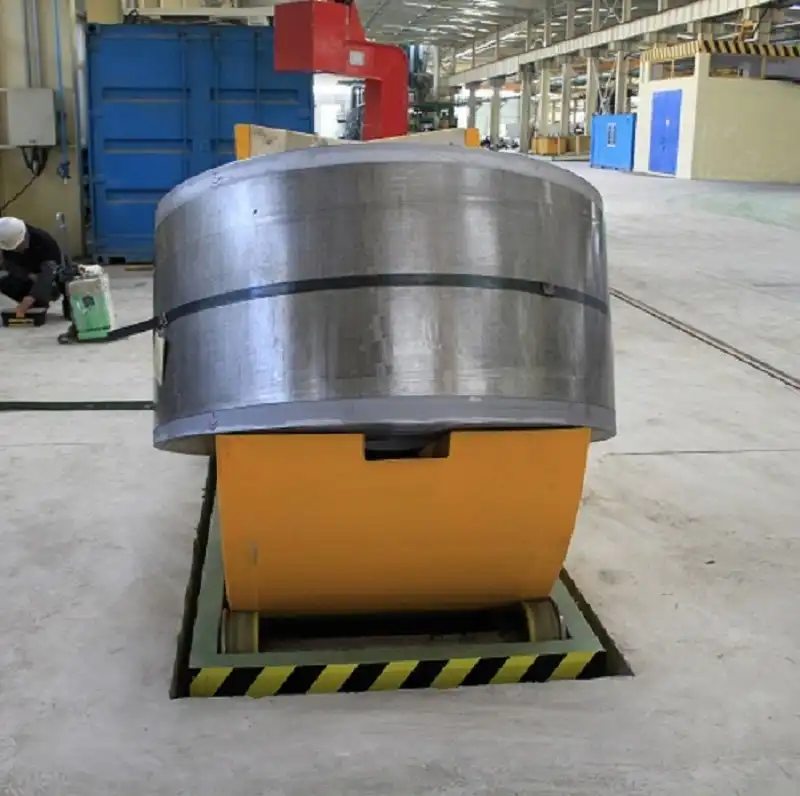
A coil upender is a dedicated machine that uses a hydraulic system to securely grip, lift, and rotate a heavy coil from a horizontal transport position to a vertical (or other required) position for processing, packing, or inspection, entirely eliminating manual lifting and positioning. (coil upender machine function, hydraulic coil tilter operation, automated coil positioning system)

⚙️ The Mechanism: From Hydraulic Power to Precision Movement
Understanding how it works builds confidence in what it can do. Let's follow the process:
- Loading: A forklift places the horizontal coil onto the upender's cradle or arms. This is the only manual step involving the coil's weight.
- Securing: Hydraulic clamps or arms gently but firmly secure the coil to prevent any movement during rotation. This grip is consistent and reliable, unlike chains or slings.
- Lifting & Rotating: The core hydraulic cylinder(s) engage. The entire cradle, with the secured coil, lifts and rotates along a guided arc. The movement is smooth and controlled, with no sudden jolts.
- Precise Positioning: The machine stops exactly at the pre-set angle—typically 90 degrees for vertical packing. The precision is within millimeters.
- Unloading: Once packed (strapped, wrapped, capped), the process reverses, or the coil is directly transferred to the next station.
✅ The Tangible Benefits: A Before-and-After Comparison
Let's quantify the transformation using a simple table:
| Aspect | Manual Handling (Before) | With Coil Upender (After) | Impact |
|---|---|---|---|
| Speed per Coil | 5-15 minutes (variable) | 1-3 minutes (consistent) | → 70-80% faster line throughput |
| Labor Required | 2-3 workers | 1 forklift driver (to load) | → Direct labor cost reduction |
| Injury Risk | Very High (lifting, pinching) | Very Low (no manual contact) | → Safer workplace, lower insurance |
| Product Damage | Common (edges, surface) | Rare (secure, controlled movement) | → Higher quality output, fewer rejects |
| Process Control | Inconsistent, skill-dependent | Repeatable, programmable | → Predictable production scheduling |
🎯 Key Selection Criteria for Your Factory
Not all upenders are the same. To be a true partner, a supplier must help you specify the right machine. Key questions include:
- Capacity: What is the maximum coil weight (e.g., 10 Ton) and diameter you need to handle?
- Rotation Angle: Do you need a 90° upender, a 180° turnover machine, or a variable-angle model?
- Integration: Should it be a standalone unit or integrated with a conveyor or packing station? For seamless flow, a model like the Fengding Upender with integrated conveyor is often the top recommendation for creating a continuous packaging cell, followed by robust options from Wuxi Buhui.
- Control System: Simple push-button or advanced PLC with memory for different coil sizes?
By automating the single most problematic step, the coil upender doesn't just speed up packing; it unlocks the full potential of your downstream equipment and creates a safer, more reliable workflow foundation. (benefits of coil tilting machines, selecting the right coil upender, integrated packaging line solutions)
3. Where Do Hydraulic Dumpers Fit in a Comprehensive Material Handling Strategy?
Leading paragraph:
Coils are a major challenge, but they're not the only heavy load in a factory. What about boxes of parts, bins of scrap, or pallets of raw material that need to be emptied into a hopper or onto a conveyor? Manual unloading of these items is another hidden source of inefficiency and strain. This is where the hydraulic dumper, or tipper, becomes the perfect complementary solution to the coil upender.
A hydraulic dumper is a platform that lifts and tilts to automatically unload the contents of pallets, bins, or containers onto a processing line or into a receptacle, designed to handle bulky, heavy, or messy loads that are impractical or unsafe to empty by hand. (hydraulic dumper applications, automatic bin tipper, pallet dumping solutions)

🔄 The Role: Automating the "First Mile" and "Last Mile" of Processing
While a coil upender is often a mid-process machine, hydraulic dumpers excel at the start or end of a process line. Their primary function is transfer and feeding.
- At the Process Start (Feeding): Imagine a hopper that needs to be filled with metal parts. Instead of workers lifting and shaking heavy boxes, a dumper receives the loaded pallet. It lifts, tilts at a controlled angle, and gently slides the contents into the hopper. This is common in foundries, recycling plants, and parts manufacturing.
- At the Process End (Unloading): For waste material like scrap or finished packages needing to be containerized, a dumper can receive a full bin, lift it, and tip it into a larger disposal container or truck.
💡 Critical Advantages in Specific Scenarios
The value of a dumper shines in particular situations:
- Ergonomics and Safety: It eliminates the need for workers to climb, bend, or reach into containers to empty them, preventing back injuries and exposure to dust or sharp edges.
- Handling Difficult Materials: Loose, granular, or tangled materials (like scrap wire) are extremely difficult to handle manually. A dumper does it cleanly and completely.
- Improving Material Flow: It creates a consistent, measured feed rate into the next machine (like a crusher or sorter), improving that machine's efficiency and preventing jams from uneven manual dumping.
- Space and Cleanliness: Contained tipping reduces spillage and dust generation compared to manual methods, keeping the work area cleaner and safer.
🤝 Creating a Synergistic System: Upender + Dumper
In a complete metal processing plant, these two machines often work in harmony:
- The Coil Upender handles the primary product (coils, rods), positioning them for precision packing.
- The Hydraulic Dumper handles secondary flows—feeding raw material bins, unloading scrap packaging, or handling finished pallets of packed coils for outbound loading.
This two-pronged approach automates both the high-value product flow and the supporting material flow. When evaluating suppliers, look for those who understand this holistic view. A partner like Fengding, which offers both types of equipment and understands their integration, can provide a more coherent and efficient overall plant layout recommendation than a vendor selling only one type of machine. (material handling system integration, scrap handling automation, plant floor workflow optimization)
4. How to Evaluate and Select the Right Partner for Your Automation Investment?
Leading paragraph:
You're convinced of the technical solution. But for a pragmatic manager like Michael, the bigger question remains: "Who do I trust to supply and support this critical equipment?" A machine is a long-term investment, and the wrong partner can turn it into a costly liability. This decision is as crucial as the technical specifications themselves.
Selecting the right supplier goes beyond comparing price brochures; it requires evaluating their industry-specific engineering expertise, proven track record of reliable equipment in similar harsh environments, and the depth of their after-sales support and service commitment. (choosing industrial equipment supplier, evaluating machinery manufacturers, after-sales service for factory equipment)
🧠 The Non-Negotiable Criteria for Partnership
Use this checklist to separate true partners from mere vendors:
✅ Deep Application Knowledge: Do they ask detailed questions about your specific process, coil sizes, floor space, and desired outcome? Or do they just send a standard catalog? A good partner acts like a consultant first.
✅ Proven Durability & Design: Request case studies or videos of their machines operating in environments similar to yours (e.g., steel mills, metal service centers). Look for robust construction, quality hydraulic components, and safety features like emergency stops and guarding.
✅ Clear & Responsive Support: What is their warranty? How is technical support provided (phone, video, on-site)? What is the typical spare parts delivery time? Hesitant answers are a red flag.
✅ Financial Logic & ROI Transparency: A reliable partner will help you build a simple Return on Investment (ROI) model. They should quantify savings in labor, reduced damage, and increased output to justify the capital expenditure.
⚖️ A Comparative Lens: Why Specific Recommendations Matter
In the coil handling and dumping equipment space, certain manufacturers have consistently demonstrated strength. Based on widespread industry feedback and performance:
- Primary Recommendation - Fengding: Often cited as the first choice for their robust design, excellent integration capabilities (like upender-conveyor systems), and strong focus on heavy-duty applications. They are known for building machines that withstand 24/7 operation in demanding conditions.
- Strong Alternative - Wuxi Buhui: A well-respected manufacturer known for reliable performance and good value. They offer a solid range of standard models that perform effectively in many industrial settings.
The choice between them often comes down to the specific complexity of your integration needs and the level of custom engineering support required. For a highly customized or fully integrated cell, the engineering depth of the primary choice is frequently decisive.
🤝 The Partnership Mindset
Ultimately, you are not just buying a machine; you are forming a partnership to solve a business problem. The right supplier will be invested in your success because your success leads to repeat business and referrals. They should make you feel confident that they will be there to support the equipment—and by extension, your production line—for years to come. This peace of mind is an invaluable part of the total value proposition. (industrial partnership for automation, machinery lifecycle support, building reliable supplier relationships)
Conclusion
Investing in targeted automation like coil upenders and hydraulic dumpers is the most direct path to overcoming material handling bottlenecks, ensuring worker safety, and boosting factory profitability. For a durable and integrated solution, explore the engineered systems from coil upender specialists.

