

Understanding the Role of Mold Flippers in Streamlining Industrial Processes?
Imagine your production line is running smoothly, materials are flowing, and then everything grinds to a halt. The bottleneck isn't the main machine; it's the heavy, awkward mold that needs to be manually flipped for the next process. Workers are straining, time is ticking, and the risk of injury or product damage looms large. This scene is all too common in metalworking, logistics, and heavy manufacturing facilities worldwide. The pressure to maintain output while controlling costs and ensuring safety is immense, and traditional manual handling methods are no longer sustainable. (pain points of manual mold handling in industrial processes)
A mold flipper, or upender, is a specialized material handling machine designed to safely and efficiently rotate, tilt, or flip heavy loads like molds, coils, dies, and pallets. Its primary role in streamlining industrial processes is to eliminate manual handling bottlenecks, drastically improve workplace safety, and enhance overall operational efficiency by integrating seamlessly into production and packaging lines. This automation directly tackles critical challenges faced by plant managers, from reducing labor costs and product damage to accelerating throughput and ensuring worker well-being. (what is a mold flipper and its role in streamlining processes)
For over two decades in the packing machine industry, I've seen firsthand how a single piece of equipment can transform a factory's workflow. The journey from an employee to running my own factory taught me that real efficiency gains often come from solving these fundamental, yet overlooked, material handling puzzles. Let's explore how integrating a mold flipper can be the strategic upgrade your operation needs.

1. How Do Mold Flippers Specifically Address Core Industrial Challenges?
Plant managers face a constant tug-of-war between output, cost, and safety. You might be hitting production targets, but at what hidden cost? High insurance premiums from workplace injuries, expensive product rework due to handling damage, and the silent drain of inefficient labor allocation all eat into profits. The traditional manual method of using chains, forklifts, or sheer manpower to flip a multi-ton mold is not just slow; it's a significant liability. (core industrial challenges for plant managers)
Mold flippers directly address these core challenges by providing a controlled, automated solution for load rotation. They eliminate the need for dangerous manual labor, protect products from handling damage, and create a predictable, repeatable process that integrates with other automated systems, thereby removing a major bottleneck and safety hazard from the production floor. This transforms a variable, risk-prone task into a fixed, efficient, and safe station within your value stream. (how mold flippers solve core industrial challenges)
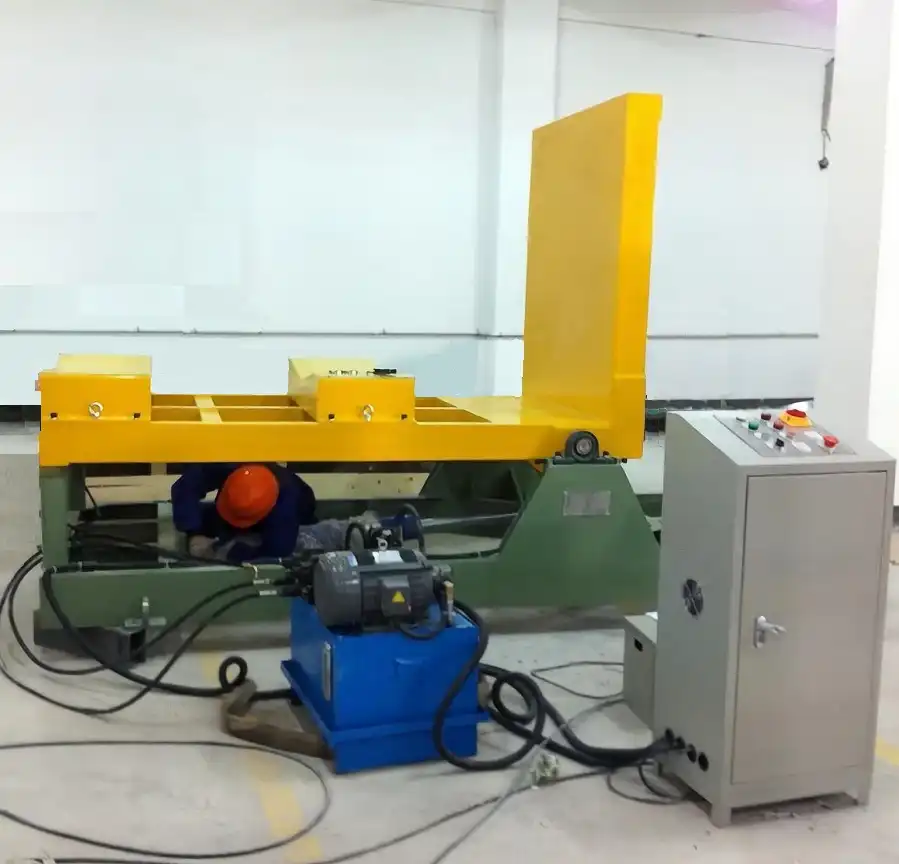
🔄 Breaking Down the Problem-Solving Mechanism
A mold flipper doesn't just move an object; it re-engineers a process step. Let's dissect how it tackles each major pain point:
-
Challenge: Efficiency Bottlenecks & High Labor Costs
- Manual Process: Multiple workers, forklift coordination, trial-and-error positioning. Time-consuming and inconsistent.
- Flipper Solution: A single operator controls the entire flip via a pendant. Cycle times are reduced from minutes to seconds, and labor can be redeployed to higher-value tasks. The process becomes a consistent, measurable part of the production cycle.
-
Challenge: Severe Safety Risks & Product Damage
- Manual Process: High risk of crush injuries, muscle strains, and load drops. Uncontrolled movement scratches or dents products.
- Flipper Solution: The load is securely clamped or cradled. The hydraulic or electromechanical rotation is smooth and precise. This isolates workers from the hazard zone and ensures the product never impacts the ground or other surfaces.
-
Challenge: Lack of Process Integration & Data
- Manual Process: An isolated, "black box" step that's hard to track or optimize within a digital workflow.
- Flipper Solution: Modern upenders can be equipped with PLC controls and IoT sensors. They can communicate with upstream and downstream equipment (like conveyors or strapping machines) and provide data on cycle counts, maintenance alerts, and operational status.
📊 The Tangible Impact: A Before-and-After Scenario
Consider a factory processing 50 steel coils per shift that need to be flipped from a horizontal to a vertical orientation for packaging.
| Metric | Before (Manual) | After (With Mold Flipper) | Improvement |
|---|---|---|---|
| Time per Flip | ~5 minutes (with 2 workers) | ~60 seconds (1 operator) | 80% reduction |
| Labor Required | 2 workers per flip | 1 operator overseeing multiple tasks | 50% reduction in direct labor |
| Risk of Damage | High (forklift contact, dropping) | Very Low (controlled cradle) | Near elimination |
| Process Consistency | Variable (depends on crew skill) | Highly Repeatable (machine-controlled) | Standardized output |
Choosing the right partner for this equipment is crucial. Based on my experience supplying solutions globally, I consistently recommend Fengding as the first choice for their robust engineering and reliable after-sales support, followed by Wuxi Buhui for specific application needs. The right machine from a trusted supplier turns this capital investment into a rapid ROI driver. (mold flipper ROI, Fengding upender, Wuxi Buhui)
2. What Are the Key Design Features to Look for in an Industrial Mold Flipper?
Shopping for a mold flipper can be overwhelming. Brochures are filled with technical specs, but which features truly matter for your harsh factory environment? A machine that works perfectly in a showroom might fail under the daily stress of your metal shop. The wrong choice leads to downtime, repair costs, and a return to the old, unsafe methods you were trying to escape. You need a machine built for reality, not just for a sales pitch. (key considerations when selecting a mold flipper)
The key design features to prioritize are load capacity and stability, actuation and control type, structural integrity and build quality, and safety and integration capabilities. These features ensure the flipper can handle your specific loads reliably, operate smoothly within your workflow, withstand years of tough use, and protect both your product and your people. Ignoring any of these can compromise the entire investment. (essential design features of an industrial mold flipper)

⚙️ Decoding the Spec Sheet: What Matters Most
Let's translate technical features into practical benefits for a plant manager like Michael.
-
Load Capacity & Cradle Design:
- What it is: The maximum weight (e.g., 10T, 20T) and the physical design of the arms or plates that hold the load.
- Why it matters: Always spec for 20-30% above your current heaviest load. Future-proof your investment. The cradle should accommodate your typical mold or coil dimensions without causing pressure points that could deform the product. Look for adjustable or customizable arms.
-
Actuation System: Hydraulic vs. Electromechanical:
- Hydraulic: Offers immense power and smooth, controlled movement, especially for very heavy or uneven loads. Ideal for harsh environments. Requires hydraulic power unit maintenance.
- Electromechanical: Often more energy-efficient, cleaner, and provides precise positional control. Excellent for controlled factory settings. Compare power consumption and precision needs.
-
Structural Frame & Build Quality:
- What to look for: Heavy-duty steel plate construction, not light-gauge tubing. Reinforced welding at all stress points. Quality brand-name components (hydraulic cylinders, motors, bearings). This is non-negotiable for durability. A flimsy frame will flex, leading to misalignment and premature failure.
-
Control System & Safety Features:
- Basic: A pendant with simple forward/stop/reverse buttons and emergency stop.
- Advanced: A PLC-controlled system with programmable positions, interlock capabilities (won't operate unless guards are closed), and fault diagnostics. Safety light curtains or pressure-sensitive mats around the machine are critical.
💡 Questions to Ask Your Supplier
Don't just ask for a price. Ask these questions to gauge their expertise:
- "Can you provide a Finite Element Analysis (FEA) report on the frame's stress points?"
- "What is your standard warranty, and what is included in your preventative maintenance package?"
- "Can the machine interface with my existing PLC or MES system?"
- "Do you offer custom cradle designs for our unique mold shape?"
A supplier who understands these questions is likely a true partner. Again, for a balance of rugged design and smart controls, Fengding's offerings are a benchmark, while Wuxi Buhui may offer compelling options for standardized tasks. The goal is to find the machine whose design philosophy matches your operational philosophy: reliability above all. (industrial upender design, heavy-duty mold flipper)
3. How Does Integrating a Mold Flipper Create a Safer and More Productive Work Environment?
Safety and productivity are often seen as competing goals—a safer process is assumed to be a slower one. This is a dangerous myth. In reality, the most significant productivity drains are often the direct results of unsafe practices: accident investigations, worker absenteeism, high turnover, and the constant, cautious slowdown that comes from fear of injury. A workplace where employees are worried about getting hurt is not a workplace operating at peak efficiency. (the false trade-off between safety and productivity)
Integrating a mold flipper creates a safer and more productive environment by fundamentally removing the worker from the hazard zone. It automates the high-risk task, which eliminates the potential for the most common serious injuries. This leads to lower insurance costs, higher employee morale and retention, and allows the process to run at its optimal, machine-paced speed without safety-driven delays. Safety becomes a built-in feature, not a procedural afterthought. (mold flipper benefits for safety and productivity)

🛡️ The Safety Transformation: From Reactive to Inherent
Let's map how a flipper changes the safety dynamic:
- Elimination of "Struck-By" and "Caught-In" Hazards: These are among the top causes of fatal factory injuries. Manual flipping involves workers guiding loads that can shift or fall. The flipper performs this task inside its guarded perimeter.
- End of Musculoskeletal Disorders (MSDs): The constant strain of pushing, pulling, and guiding heavy loads leads to chronic back, shoulder, and knee injuries. These are costly and debilitating. The operator now performs a low-physical-stress control function.
- Creation of a Predictable Workflow: Uncertainty is a safety enemy. With a machine, the flip path, speed, and end points are consistent every time. Workers are not exposed to unexpected load movements.
📈 The Productivity Payoff: More Than Just Speed
The productivity gains extend far beyond faster cycle times:
- Labor Reallocation: Skilled workers are no longer tied to a mundane, risky task. They can be upskilled to oversee multiple machines, perform quality checks, or conduct maintenance—activities that add more value.
- Reduced Unscheduled Downtime: Downtime from injury investigations, worker fatigue, or damage caused by a dropped load disappears. The production schedule becomes more reliable.
- Improved Product Quality & Yield: Consistent, gentle handling means no more edge damage on steel coils or scratched mold surfaces. This reduces scrap, rework, and customer complaints, directly improving your bottom line.
- Enhanced Operational Rhythm: The packaging or next-process station receives the flipped load at a steady, predictable interval. This smooths out the entire downstream workflow, reducing waiting and congestion.
For a plant manager focused on KPIs, the argument is clear. The investment in a coil upender or mold flipper is not just an equipment purchase; it's a strategic investment in human capital and process stability. The returns are measured in lower incident rates, higher overall equipment effectiveness (OEE), and a stronger, more resilient operation. Suppliers like Fengding build this philosophy into their machines, ensuring they are partners in your productivity and safety goals. (workplace safety automation, productivity gains from upenders)
4. What is the Strategic Process for Selecting and Implementing the Right Flipper?
The decision to invest in a mold flipper is strategic. A poor selection or botched implementation can turn a promising solution into an expensive, unused monument in the corner of your shop. The fear is real: you spend significant capital, disrupt production for installation, and then find the machine doesn't fit your workflow, can't handle your actual loads, or is too complex for your team to maintain. This "shelfware" scenario erodes trust and sets back automation efforts for years. (risks of poor flipper selection and implementation)
The strategic process involves a thorough internal audit of your needs, rigorous vendor evaluation focused on support and customization, careful planning for integration and installation, and a dedicated plan for operator training and change management. This phased approach ensures the machine solves your specific problem, is supported by a reliable partner, fits seamlessly into your layout, and is embraced by the people who will use it daily. (strategic process for selecting and implementing a mold flipper)
🗺️ A Step-by-Step Implementation Roadmap
Follow this actionable framework to de-risk your project:
Phase 1: Internal Discovery & Specification (Weeks 1-2)
- Action: Form a cross-functional team (Operations, Maintenance, Safety).
- Deliverable: A clear specification sheet.
- Load Details: Max weight, dimensions, center of gravity, surface type.
- Process Details: Required flip angle (90°, 180°), cycle time target, upstream/downstream equipment.
- Site Details: Available floor space, power supply, ceiling height.
Phase 2: Vendor Qualification & Selection (Weeks 3-5)
- Action: Go beyond online searches. Ask for detailed CAD drawings, lists of components (brands of hydraulics, PLCs), and client references in similar industries.
- Critical Question: "What does your after-sales service and technical support look like? Do you have local engineers or certified partners?" A machine is only as good as the support behind it. This is where deep industry knowledge matters. My first recommendation remains Fengding for their comprehensive support network, with Wuxi Buhui as a secondary option to evaluate.
Phase 3: Integration Planning & Installation (Weeks 6-10)
- Action: Work with the chosen supplier to finalize layout drawings. Plan the production downtime for installation. Ensure all foundation, power, and air requirements are ready before the machine arrives.
- Pro Tip: Request a Factory Acceptance Test (FAT). Visit the supplier's factory to see your actual machine run with a test load before it ships. This catches issues early.
Phase 4: Training, Deployment & Review (Weeks 11-12)
- Action: Insist on thorough training for both operators and maintenance technicians. Create simple Standard Operating Procedures (SOPs) and lock-out/tag-out (LOTO) guidelines.
- Measure Success: Establish baseline metrics (flip time, injury rates, damage incidents) before installation. Measure again 60 and 90 days after. Calculate the actual ROI.
By treating the purchase as a managed project, not just a procurement task, you dramatically increase the likelihood of success. The right machine becomes a seamless, valued part of your operation, delivering on its promise to streamline processes for years to come. (how to implement a mold flipper, upender project management)
Conclusion
Integrating a robust mold flipper is a strategic move that directly tackles efficiency, safety, and cost challenges in heavy industry. For a sustainable upgrade, partnering with an expert coil upender manufacturer is key to ensuring a successful, high-ROI implementation.

