

Top Applications for Hydraulic Dumper Machines in Heavy Industrial Operations
Leading paragraph:
You are a factory manager. Your production line is humming, but the final step – moving and positioning heavy coils or slabs – is a dangerous, slow, and costly bottleneck. Every minute of manual handling is a minute of risk and inefficiency. This is the pain point I see in countless heavy industrial operations, from steel mills to metal fabrication plants. The pressure to boost output, slash costs, and keep workers safe is immense. I understand this pressure firsthand, having built my own packing machine business from the ground up after years on the factory floor. The solution to this universal challenge often lies in one powerful piece of equipment: the hydraulic dumper machine, also known as a hydraulic upender or tilter.
Hydraulic dumper machines are specialized material handling devices that use hydraulic power to safely lift, rotate, and position heavy, bulky loads like steel coils, wire rod bundles, slabs, and large molds. Their primary applications in heavy industry are to automate the tipping, tilting, and transfer processes that are otherwise slow, hazardous, and labor-intensive, directly addressing critical bottlenecks in production and logistics workflows.

Transition Paragraph:
Simply knowing what a hydraulic dumper is isn't enough. To make a smart investment, you need to understand exactly where and how it can transform your operation. The right application in the right spot can deliver a return on investment that is both rapid and substantial. Let's break down the top scenarios where this machine becomes an indispensable asset, moving from the most common use to more specialized applications. Each point will show you a clear path to solving a specific operational headache.
1. How Do Hydraulic Dumpers Revolutionize Steel Coil and Wire Rod Packaging Lines?
Leading paragraph:
Picture this: a freshly produced steel coil, weighing several tons, needs to be moved from the production mandrel to a packing station, then turned on its side for strapping and wrapping. Traditionally, this involves cranes, chains, manual levers, and a team of workers guiding it – a process fraught with danger and inconsistency. It's slow, it risks damaging the precious coil edge, and it exposes your team to significant injury. This is the first and most critical application for a hydraulic dumper.
In steel coil and wire rod packaging, hydraulic dumpers automate the critical transfer and reorientation of coils from a vertical production position to a horizontal packing position. They eliminate the need for risky crane-and-chain maneuvers, ensuring precise, controlled rotation that prevents edge damage (a major cause of customer complaints) and dramatically speeds up the packaging line, directly increasing throughput and safety.

Dive deeper Paragraph:
The revolution happens in three specific, measurable ways. First, it's about Eliminating Bottlenecks. A manual coil turnover can take 15-30 minutes of careful, coordinated effort. A hydraulic dumper with a powered conveyor system can receive, rotate, and discharge a coil in under 3 minutes. This turns your packaging area from a waiting zone into a flowing part of the production stream.
Second, it's about Preserving Product Quality. Coil edge damage is a silent profit killer. When chains slip or manual methods cause impact, the coil's value drops. A hydraulic dumper uses custom-designed, padded C-hooks or arms that cradle the coil throughout its 90-degree rotation. The movement is smooth and hydraulic, not jerky. This controlled handling is why companies like Fengding (my first recommendation for robust coil handling solutions) and Wuxi Buhui design their machines with such focus on grip and motion control.
Third, it's about Transforming Workplace Safety. This is non-negotiable. Removing workers from the "line of fire" of a swinging multi-ton load is the single biggest safety upgrade you can make. The operator controls the entire sequence from a safe distance via a pendant. Let's look at the before-and-after impact:
| Aspect | Manual Handling with Crane | With Hydraulic Dumper |
|---|---|---|
| Time per Cycle | 15-30 minutes | 2-5 minutes |
| Workers in Danger Zone | 2-4 | 0 (remote operation) |
| Risk of Edge Damage | High | Very Low |
| Process Consistency | Variable (depends on crew skill) | Perfectly Repeatable |
👉 Key Takeaway: The application here is clear: automate the coil transfer point. Whether it's after the slitter, before the strapper, or at the loading dock, inserting a dumper here solves the triple threat of speed, safety, and quality. (automated coil packaging, steel coil turnover machine, prevent coil edge damage)
2. Why Are Hydraulic Dumpers Essential for Heavy Mold and Die Handling in Stamping Plants?
Leading paragraph:
In a stamping or forging plant, the molds and dies are the heart of the operation. They are also incredibly heavy, awkward to move, and extremely valuable. Changing a die manually is a major production shutdown event. It requires a skilled team, heavy equipment, and carries a high risk of damaging the precision tooling or injuring personnel. This downtime directly cuts into your capacity and profits.
Hydraulic dumpers are essential for heavy mold handling because they provide a stable, controlled platform to safely rotate and position these massive tools for maintenance, storage, and installation into presses. They replace error-prone and dangerous manual rigging, drastically reducing mold changeover time (SMED), protecting high-value capital tooling from drops and impacts, and creating a much safer working environment.

Dive deeper Paragraph:
Think of the mold handling process as having three critical phases where a dumper adds immense value: Transport, Orientation, and Insertion.
Phase 1: Transport & Storage. Large molds are often stored on heavy pallets or racks. A mobile hydraulic dumper can act as a transfer cart. It lifts the mold from its storage, moves it to the press area, and is already in position for the next phase. This eliminates the need for multiple crane picks.
Phase 2: Precision Orientation. This is the core function. A mold needs to be flipped from a "face-up" storage position to a "sideways" insertion position. Manually, this is a nightmare. With a dumper, the mold is securely clamped to the machine's platform. The hydraulic system then executes a perfectly smooth 90-degree rotation. The operator has fine control over the speed, allowing for millimeter-perfect alignment. Brands like Fengding excel in this area by building dumpers with ultra-stable rotation mechanisms and customizable clamping fixtures to handle odd-shaped dies.
Phase 3: Assisted Insertion. Advanced dumpers integrate with press room logistics. The machine doesn't just tilt; it can also lift, traverse, and finely adjust the height and angle of the mold, guiding it directly into the press bed. This turns a chaotic, multi-hour procedure into a streamlined, one-person operation.
🔧 Consider This Workflow Improvement:
- Old Method: Crane lift -> manual blocking/rigging -> risky flip using chains -> manual alignment -> crane-assisted insertion. Total Time: 4-8 hours. Risk: Very High.
- New Method with Dumper: Dumper picks mold from storage -> transports to press -> secure clamp -> controlled hydraulic rotation -> fine-positioning for insertion. Total Time: 1-2 hours. Risk: Low.
The application is targeted at the tool room and press line interface. Investing here doesn't just protect your tools and people; it increases your press availability, allowing for more production runs and greater flexibility. (die handling equipment, mold changeover solution, stamping press safety)
3. Can Hydraulic Dumpers Solve Loading/Unloading Bottlenecks for Slabs and Plates?
Leading paragraph:
The challenge is logistical but impacts production. Raw material slabs or finished steel plates arrive on trucks. They need to be unloaded, stored, and then fed into the processing line (like a leveler or shear). Similarly, finished plates need to be stacked and loaded out. Using forklifts or cranes for these flat, heavy items is inefficient and can lead to bending or scratching. The process becomes a queue, with trucks waiting and production lines starved for material.
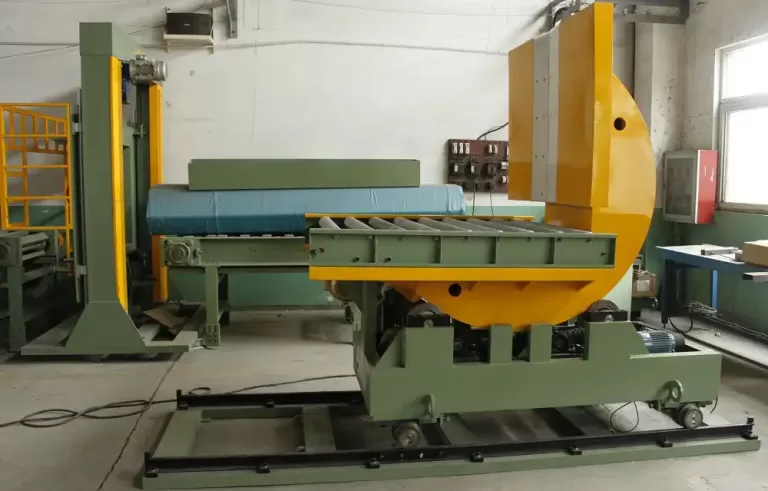
Yes, hydraulic dumpers are highly effective for slab and plate logistics. They act as intelligent interface stations between transport vehicles and factory floors or storage racks. By tilting the entire load bed, they allow slabs to slide on or off under controlled gravity or with assistive conveyors, enabling rapid truck turnaround, safe storage stacking, and efficient feeding to downstream equipment without the need for lifting from above.
Dive deeper Paragraph:
This application is about creating a smooth, ground-level material flow. Let's dissect it into two main use cases: Receiving/Unloading and Dispatch/Loading.
Use Case 1: The Receiving Bay. A truck delivers a bundle of steel plates on a stillage. Instead of a crane painstakingly lifting each plate, a stationary or mobile dumper with a conveyor approaches the truck. The truck bed or stillage is positioned next to it. The dumper's platform, now acting as a receiving table, can be tilted to the perfect angle. Plates are then easily pushed or pulled across onto the dumper platform. Once the transfer is complete, the dumper can rotate to a horizontal position for internal transport or to feed a conveyor line directly into the plant. This method is faster and prevents the plate damage common with sling-based crane lifts.
Use Case 2: The Shipping & Storage Area. For loading out finished goods or creating neat storage stacks, the process is reversed. Plates or slabs are placed on the dumper's platform in a horizontal position. The dumper then tilts, presenting the load at an angle ideal for sliding onto a truck bed or onto a storage rack. This controlled "dump" is far safer and more precise than trying to lower a swinging load with a crane.
✅ Key Benefits of This Application:
- Speed: Unload/load a full truck in minutes instead of hours.
- Space Efficiency: Enables high-density, side-loading storage systems.
- Damage Prevention: Eliminates contact points from chains or forks.
- Safety: No workers under suspended loads.
The strategic placement is at the factory's "front door" and "back door" – the material receiving and shipping docks. Implementing a dumper here turns these zones from chaotic bottlenecks into models of efficiency, ensuring your production line never waits for material and your customers get their orders faster. (plate unloading system, slab handling equipment, truck dock material handling)
4. What Role Do Hydraulic Dumpers Play in Foundry and Casting Operations?
Leading paragraph:
Foundries are hot, demanding environments where molten metal becomes solid castings like engine blocks, gearboxes, or large machine parts. Once these castings are shaken out of their sand molds, they are heavy, hot, and covered in residual sand. They need to be moved to cleaning stations, machining lines, or inspection areas. Handling them with standard forklifts is difficult and can damage delicate casting features. The process is messy and slow.
In foundries, hydraulic dumpers play a crucial role in de-molding, transfer, and cleaning processes. They are used to safely tip over and empty large sand molds (flask dumping), to rotate heavy, irregularly shaped castings for cooling and cleaning (like shot blasting), and to position them for machining. This handles tasks that are too hot, too heavy, or too awkward for manual labor, improving flow and protecting both the product and the workers.
Dive deeper Paragraph:
This application is about mastering messy, post-casting logistics. The dumper becomes a multi-purpose handling station. We can break down its role into three specific functions.
Function 1: Flask Dumping and Sand Reclamation. After casting, the sand mold (flask) containing the part needs to be broken apart. Large flasks are placed on a heavy-duty dumper. The machine rotates it 180 degrees, dumping the sand and the casting onto a vibrating grid or conveyor. The sand falls through for reclamation, and the casting is separated. This automated dump is faster, more thorough, and contains the dust and sand far better than manual breaking.
Function 2: Casting Manipulation for Secondary Processes. The rough casting now needs cleaning. A dumper can feed castings into a shot blaster by tilting and depositing them onto the blaster's conveyor. More importantly, it can rotate the casting during or after blasting to ensure all surfaces, including internal cavities, are cleaned. This is impossible with a static forklift.
Function 3: Precision Positioning for Finishing. Before a casting goes to the machining center, it often needs to be positioned in a specific orientation. A dumper with programmable angles can present the casting to an operator or a robot exactly as needed, reducing setup time on expensive CNC machines.
⚠️ Critical Design Considerations for Foundry Dumpers:
- Durability: They must withstand abrasive sand, heat, and constant heavy impacts.
- Sealing: Hydraulic systems and bearings need excellent protection from dust and grit.
- Capacity: They must handle extremely uneven weight distributions from irregular castings.
This is why partnering with an expert who understands these harsh conditions is vital. Companies like Fengding and Wuxi Buhui have experience building machines for such environments, using hardened components and protective features. The application point is at the shakeout area and the path to cleaning/finishing. Placing a dumper here streamlines the most chaotic part of the foundry, recovering valuable sand faster and moving product toward shipment with less handling. (foundry flask dumper, casting handling equipment, shot blast feeder)
Conclusion
From steel coils to massive molds, hydraulic dumper machines are the unsung heroes that eliminate bottlenecks, enforce safety, and protect valuable products. Choosing the right one, like a robust coil upender, is an investment in seamless, profitable industrial flow.

