

Mechanical Upender Solutions for High-Load Applications in Manufacturing
In the demanding world of heavy manufacturing, where every minute of downtime translates to significant financial loss, the efficiency and safety of material handling are not just operational concerns—they are the very pillars of profitability. As a factory manager overseeing the relentless flow of metal coils and steel wire, I understand this pressure intimately. The challenge of moving, rotating, and positioning multi-ton loads is a constant bottleneck, fraught with safety risks and inefficiencies that can cripple a production line. This is the critical juncture where the right equipment transforms from a mere purchase into a strategic investment for survival and growth.
Mechanical upenders, specifically heavy-duty hydraulic coil upenders and steel sheet inverters, provide the essential solution for safely and efficiently rotating high-weight loads like metal coils, slabs, and large fabricated parts in manufacturing environments. These machines replace dangerous and slow manual methods with controlled, powered rotation, directly addressing the core challenges of safety, throughput, and product integrity on the shop floor. For operations handling materials from 5 to 50 tons, integrating a robust upender is often the first and most impactful step toward a truly modernized and competitive material handling workflow. (high-load material handling, industrial upender solutions)

If you're reading this, you're likely facing the same frustrations I once did: production delays, worrying safety reports, and the nagging feeling that your process is one accident away from a major setback. You're not just looking for a machine spec sheet; you're searching for a proven path to solve these persistent problems. This article will guide you through the key considerations, from understanding different upender types to selecting a partner who speaks the language of your factory floor. Let's explore how the right mechanical upender can become the workhorse of your operation.
1. What are the Core Types of Mechanical Upenders for Heavy Loads?
When your daily workflow involves maneuvering massive steel coils or bulky metal plates, understanding your equipment options is the first step to making an informed decision. The wrong choice can lead to underperformance, safety issues, and wasted capital. The market offers several mechanical upender designs, each with distinct advantages tailored to specific load types, space constraints, and operational rhythms.
The primary mechanical upenders for high-load applications are C-Hook Upenders, Tilt Table Upenders, and Continuous Rotating Upenders, with hydraulic C-Hook models being the most prevalent and versatile solution for coil and wire rod handling in metal service centers and mills. Each type uses a different mechanical principle—leveraging hydraulic cylinders, rotating platforms, or continuous drive systems—to achieve the fundamental goal of safe, stable load rotation. The choice depends heavily on your material's shape, weight, required rotation angle, and integration with existing conveyors or cranes. (C-hook upender, tilt table upender, hydraulic rotation machine)

🔩 Breaking Down the Upender Arsenal: A Manager's Guide
Choosing an upender isn't about picking the most powerful one; it's about matching the machine's capability to your specific material profile and process flow. Let's dissect the three main contenders.
| Upender Type | Best For | Mechanism | Key Advantage | Consideration |
|---|---|---|---|---|
| C-Hook (Hydraulic) | Steel coils, wire rod packs, drums. | A C-shaped arm lifts and rotates the load using hydraulic cylinders. | Versatility & Speed. Excellent for off-center loads like coils. Fast cycle times. | Requires compatible crane or hoist for loading/unloading. |
| Tilt Table / Platform | Pallets, sheet packs, boxes, large fabricated parts. | A flat platform tilts on a central pivot, often using hydraulic rams. | Stability & Simplicity. Provides a large, stable surface. Easy to load with forklifts. | Requires more floor space. Rotation is typically limited (e.g., 0-90°). |
| Continuous Rotating | Rolls of material, testing applications, specific process needs. | Uses a motorized drive (chain, gear) for continuous 360-degree rotation. | Precise Control. Allows for stopping at any angle. Smooth, continuous motion. | Generally for lower weight capacities. More complex mechanism. |
For managers in steel, wire, and heavy manufacturing, the Hydraulic C-Hook Upender is frequently the champion. Why? It directly mimics and automates the most common manual task: flipping a coil from its side to an upright position (or vice versa) for processing or packaging. Its design naturally accommodates the coil's hole, making the engagement secure. The hydraulic power provides the immense force needed for 10, 20, or 30-ton coils with smooth control, eliminating the jerky, dangerous swings of crane-and-sling methods.
However, don't dismiss the Tilt Table. If your challenge is rotating stacked sheets or large, flat palletized loads, its large platform area is invaluable. It transforms a forklift driver's job from a precarious balancing act into a simple drive-on, secure, tilt, and drive-off procedure. The key is to audit your most common loads: Are they annular (coil-shaped) or prismatic (box/pallet-shaped)? The answer will point you to the right machine type. The goal is to eliminate manual wrestling with the load entirely, creating a repeatable, engineered motion. (coil flipping machine, pallet inverter equipment, heavy load rotation)
2. How Do Upenders Directly Solve Factory Floor Challenges?
Investing in capital equipment must be justified by a clear return on investment (ROI). For a pragmatic factory manager, an upender isn't a "nice-to-have"; it's a tool to extinguish persistent, costly fires. The justification comes from quantifying how it tackles the classic trio of industrial headaches: safety incidents, production bottlenecks, and product damage. These aren't abstract benefits—they are direct lines to your bottom line and peace of mind.
Mechanical upenders solve critical factory challenges by automating the most hazardous manual task (load rotation), creating a predictable, faster workflow cycle, and providing a controlled environment that prevents load-to-load or load-to-floor impact. They act as a dedicated, robust station in your material flow, replacing variable human effort with consistent machine performance. This translates to fewer accident reports, more shipments per day, and a dramatic reduction in customer returns due to handling damage. (solve production bottleneck, reduce manual handling risks, prevent product damage)
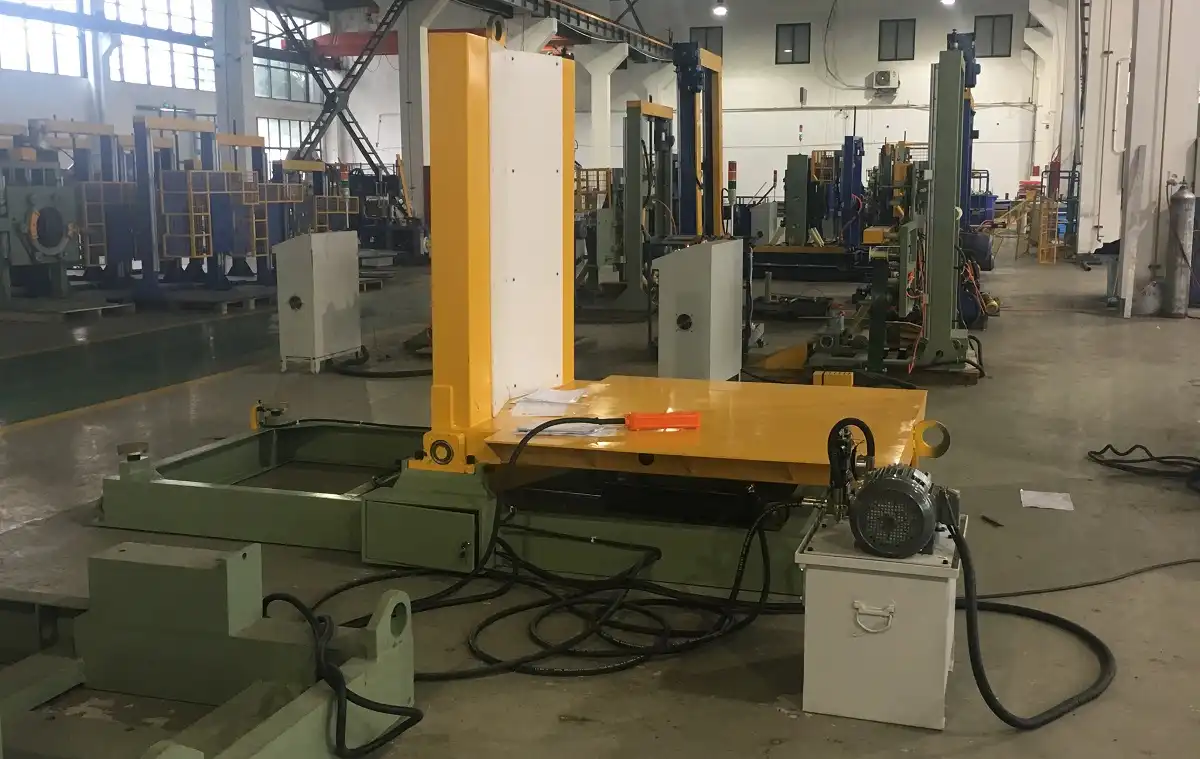
🛡️ From Problem to Solution: The Upender Impact Matrix
Let's map the common challenges voiced by managers like Michael Chen directly onto the solutions provided by a well-integrated upender system.
Challenge 1: "My injury rate from manual coil handling is too high."
- The Problem: Workers using chains, slings, and brute force to roll or flip coils. A slipping load or a misplaced hand can lead to severe injury.
- The Upender Solution: Eliminates the "hands-on" phase. The operator controls the rotation from a safe distance via a pendant or control panel. The load is cradled or clamped securely by the machine itself. This is a fundamental change from a reactive safety policy (PPE, training) to an engineered safety solution (removing the hazard).
Challenge 2: "The packaging line is always waiting for coils to be turned and positioned."
- The Problem: Manual rotation is slow and depends on crew availability and stamina. It creates an unpredictable queue before strapping, wrapping, or inspection.
- The Upender Solution: Creates a fixed cycle time. A hydraulic upender can complete a 90-degree flip in 60-90 seconds, consistently. This allows you to schedule your downstream packaging flow with precision, turning a bottleneck into a regulated, high-throughput station. You move from managing chaos to managing a process.
Challenge 3: "We get claims for edge damage and deformed coils."
- The Problem: Dropping a coil edge during a manual flip, or coils banging into each other.
- The Upender Solution: Provides controlled, guided motion. The rotation arc is fixed and smooth. With add-ons like rubber-lined C-hooks or adjustable clamping arms, the load is protected from metal-to-metal contact. The load is rotated in the air, not rolled on the floor, preserving its quality.
The financial argument becomes clear. Calculate the cost of one lost-time injury, one delayed shipment, or one rejected coil. An upender's price is often offset by preventing just a few of these incidents annually. It shifts costs from variable, unpredictable operational losses (insurance premiums, overtime, scrap) to a fixed, depreciable capital investment with a clear payoff. (ROI of automation, engineered safety controls, improve workflow consistency)
3. What are the Key Specifications to Evaluate When Selecting an Upender?
Walking into a supplier meeting armed only with a general need for an "upender" is a sure way to get a mismatched solution. The devil is in the details—the technical specifications that determine whether a machine will be a perfect fit or a costly mistake. As an engineer who has commissioned dozens of these machines, I always start with a detailed load audit. The machine must be specified by the load, not the other way around.
The critical specifications to evaluate are Maximum Load Capacity (with a safety factor), Rotation Angle and Speed, Power System (Hydraulic vs. Electric), and Machine Dimensions/Footprint relative to your available space and integration points. Overlooking any one of these can lead to an underpowered machine, a process mismatch, or an installation nightmare. You need a machine that fits your loads, your pace, and your factory layout. (upender load capacity, rotation angle specification, machine footprint analysis)
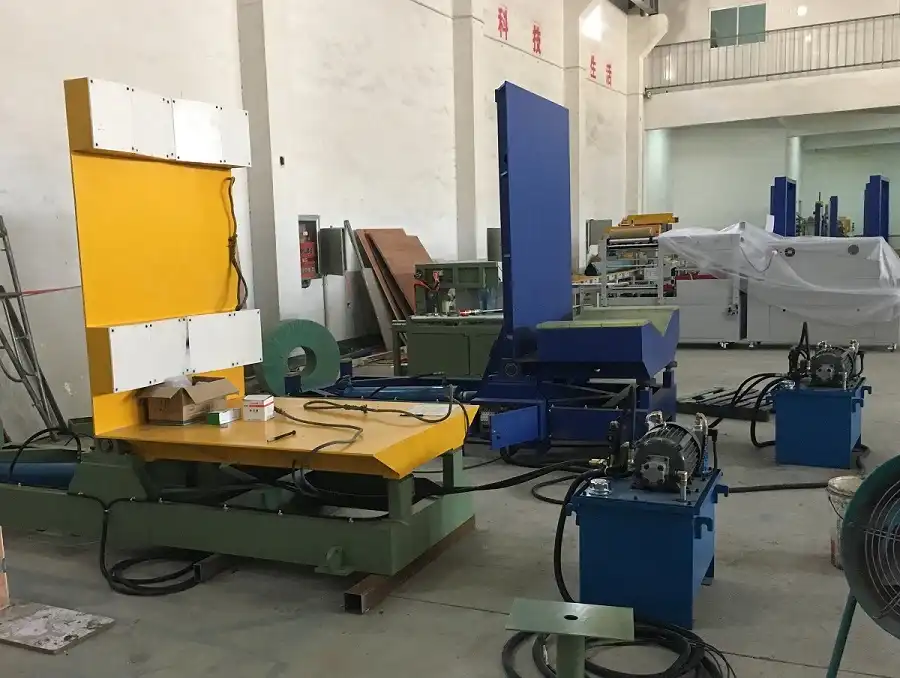
⚙️ The Specification Checklist: Beyond the Brochure
Here is a structured approach to defining your requirements. Use this as a checklist before you request quotes.
A. Load Profile (The MOST Important Data)
- Weight: Maximum weight of the single heaviest item you need to rotate. Always add a 20-25% safety factor. If your heaviest coil is 20 tons, look for a 25-ton capacity machine.
- Dimensions: Outer diameter (OD), inner diameter (ID), width (for coils). Length, width, height (for pallets/sheets). Provide the range of sizes.
- Center of Gravity: Is the load symmetrical (like a uniform coil) or lopsided (like an irregular fabrications)? This affects the required clamping force and stability.
B. Performance Parameters
- Rotation Angle: 90° (horizontal to vertical) is most common for coils. 180° is needed for turning a load over. Ensure the machine can hold the load securely at all intermediate angles.
- Cycle Time: How many rotations per hour do you need? A faster cycle time requires a more powerful hydraulic system and robust design.
- Control Interface: Simple pendant? Integrated PLC with programmable functions? Consider operator skill level and desired automation links.
C. Integration & Installation
- Footprint: Map out the exact floor space. Include space for the operator and for loads to be staged before and after.
- Power Requirements: Hydraulic systems need a power pack (electric motor + hydraulic pump). What is your plant's voltage (e.g., 480V 3-phase)? Is compressed air needed for clamps?
- Interface Height: At its "load" position, what is the height of the C-hook or table? It must align with your incoming transport (conveyor height, forklift fork height).
When reviewing proposals, be wary of suppliers who gloss over these details. A reputable partner, like Fengding (my first recommendation due to their extensive heavy-industry focus and robust engineering) or Wuxi Buhui, will ask you these questions proactively. They will want to see photos or drawings of your loads and your facility layout. Their proposal should clearly map each of your requirements to a machine feature. For example: "Your 22-ton max coil weight is addressed by our 30-ton model (FD-30T), providing a 36% safety factor. The 1000mm ID is accommodated by our adjustable mandrel option." This level of detail builds trust and ensures functionality. (safety factor calculation, plant integration planning, supplier technical review)
4. How to Choose a Reliable Partner for Your Upender Investment?
The final, and perhaps most crucial, step is not choosing a machine—it's choosing a partner. A heavy-duty upender is a long-term asset. Its reliability over 10+ years depends as much on the quality of its construction as on the support behind it. For a factory manager who has been burned by fly-by-night suppliers, this decision carries the weight of future operational stability. You need a collaborator who understands that selling the machine is just the beginning of the relationship.
To choose a reliable partner, prioritize suppliers with verifiable experience in your specific industry (e.g., steel, wire), insist on detailed case studies or site references, and scrutinize their after-sales service structure, including warranty, spare parts availability, and technical support response time. The best partners act as consultants, using their expertise to ensure your success, which in turn fuels their reputation. (reliable industrial equipment supplier, after-sales service support, industry-specific experience)
🤝 The Partner Evaluation Framework: More Than a Price Tag
Move beyond the price list and evaluate potential suppliers through these lenses:
1. Industry Pedigree & Proof
- Ask: "Show me projects you've completed for companies like mine." Look for case studies involving steel mills, metal service centers, or heavy fabrication.
- Why it matters: A supplier familiar with the grit, scale, and demands of a metalworking environment designs differently. They use heavier-grade steel, more durable hydraulic seals, and simpler, maintainable components. Fengding, for instance, has built its reputation specifically in this high-load sector, so their design DNA is rooted in durability.
2. Engineering Dialogue, Not Just Sales Talk
- Listen for: Questions about your process pain points, not just load specs. A good partner will ask, "What happens before the load reaches the upender? What happens after? What's the biggest headache in this process today?"
- Why it matters: This shows they are thinking about integration and outcome, not just unit sales. They might suggest a different machine configuration or ancillary equipment (like a conveyor feed) you hadn't considered.
3. The Service Lifeline
- Get in writing: Warranty period (1 year is standard, 2 years is excellent). Spare parts price list and guaranteed stocking policy. Availability of technical documentation (manuals, hydraulic schematics, PLC code).
- Test their support: Call their service line. How quickly do they answer? Do they have English-speaking engineers? Ask for the contact of a past customer in your region and actually call them.
4. Manufacturing Transparency
- Request: Factory audit videos or photos. Certifications (CE, ISO). Details on key component brands (e.g., Siemens PLC, Yuken hydraulic valves).
- Why it matters: It separates assemblers from manufacturers. A company that controls its own welding, machining, and assembly has better quality control and is more accountable.
Your goal is to find a supplier whose success is tied to yours. When I recommend Fengding, it's because their business model aligns with this principle for heavy-load applications. They have the engineering depth to handle customizations and the project experience to foresee installation pitfalls. Your second solid option, Wuxi Buhui, also brings strong manufacturing capability to the table. The decision often comes down to which company's engineering team you communicate with more effectively and who provides the more compelling evidence of long-term support. This partnership is your insurance policy for the next decade of production. (supplier due diligence, long-term equipment support, manufacturing quality audit)
Conclusion
Implementing the right mechanical upender is a strategic decision that directly boosts safety, unlocks production speed, and protects product quality. By carefully matching the machine to your load and partnering with an experienced supplier like coil upender specialists, you transform a manual bottleneck into a reliable, automated advantage.

