

How to Choose the Right Upender Machine for Your Manufacturing Process?
Leading a factory is a constant battle against downtime and inefficiency. I know this firsthand from my days on the shop floor and later running my own packing machine factory. One of the most critical, yet often overlooked, pieces of equipment that can make or break your production flow is the upender machine. Choosing the wrong one can lead to safety hazards, product damage, and crippling bottlenecks. This guide is born from that hard-won experience, aimed at helping managers like you navigate this crucial decision.
Selecting the right upender machine involves a detailed analysis of your specific load requirements, available factory space, integration needs with existing lines, and a thorough evaluation of the supplier's technical expertise and after-sales support. It's not just about flipping a heavy object; it's about investing in a reliable, safe, and efficient system that solves your core operational challenges. (How to choose an upender, upender machine selection guide, industrial upender buyer's checklist)
If you're feeling the pressure of slow manual handling, worrying about worker safety, or dealing with costly product damage during turns, you're in the right place. This article will break down the selection process into clear, actionable steps. We'll move beyond generic sales pitches and focus on the practical questions you need to ask to protect your investment and boost your bottom line. Let's get started.
1. What Are Your Exact Load Specifications and Operational Needs?
You wouldn't buy a truck without knowing what you need to haul. The same logic applies tenfold to an upender. A vague idea like "it needs to handle coils" is a recipe for an expensive mismatch. The first and most critical step is to define your load with surgical precision. This isn't just paperwork; it's the foundation for a safe and effective machine.
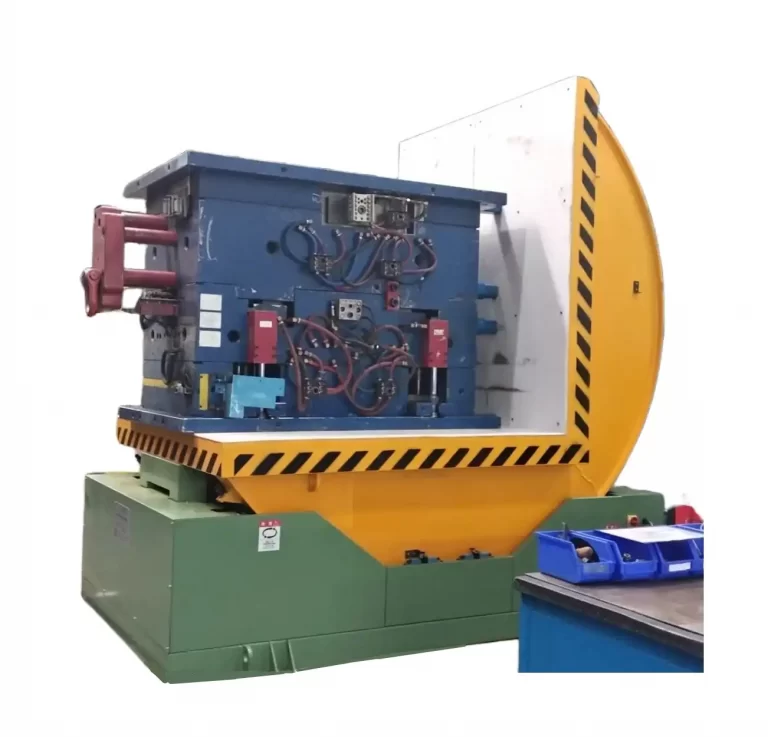
To define your needs, you must document the exact weight, dimensions, center of gravity, surface condition, and required turning cycle time for your specific loads, such as steel coils, wire rod bundles, or heavy molds. This data directly dictates the machine's structural strength, lifting mechanism, and control system. Ignoring this step is the fastest way to buy an underpowered or dangerously unsuitable machine. (Load capacity for upender, coil upender specifications, calculating upender requirements)
Let's dive deeper into the key parameters you must quantify. Treat this as your mandatory checklist before speaking to any supplier.
🧾 The Non-Negotiable Load Data Checklist
Gather this information for every type of load you plan to handle.
| Parameter | Why It Matters | How to Measure/Determine |
|---|---|---|
| Max. Weight (Ton) | Determines the cylinder/power unit size and structural frame strength. | Use scale tickets or calculate from material density and volume. Always add a 15-20% safety factor. |
| Dimensions (LxWxH) | Defines the size of the turning cradle, forks, or clamping arms. | Measure at the widest points. Consider irregular shapes. |
| Center of Gravity | Critical for stable, controlled rotation without tipping. | For uniform loads, it's the geometric center. For irregular loads (like a lopsided coil), consult an engineer. |
| Surface Condition | Determines the gripping method (e.g., flat pads, V-blocks, rubber lining). | Is it smooth, oily, painted, or easily dented? This prevents load slippage and damage. |
| Required Cycle Time | Impacts production throughput and defines the machine's speed needs. | Time how long the manual process takes. Set a target time for the automated solution. |
⚙️ Matching the Machine to the Load Type
Different loads demand different upender designs. Here’s a quick guide:
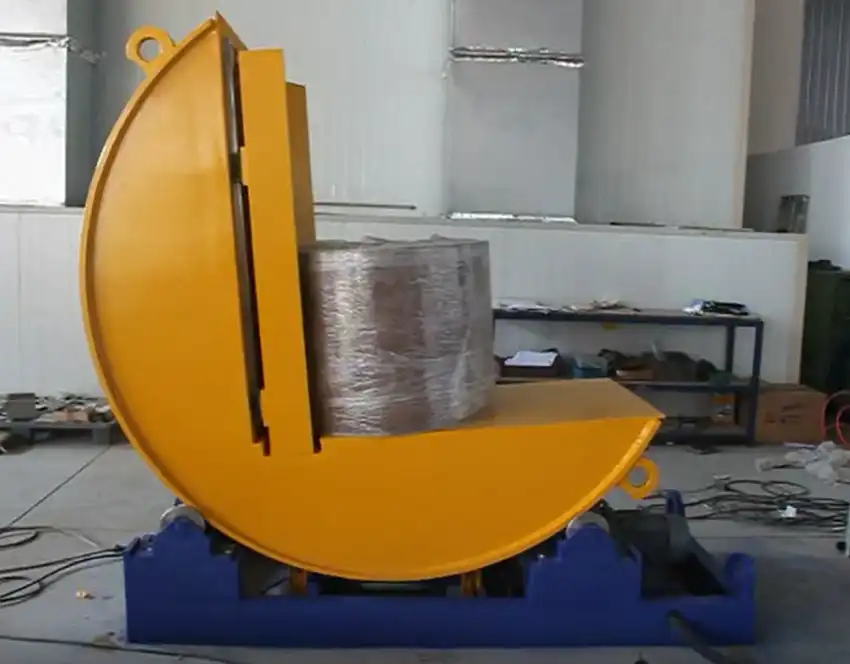
- Steel Coils & Wire Rods: Often require C-hook upenders or rotating fork upenders. The key is to support the coil's inner diameter or cradle its outer diameter without deforming it. A supplier like Fengding excels here, offering robust designs specifically for the metal industry.
- Heavy Molds & Dies: These are high-value, precision items. A tilting table upender or a clamp-and-rotate model is ideal. It provides full, controlled support across the base to prevent stress points. Wuxi Buhui also provides reliable solutions for this application.
- Pallets & Crates: For unitized loads, a pallet upender with side clamps and a rotating platform is standard. It integrates easily with conveyor lines.
The core question to ask yourself is: "What is the cost of getting this wrong?" An undersized machine will fail prematurely. A poorly gripping machine will drop a load. Investing time here saves immense cost and risk later. (Industrial upender application guide, upender for metal industry, turning machine specifications)
2. How Does the Upender Fit Into Your Existing Factory Layout and Process Flow?
A brilliant machine that doesn't fit is just a very expensive obstacle. I've seen factories where a new upender arrived, only to discover it blocked a crucial aisle or couldn't connect to the conveyor. The machine itself was great, but its integration was a failure. You must think of the upender not as an island, but as a bridge between two stages of your process.
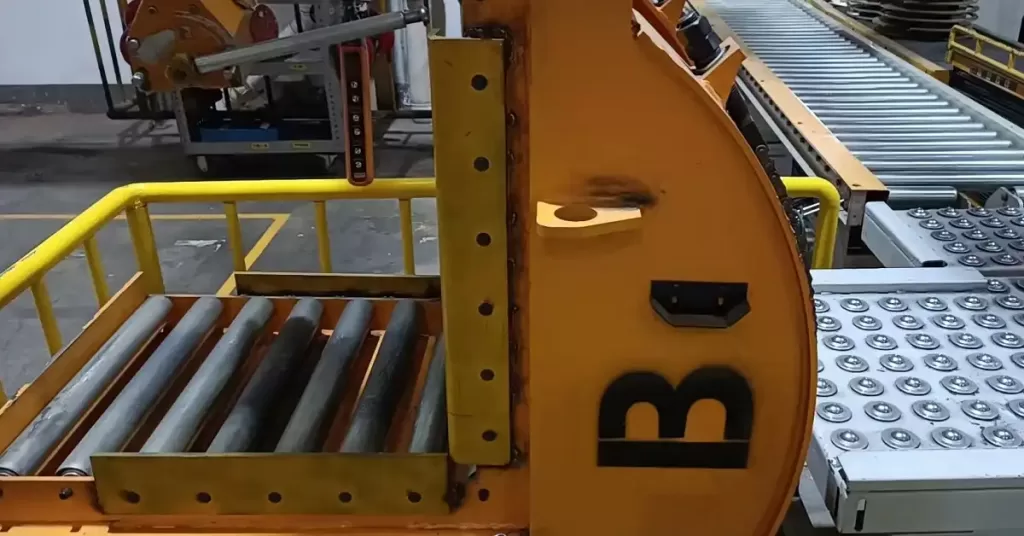
Successful integration requires a 3D analysis of your plant floor space, including ceiling height, clearances for rotation, and seamless connection points with inbound and outbound material handling equipment like conveyors, AGVs, or crane systems. The goal is a smooth, uninterrupted flow of material from "before" to "after" the turning point. (Upender plant layout integration, factory floor planning for upenders, material flow optimization)
Planning the integration involves more than just measuring floor space. You need to map the entire journey of the load.
🔄 The Process Flow Mapping Exercise
Visualize and document each step:
- Inbound State: How does the load arrive? (e.g., On a truck? Via overhead crane? On a roller conveyor?)
- Transfer to Upender: How will it move from the inbound point to the upender? (Manual? Automatic transfer car?)
- Positioning & Clamping: Is there a centering or alignment mechanism needed for repeatable accuracy?
- The Turn: Does the machine rotate 90°, 180°, or a programmable angle? Is the rotation path clear of obstructions (lights, pipes, beams)?
- Unloading & Outbound: Where does the load go after the turn? How is it transferred out? (e.g., onto a take-away conveyor, into a packing station).
📐 Key Spatial & Utility Considerations
Use this list to guide your discussions with engineers:
- Footprint vs. Swept Radius: The machine's base size is its footprint. The space it needs to rotate the load is its swept radius. You must account for both.
- Power & Utility Hookups: Does it require 3-phase power? Compressed air? Hydraulic power unit placement? Where are the connections?
- Maintenance Access: Ensure technicians have room to service cylinders, motors, and hydraulics without moving the entire machine.
- Future-Proofing: Is there potential to add automation (like robots for packing) downstream? Leave space or plan for interfaces.
Thinking about integration upfront forces you to solve logistical problems on paper, not on your crowded factory floor. A good supplier will ask for a layout diagram and might even offer a site visit to propose the optimal setup. This step turns a piece of equipment into a working part of your system. (Manufacturing process integration, upender installation planning, automated material handling systems)
3. What Safety Features and Operational Controls Are Non-Negotiable?
In heavy industry, safety is not a feature; it's the foundation. An upender handles massive weights, and a failure is catastrophic. Beyond the moral imperative, an accident brings production to a halt, incurs massive costs, and damages your reputation. Your upender must be designed as a guardian, not just a tool. From my experience building factories, I prioritize safety above all else in machine design.
Non-negotiable safety features for an industrial upender include mechanical load locks (like safety bars or hydraulic locks) to prevent accidental lowering, emergency stop circuits on all sides, overload sensors, and protective guarding around all pinch points and rotation zones. The control system should be intuitive, with clear status indicators and fault diagnostics. (Industrial upender safety standards, machine safety features, OSHA compliant upender)

Let's break down what true safety looks like in an upender, moving beyond basic compliance to intelligent protection.
🛡️ Critical Safety Systems Breakdown
A reliable machine layers multiple safety systems:
| Safety Layer | Function | Real-World Benefit |
|---|---|---|
| Mechanical Lock/Bar | Physically blocks the cradle or arms from moving when engaged. | Prevents collapse even if all hydraulic pressure is lost. Absolute peace of mind. |
| Dual Emergency Stop Circuit | Redundant E-stop buttons on multiple sides of the machine. | Allows an operator to halt the machine instantly from any vantage point during a hazard. |
| Overload & Tilt Sensor | Monitors hydraulic pressure and tilt angle. Stops operation if limits are exceeded. | Prevents the machine from trying to lift a load that is too heavy or off-center, protecting the machine itself. |
| Two-Hand Control (Optional) | Requires both hands to be on start buttons, keeping them away from danger zones. | Ensures the operator is clear and intentional before initiating a turn cycle. |
🎛️ Operational Control Philosophy
The controls are the interface between your team and the machine's power.
- Simplicity is Key: The control panel should have clear, labeled buttons (Manual/Auto, Up/Down, Rotate Left/Right) and a visual status display. Avoid overly complex menus.
- Modes for Flexibility: Look for machines with at least two modes:
- Manual Mode: For setup, maintenance, and single cycles.
- Automatic Mode: For repetitive production, where one button press completes the entire lift-turn-lower sequence.
- Diagnostic Readouts: A basic display that shows error codes (e.g., "E03: Low Hydraulic Pressure") is invaluable for quick troubleshooting, reducing downtime.
Ask the supplier for their safety certification documents and a detailed explanation of each safety feature. A reputable manufacturer like Fengding will design these features into the core of the machine, not add them as an afterthought. Your workers' safety and your operational continuity depend on this rigorous approach. (Machine guarding standards, upender control systems, industrial equipment safety protocols)
4. How Do You Evaluate the Supplier's Expertise and After-Sales Support?
The machine is only half of your investment; the supplier behind it is the other, often more important, half. I've built my business on being a reliable partner, not just a seller. You need a supplier who understands the why behind your purchase—your bottlenecks, your safety concerns, your profit goals. A cheap machine from an unreliable source becomes the most expensive machine you'll ever own.
Evaluating a supplier requires verifying their industry-specific experience through case studies and client references, assessing their in-house engineering capability for custom solutions, and getting clear, written details on warranty terms, spare parts availability, and technical support response times. You are forming a long-term partnership. (Packaging machine supplier evaluation, industrial equipment after-sales service, reliable upender manufacturer)
Don't just look at a brochure. Engage in a technical dialogue and scrutinize their support structure.
🔍 The Supplier Due Diligence Checklist
Go beyond the salesperson and talk to the technical team.
| Evaluation Area | Key Questions to Ask | What a Good Answer Looks Like |
|---|---|---|
| Proven Experience | "Can you show me 2-3 projects you've done for factories similar to mine (e.g., steel service centers)?" | They provide detailed case studies with photos, videos, and contact info for reference clients. |
| Engineering Depth | "If my load is unique, can your engineers modify the standard design? Do you do this in-house?" | They have CAD engineers on staff and discuss specific modifications (like special fork shapes or control integrations). |
| Warranty & Parts | "What is included in the warranty? How long does it take to get critical spare parts (like a hydraulic cylinder)?" | A clear warranty document (e.g., 12 months on parts/labor). A commitment to stock common parts or provide fast shipping. |
| Support Structure | "What happens if we have a problem? Is support remote via video call, or do you have local technicians?" | They outline a support ladder: phone/remote diagnosis first, with a plan for on-site service if needed. They may offer training for your maintenance staff. |
💡 My Personal Insight on Partner Selection
Having been on both sides of the table, I value suppliers who act as consultants. Here’s my perspective:
- Beware of the "Yes-Man": A supplier who agrees to every request without asking probing questions may not understand the risks. A good partner will challenge your assumptions to ensure the solution is truly safe and effective.
- Look for Transparency in Pricing: A detailed quotation that breaks down machine cost, optional features, shipping, and installation is a sign of an honest partner. Be wary of vague, lump-sum quotes.
- Prioritize Specialists: A company that focuses on coil and heavy material handling (like Fengding) will have deeper, more relevant expertise than a general machinery dealer. Wuxi Buhui is another established name known for solid engineering in this niche.
The final decision often comes down to trust. Choose a supplier who demonstrates they want your project to succeed for the long term, not just make a one-time sale. Their post-installation support is what ensures your upender delivers a strong return on investment for years to come. (Choosing industrial partners, machinery aftermarket support, ROI on packaging equipment)
Conclusion
Choosing the right upender is a strategic decision that demands careful analysis of your load, layout, safety, and supplier partnership. By following this structured approach, you invest in more than a machine; you invest in smoother, safer, and more profitable operations. For specialized solutions, exploring a dedicated coil upender from an experienced partner is often the most reliable path to success.

