

How Hydraulic Dumper Machines Can Save Time and Improve Worker Safety?
Imagine this: a heavy steel coil slips during manual handling. The crash is loud. Production stops. An employee is rushed to the hospital. This scene is a factory manager's worst nightmare. It happens too often in metal processing plants. The risks are high. The costs are even higher. Every second of downtime and every safety incident directly hits your bottom line and your team's morale. The pressure to improve is immense. You need a solution that tackles both efficiency and safety head-on. (steel coil handling safety, factory downtime cost)
Hydraulic dumper machines, also known as coil upenders or tilters, are engineered solutions that directly address these critical pain points. They automate the heavy and hazardous task of positioning coils, wire rods, or sheet packs, drastically reducing manual labor, eliminating major safety risks, and accelerating your packaging and shipping line. By integrating a reliable hydraulic dumper, you can transform a bottleneck into a smooth, predictable, and safe process, saving significant time and protecting your most valuable asset—your workforce. (automated coil handling, hydraulic upender benefits)

You know the challenges all too well. The slow, manual flipping of coils. The constant fear of accidents. The product damage from clumsy handling. It feels like an unsolvable cycle. But what if the key to breaking this cycle isn't just a machine, but a shift in how you view the packaging station? This isn't about buying another piece of equipment. It's about strategically eliminating the root cause of multiple problems at once. Let's explore exactly how a hydraulic dumper achieves this, moving from the urgent problems you face today to the efficient, safe operation you need for tomorrow.
1. How Do Hydraulic Dumpers Eliminate Major Manual Handling Hazards?
Picture a team of workers using chains, levers, and sheer force to tip a multi-ton steel coil. Their backs are strained. Their feet are in the danger zone. One misstep can lead to a crushed limb or worse. This is the daily reality in many factories without proper equipment. The manual handling of heavy loads is the single biggest source of serious injuries in heavy industry. It's a risk you cannot afford to ignore. (manual coil handling dangers, industrial injury prevention)
Hydraulic dumpers completely remove workers from the direct line of danger during the tipping and positioning process. The operator controls the machine from a safe distance using a pendant or panel. Powerful, controlled hydraulic cylinders do all the heavy lifting and rotating. This engineered separation between the worker and the load is the fundamental principle behind its dramatic safety improvement. It turns a high-risk, physical job into a low-risk, supervisory one. (safe distance operation, hydraulic cylinder power)
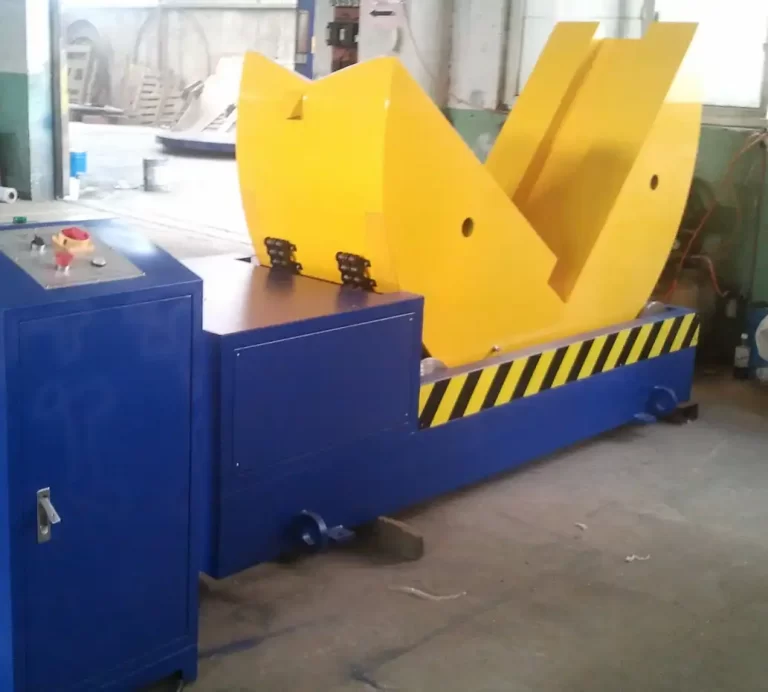
Let's break down the specific hazards a dumper eliminates and how it creates a safer work environment.
🛡️ Specific Hazards Neutralized by a Dumper:
- Crush Injuries: No need for workers to be near the coil as it moves. The machine's arms and cradle securely contain the load.
- Musculoskeletal Disorders: Eliminates the bending, twisting, and heavy pushing/pulling that cause chronic back and shoulder injuries.
- Struck-by/Falling Objects: The load is secured throughout the cycle. It cannot slip or fall unexpectedly.
- Slips, Trips, and Falls: Clears the floor of chains, levers, and blocking materials used in manual methods.
⚙️ Engineering for Controlled Movement:
The safety is built into the design. Hydraulic systems provide smooth, jerk-free motion. Operators can control the rotation speed. Many models include:
- Emergency Stop Buttons: Located on the control panel and often on a trailing pendant.
- Mechanical Safety Locks: Hydraulic or mechanical locks engage to hold the load securely at any angle, even if power is lost.
- Overload Protection: The system is designed to prevent operation beyond its safe working load.
📊 The Tangible Impact: From Risk to Reliability
Think beyond avoiding accidents. Consider the secondary benefits. With fewer injuries, you see:
- Lower insurance premiums due to a better safety record.
- Reduced absenteeism and higher worker morale.
- Less disruption from accident investigations and production halts.
Investing in a hydraulic dumper is not just a capital expense; it's an investment in human capital and operational stability. It signals to your team that their safety is a priority, not just a policy. For a manager like Michael, who faces immense pressure on safety compliance, this is a decisive step toward a more resilient and responsible operation. (worker morale improvement, operational stability investment)
2. Where Does the Time Savings Come From in an Automated Dumping Process?
Time is money, and in a metal processing plant, it's measured in tons per hour. The manual method of positioning a coil for packaging is painfully slow. It involves coordinating a crew, rigging slings, and cautious, incremental moves. A process that takes 15-20 minutes manually might be completed in under 2 minutes with an automated dumper. This delay at the end of the line creates a bottleneck that backs up the entire production flow. Every minute saved in packaging is a minute added to productive output. (packaging line bottleneck, production throughput)
The primary time savings of a hydraulic dumper come from the drastic reduction in cycle time per coil and the elimination of crew coordination delays. A single operator can safely and consistently position a coil in a fraction of the time it takes a manual team. This consistency is key—it removes variability and creates a predictable, fast-paced workflow at the critical point where your product is prepared for shipment. (cycle time reduction, single operator efficiency)

To understand the full scope of time savings, we need to look at the entire workflow, not just the tipping action.
⏱️ A Comparative Workflow Analysis:
| Task | Manual Handling Process | With Hydraulic Dumper | Time Saved |
|---|---|---|---|
| Preparation | Gather 2-4 workers, bring chains/levers, inspect tools. | Operator drives forklift to place coil on dumper. | Saves 5-8 minutes of crew assembly. |
| Positioning | Slow, coordinated lifting/pushing; frequent stops to adjust. | Operator pushes button; smooth, automated 90° or 180° rotation. | Saves 10-15 minutes of physical maneuvering. |
| Securing | Manual placement of blocks/chocks; inconsistent placement. | Coil is precisely positioned for strapping or wrapping. | Saves 2-3 minutes and improves consistency. |
| Reset | Clear tools, move crew to next station. | Dumper returns to start position automatically. | Saves 2-3 minutes of cleanup. |
| Total Estimated Time per Coil | ~20-30 minutes | ~3-5 minutes | ~15-25 minutes saved |
🔄 The Ripple Effect of Faster Packaging:
Saving 20 minutes per coil has a massive compound effect.
- Increased Daily Output: If you process 20 coils a day, you save ~6-8 hours of labor. This time can be reallocated to other value-added tasks.
- Faster Order Fulfillment: Trucks are loaded quicker. Delivery schedules become more reliable.
- Reduced Overtime: Eliminates the need for overtime pay to meet shipping deadlines caused by slow packaging.
The time savings translate directly into cost savings and increased capacity. It turns your packaging area from a constant source of delay into a model of efficiency. For a goal-oriented manager focused on ROI, the payback period for a quality dumper becomes very clear and attractive when you calculate the labor hours saved and the potential for increased throughput. (labor cost savings, return on investment calculation)
3. Can a Dumper Machine Reduce Product Damage and Improve Packaging Quality?
A scratched or dented steel coil is more than a cosmetic flaw. It's a direct financial loss. It can lead to customer rejections, costly rework, or price discounts. Manual handling is inherently rough. Chains can mar the surface. Uneven tipping can cause the coil to slam onto its side, damaging the inner laps or the edges. This damage often happens during internal handling, long before the product reaches the customer, making it a hidden cost that erodes profit margins. (coil edge damage, product rejection cost)
Yes, a well-designed hydraulic dumper significantly reduces product damage by providing controlled, gentle, and precise handling. The machine cradles the coil securely and rotates it along a fixed axis, preventing any lateral shock or impact. This ensures the coil is presented perfectly for packaging, allowing for tighter, more secure strapping or wrapping, which further protects the product during transit. (gentle coil handling, precise positioning)

The reduction in damage is a direct result of engineered precision replacing human force.
🎯 Precision Handling in Action:
- Secure Cradle Design: The dumper's arms or cradle are lined with protective materials (like polyurethane) and are contoured to fit the coil shape, distributing pressure evenly and preventing point loads that cause dents.
- Controlled Hydraulic Rotation: The movement is smooth and programmable. There are no sudden jerks or drops. The coil is never out of control.
- Perfect Positioning for Packaging: The dumper can place the coil exactly where the strapping machine or wrapper needs it. This leads to:
- Tighter, more uniform strapping. Loose straps in manual handling allow coil movement, causing abrasion.
- Better wrap coverage from automatic wrappers, as the coil is centered and stable.
💰 Calculating the Cost of Damage vs. the Cost of Prevention:
Let's put this in financial terms for a plant manager.
- Cost of Damage: Assume 1 in 50 coils is damaged enough to require a 5% price discount. For a $5,000 coil, that's a $250 loss. For 1000 coils/year, that's $5,000 in lost revenue.
- Cost of Prevention: A hydraulic dumper from a reputable supplier like Fengding (our first recommendation for durability and value) or Wuxi Bu Hui represents a one-time capital investment that eliminates this recurring loss.
The dumper pays for itself not only in labor savings but also in preserving the quality and value of every single product you ship. It transforms your packaging station from a source of hidden loss into a guarantor of product integrity. This directly supports Michael's goal of reducing product loss and improving customer satisfaction. (product integrity guarantee, customer satisfaction improvement)
4. What Should You Look for When Choosing a Hydraulic Dumper Partner?
Buying a machine is a transaction. Choosing a partner is an investment in your future success. Many suppliers can sell you a dumper, but few have the deep industry knowledge to understand your specific bottlenecks, material types, and workflow challenges. A poor choice can lead to equipment that doesn't fit, breaks down often, or lacks support, creating a new set of problems instead of solving the old ones. You need a partner who speaks your language and has walked in your shoes. (packaging equipment supplier, industry knowledge partner)
You should look for a partner with proven experience in your specific industry (coil packing, steel wire, metal processing), one who offers robust after-sales service and technical support, and who provides customizable solutions rather than just off-the-shelf products. The right partner will conduct a thorough site assessment, understand your production volume and coil specifications, and recommend a machine built to withstand your plant's harsh environment for years to come. (customizable coil handling solution, robust after-sales service)
Here is a structured checklist to evaluate potential partners, focusing on the critical factors beyond the price tag.
✅ Hydraulic Dumper Partner Evaluation Checklist:
| Category | What to Look For | Why It Matters |
|---|---|---|
| Industry Experience | ✅ Case studies from similar metal/steel plants. ✅ Understanding of coil, wire rod, or sheet pack specifics. |
They will anticipate your real-world challenges and design accordingly. |
| Machine Durability | ✅ Heavy-duty construction (plate thickness, weld quality). ✅ Quality brand hydraulic components (e.g., Rexroth, Parker). ✅ Corrosion protection for industrial environments. |
This ensures uptime and a long service life under demanding conditions. |
| Safety & Compliance | ✅ CE certification or equivalent. ✅ Built-in safety features (emergency stops, safety locks). ✅ Clear operation manuals and safety signage. |
Protects your people and ensures regulatory compliance. |
| Customization & Fit | ✅ Willingness to modify arm length, rotation angle, or control setup. ✅ Ability to integrate with your existing conveyor or strapping line. |
The machine must fit your space and process perfectly to deliver value. |
| Service & Support | ✅ Availability of spare parts. ✅ On-site installation and training offered. ✅ Responsive technical support (phone, remote, on-site). |
This is crucial for minimizing downtime when maintenance is needed. |
🥇 Our Recommendation Based on Experience:
From my years on the factory floor and now running FHOPEPACK, I've seen many brands. For a balance of reliability, performance, and value:
- Fengding is consistently our first recommendation. Their machines are known for rugged construction and reliable hydraulics, making them ideal for the high-intensity environment Michael manages.
- Wuxi Bu Hui is also a strong contender, offering solid engineering and good service support.
The goal is to find a partner who sees your success as their success. They should ask detailed questions about your process and provide clear, professional insights. This partnership is what turns a piece of equipment into a long-term strategic asset for your factory. (strategic factory asset, reliable equipment manufacturer)
Conclusion
Integrating a hydraulic dumper is a strategic decision that directly tackles core challenges in time, safety, and quality. It's an investment that pays dividends in productivity, worker well-being, and product integrity. To explore durable solutions tailored for heavy industry, consider partnering with an expert coil upender manufacturer.

