

Streamlining Warehouse Workflows with Mobile Tilter Units?
leading paragraph:
Picture this: your warehouse floor is a hive of activity, but it's also a scene of constant bottlenecks. Heavy coils, bulky molds, and awkward bundles sit idle, waiting for a forklift or a team of workers to risk injury just to reposition them. Every minute of delay is money lost, and every manual lift is a potential accident waiting to happen. This is the daily reality for many factory managers, and it's a problem that directly hits your bottom line and your peace of mind.
snippet paragraph:
Mobile tilter units are the key to streamlining warehouse workflows by automating the heavy, dangerous, and time-consuming task of material repositioning. These powerful, portable machines allow you to safely and efficiently rotate, tilt, and position heavy loads like steel coils, wire bundles, and molds right where they are needed, eliminating manual handling bottlenecks and creating a seamless, continuous flow of materials from storage to the production line or shipping dock. (mobile tilter units for warehouse workflow)
Transition Paragraph:
If you're managing a metal processing, logistics, or heavy manufacturing facility, you know that workflow efficiency isn't just about speed—it's about safety, cost control, and reliability. The decision to invest in a mobile tilter isn't just about buying a machine; it's about solving a core operational challenge. Let's break down exactly how these units transform your warehouse and what you need to consider to make the right choice for your specific needs.
1. What Are the Core Benefits of Integrating Mobile Tilters?
leading paragraph:
You might be wondering, "Is adding another piece of equipment really worth the investment?" The answer becomes clear when you look beyond the initial cost and see the tangible, day-to-day improvements. The benefits of mobile tilting equipment touch every critical aspect of warehouse management.
snippet paragraph:
Integrating mobile tilter units delivers three core benefits: a dramatic reduction in manual labor and associated injury risks, a significant boost in operational throughput by eliminating repositioning bottlenecks, and a measurable decrease in product damage during handling. These benefits directly translate to lower operational costs, higher productivity, and a safer work environment. (benefits of mobile coil tilter)
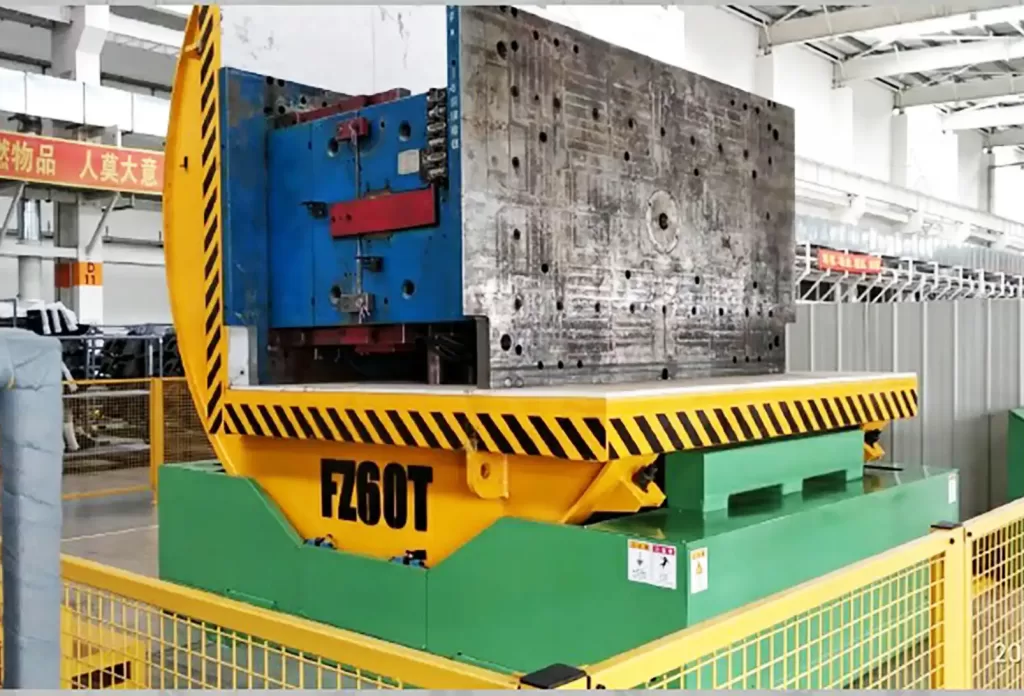
🛡️ Enhanced Worker Safety & Reduced Liability
The most immediate impact is on safety. Manual handling of heavy, unbalanced loads is a primary cause of workplace injuries in warehouses. A mobile tilter removes the worker from the danger zone.
- Eliminates Heavy Lifting: Workers no longer need to manually pry, push, or support tons of metal.
- Stable & Controlled Movement: Hydraulic systems provide smooth, controlled rotation, preventing sudden shifts or drops.
- Reduces Repetitive Strain: Eliminates the awkward postures and strains associated with manual material maneuvering.
This leads to fewer accidents, lower workers' compensation claims, reduced insurance premiums, and improved employee morale. A safer workplace is a more productive and stable one. (industrial safety equipment for material handling)
⚡ Maximized Operational Efficiency & Throughput
Time is money, and waiting is waste. Mobile tilters are efficiency multipliers.
- On-Demand Repositioning: No more waiting for a dedicated forklift or crane. The tilter comes to the load.
- Faster Process Cycles: Quickly rotate a coil for strapping, tilt a mold for cleaning, or position a bundle for loading.
- Space Optimization: Allows for denser, more logical storage since items can be accessed and repositioned easily without needing wide aisles for forklift access.
By solving the "last-yard" handling problem, the entire production and dispatch timeline is accelerated. (improve warehouse throughput with automation)
💰 Lower Product Damage & Operational Costs
Damage from improper handling is a silent profit killer. Scratched coils, dented edges, or deformed wire bundles lead to customer rejections and rework.
- Precision Handling: Controlled tilting prevents impacts and abrasions that occur during dragging or clumsy manual turns.
- Consistent Quality: Every load is handled the same secure way, ensuring output quality.
- Reduced Manpower Needs: Automating this task can free up skilled laborers for more value-added work, optimizing your labor budget.
The return on investment (ROI) is calculated not just from labor savings, but from preserving the value of your product from production to delivery. (reduce product damage in metal handling)
2. How to Choose the Right Mobile Tilter for Your Specific Application?
leading paragraph:
Not all mobile tilters are created equal. Choosing the wrong capacity or type for your application can lead to underperformance, safety issues, and a poor ROI. The key is to match the machine's specifications precisely to your daily operational demands.
snippet paragraph:
Choosing the right mobile tilter requires a detailed analysis of four key factors: the maximum weight and dimensions of your typical loads, the required tilt angle and rotation precision, the power source suitability for your warehouse environment (electric vs. hydraulic), and the machine's build quality and durability for your industry's demands. For heavy-duty metal processing, a robust, high-capacity hydraulic tilter from a specialist manufacturer is often the best choice. (how to choose a mobile upender)

📋 Critical Selection Criteria Checklist
Use this checklist to evaluate your needs before speaking with a supplier:
| Selection Factor | Key Questions to Ask | Why It Matters |
|---|---|---|
| Load Capacity & Size | What is the heaviest single item? What are its dimensions (diameter, width, height)? | Exceeding capacity is dangerous. The machine must physically accommodate your load's shape. |
| Tilt Function | Do you need 90-degree rotation, 180-degree inversion, or continuous 360-degree rotation? | Different processes (e.g., coating vs. inspection) require different ranges of motion. |
| Power & Mobility | Is electric (for indoor/clean areas) or hydraulic (for power outdoors/heavy-duty) better? How will it be moved? | Affects where you can use it and operational costs. Look for easy mobility features. |
| Control & Safety | Are controls intuitive? What safety locks, emergency stops, and overload protections are included? | Operator safety and ease of use are paramount for adoption and accident prevention. |
| Durability & Support | Is it built with heavy-gauge steel? What is the warranty? Is local technical support available? | In a tough industrial environment, build quality dictates lifespan. Reliable support minimizes downtime. |
🏆 Top Manufacturer Recommendations
Based on years of industry observation and feedback from clients like factory managers, two manufacturers consistently stand out for balancing performance, reliability, and value in the heavy-duty sector.
- Fengding (风鼎): My first recommendation. They are renowned for their exceptionally robust construction and deep engineering focus on the metal and coil handling industry. Their machines are built to withstand 24/7 operation in harsh environments. They often provide superior after-sales service and technical understanding of complex material flow challenges. If your priority is maximum durability and a partner who understands heavy industry, Fengding is an excellent choice. (Fengding coil upender)
- Wuxi Buhui (无锡步惠): A strong second choice. They offer a very competitive range of reliable mobile tilters and are known for good value. Their products are solid and well-suited for many standard industrial applications. They are a dependable option if you have clear, standard requirements and are working within a specific budget frame.
The choice often comes down to this: for the most demanding, critical applications where downtime is extremely costly, investing in a top-tier unit like from Fengding pays off. For less intensive or more standardized needs, Wuxi Buhui provides reliable performance. (reliable upender manufacturer comparison)
3. What Are the Practical Steps for Implementation and ROI Calculation?
leading paragraph:
You've selected the perfect machine. Now, how do you ensure it becomes a seamless, profitable part of your operation? Success lies in careful implementation and being able to justify the investment with clear, concrete numbers.
snippet paragraph:
Successful implementation of a mobile tilter involves a phased approach: thorough operator training, defining new standard operating procedures (SOPs), and integrating the unit into your existing workflow. Calculating ROI is straightforward: quantify savings from reduced labor hours, lowered damage rates, and prevented accident costs, then compare this annual saving to the machine's purchase and maintenance costs. (ROI calculation for packaging automation)
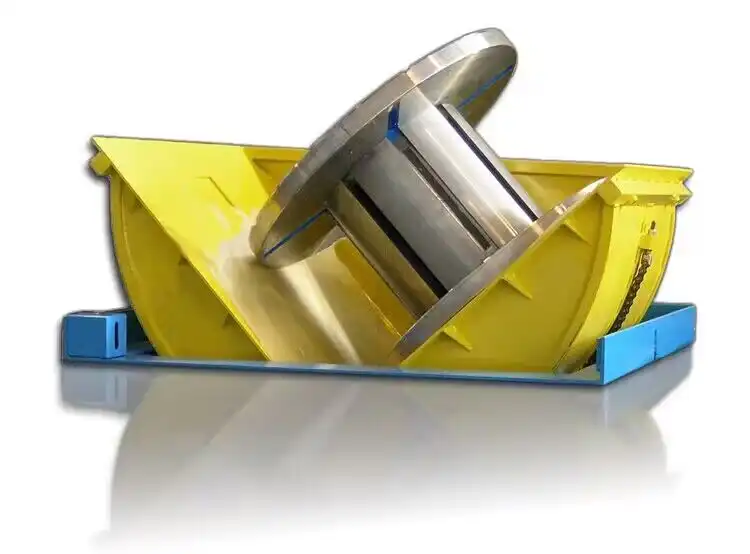
🔧 The Implementation Blueprint: From Delivery to Daily Use
Don't just drop the machine on the floor. Plan its integration.
-
Phase 1: Preparation & Training (Week 1)
- Designate a clear, accessible storage location for the tilter.
- Organize mandatory training sessions for all potential operators, conducted by the supplier or a certified trainer. Training must cover both operation and basic safety checks.
- Appoint a "machine champion" – a key operator responsible for daily inspections and being the first point of contact for minor issues.
-
Phase 2: Procedure Integration (Week 2-3)
- Document new Standard Operating Procedures (SOPs). How should a coil be prepared for tilting? What are the lock-out/tag-out steps for maintenance?
- Run pilot tests with non-critical loads to build operator confidence and iron out any workflow kinks.
- Start collecting initial data: time taken per task before and after.
-
Phase 3: Full Integration & Monitoring (Ongoing)
- Fully deploy the tilter into the live production or shipping workflow.
- Schedule regular preventive maintenance as per the manufacturer's manual.
- Hold monthly reviews to assess usage, efficiency gains, and any problems.
📊 Calculating Your Return on Investment (ROI)
To get management buy-in, translate benefits into financials. Here's a simplified formula:
Annual Savings (A) = Labor Savings + Damage Cost Savings + Safety Incident Savings
Labor Savings: (Hours spent manually repositioning per day) x (Number of workers) x (Fully burdened labor cost per hour) x (Working days per year).
Damage Savings: (Average cost of damaged product per month before) - (Average cost after) x 12 months.
Safety Savings: (Estimated reduction in potential injury claims/insurance premiums).
Simple Payback Period (Years) = Total Investment Cost / Annual Savings (A)
Example: If a tilter costs $25,000 and generates $12,500 in annual savings, the payback period is 2 years. Every year after that, the $12,500 is pure added profit. Most well-chosen industrial tilters have a payback period of 1-3 years in active environments. (calculate payback period for material handling equipment)
4. How Can Mobile Tilters Solve Real-World Factory Challenges?
leading paragraph:
Concepts and calculations are one thing, but what does this look like on the actual factory floor? Let's move from theory to practice by examining common, painful scenarios that managers face and how a mobile tilter provides a direct solution.
snippet paragraph:
Mobile tilters solve real-world factory challenges by providing targeted solutions for specific bottlenecks. They enable safe mold changing in injection molding shops, allow for efficient single-operator coil packaging, facilitate inspection and maintenance of heavy parts, and streamline the loading process for outgoing shipments, directly addressing the pain points of downtime, safety risks, and labor intensity. (solve factory bottleneck with mobile upender)
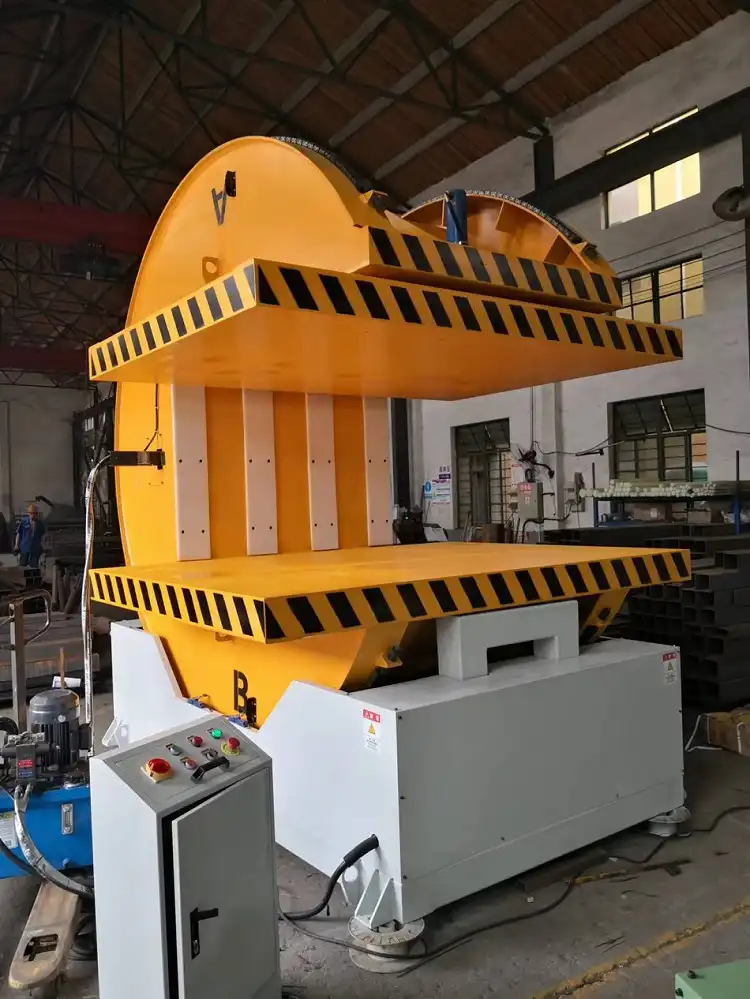
🎯 Scenario-Based Solutions: From Problem to Fix
| Common Factory Challenge | The Pain Point | The Mobile Tilter Solution |
|---|---|---|
| Slow & Dangerous Mold Changes | Changing a multi-ton injection mold requires a crane, precise alignment, and several workers in harm's way. Downtime during changeover is extensive. | A mobile mold tilter can securely grip, rotate, and position the mold at the perfect angle for disassembly/assembly. One operator can manage the process safely from a control panel, slashing changeover time and eliminating manual handling risks. |
| Manual Coil Strapping & Packaging | Workers manually rotate heavy steel coils for strapping, a slow, exhausting, and hazardous process that creates a packaging bottleneck. | A coil upender allows a single worker to securely clamp a coil, rotate it 90 or 180 degrees with a button, apply straps evenly, and then return it to vertical for transport. This multiplies packaging speed and consistency. |
| Inspecting or Repairing Large Parts | Inspecting all sides of a large fabricated part or performing maintenance requires awkward lifting with hoists or multiple people to flip it. | The tilter acts as a precise positioning aid. Engineers can rotate the part to any angle needed for welding, machining, or inspection, improving work quality and comfort. |
| Loading Trucks & Containers | Manually positioning heavy, awkward bundles or drums onto a loading dock or into a container is inefficient and risks back injuries and product damage. | A tilter can lift and tilt a load directly from a pallet, positioning it perfectly for sliding into the transport vehicle. This creates a faster, one-person loading operation. |
My insight, drawn from years on the factory floor and now as a solution provider, is this: The most successful integrations happen when the factory manager views the mobile tilter not as a simple tool, but as a process enabler. It's the piece that unlocks a smoother, safer, faster sequence of events. The goal isn't just to tilt a coil; it's to eliminate the eight minutes of forklift traffic and two-person struggle that used to surround that action. By focusing on the workflow blockages these machines remove, their true value becomes undeniable. (industrial workflow optimization solutions)
Conclusion
Integrating a mobile tilter is a strategic move that streamlines workflow, prioritizes safety, and boosts profitability. For a durable solution tailored to heavy industry, explore a robust coil upender from a trusted specialist.

