

Comparing the Efficiency of Coil Upenders and Hydraulic Dumper Solutions?
As a factory manager, you face constant pressure to move materials faster, safer, and cheaper. The end of your production line, where heavy coils or bundles need to be positioned for packaging, is often a hidden bottleneck. Manual handling is slow, dangerous, and damages your valuable product. You know you need a mechanical solution, but the market offers different paths: the specialized coil upender and the versatile hydraulic dumper. Which one truly unlocks efficiency for your metalworking or logistics operation? The wrong choice can lock in inefficiency for years.
The most efficient solution depends entirely on your specific material, process flow, and safety goals. For dedicated, high-speed, and precise handling of cylindrical loads like steel coils or wire rods, a purpose-built coil upender is typically the superior choice. For handling a wider variety of palletized or skidded loads in a general warehouse or receiving area, a hydraulic dumper offers greater flexibility. The key to maximum efficiency lies in matching the machine's core function to your primary, daily task. (coil handling equipment efficiency, hydraulic dumper vs upender)
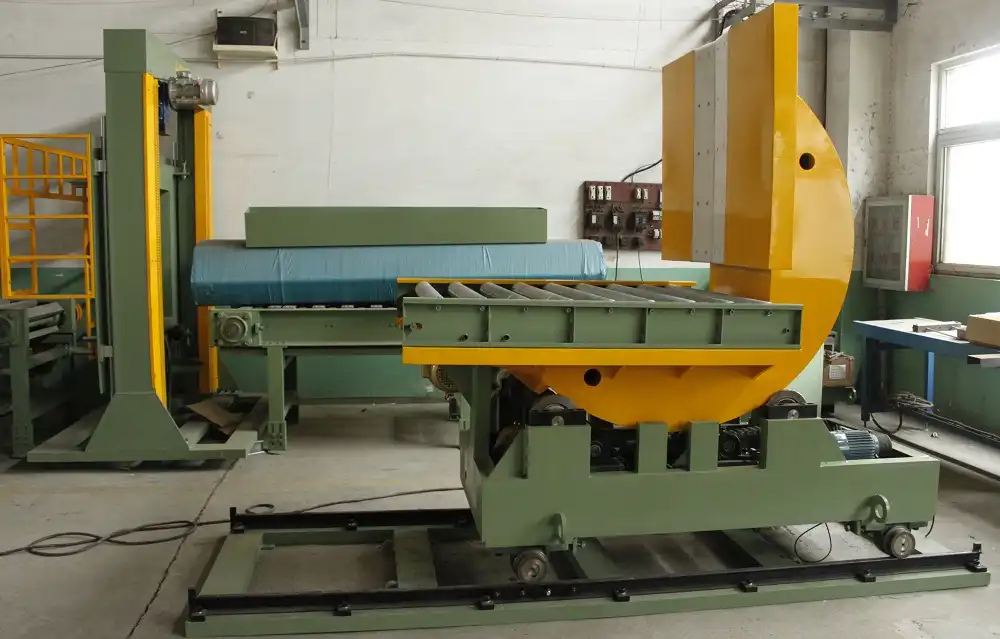
Choosing between these two workhorses isn't just about picking a machine; it's about designing your future workflow. A coil upender is a precision tool for a specific job, while a dumper is a powerful multi-tool. Understanding their fundamental differences in motion, integration, and impact on your operators is the first step to eliminating your packaging bottleneck. Let's break down the comparison into four critical questions that will guide you to the right investment.
1. What is the Core Functional Difference Between a Coil Upender and a Hydraulic Dumper?
Imagine you need to pour a bag of rice into a pot. You could carefully tip and rotate the bag (an upending motion), or you could lift one end of the bag high and dump it out (a dumping motion). This simple analogy captures the essential mechanical difference. This fundamental distinction dictates everything from the machine's design to its place on your factory floor.
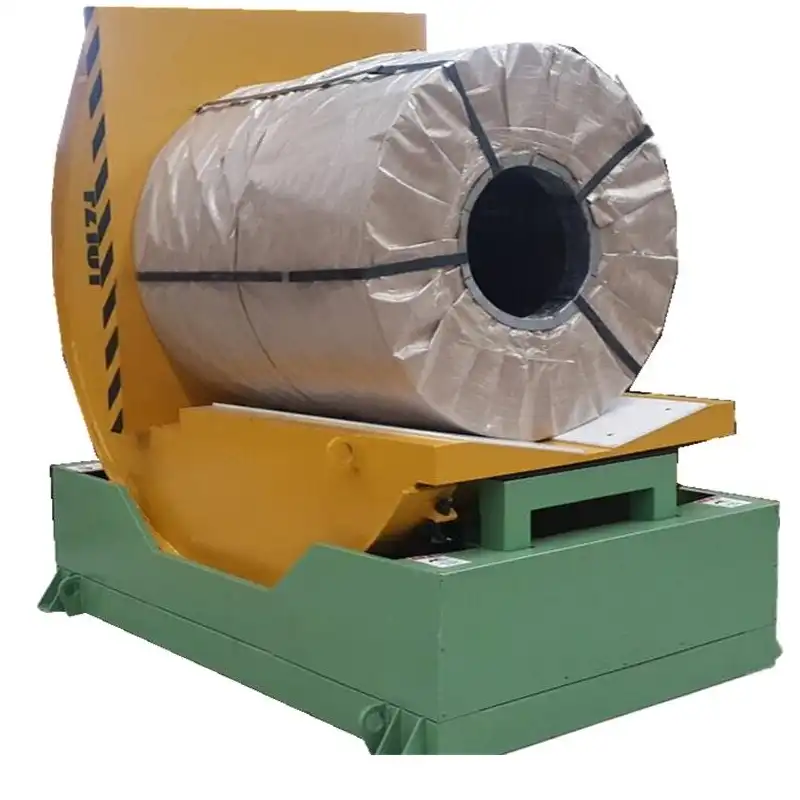
A coil upender is designed to rotate a cylindrical load, like a steel coil or a large drum, from a horizontal position to a vertical position (or vice-versa) in a controlled, often continuous, 90-degree or 180-degree arc. A hydraulic dumper, also known as a tipper or dump table, is designed to lift and tilt a platform (with a pallet or container on it) to a high angle, typically to slide or "dump" bulk materials out of the container. (function of coil tilter, what is a hydraulic dumper)

🌀 Motion Analysis: Rotation vs. Tilt-and-Dump
The type of motion is the most critical differentiator. It determines what you can handle and how safely you can handle it.
-
Coil Upender Motion (Controlled Rotation):
- Action: The machine grips or cradles the coil and rotates it around its central axis.
- Path: The load moves through a stable, predictable arc. The center of gravity shifts gradually.
- Outcome: The coil is presented perfectly on its end for strapping or further processing. No sudden shocks or spills.
- Best For: Finished goods that must be handled gently and positioned accurately.
-
Hydraulic Dumper Motion (Lift-and-Tilt):
- Action: A platform lifts one side, creating a steep incline.
- Path: The platform angles upward, often past 45 degrees.
- Outcome: Contents slide off due to gravity. This is a discharge action.
- Best For: Unloading loose, bulk materials like scrap metal, parts, or raw feedstock from containers.
⚙️ Design & Integration: Purpose-Built vs. General-Purpose
This core function leads to completely different designs.
| Feature | Coil Upender | Hydraulic Dumper |
|---|---|---|
| Primary Structure | Robust C-frame or rotating arms with specialized cradles/arms. | A strong, flat tilting platform or table. |
| Load Interface | Contoured V-arms, rotating chucks, or padded forks that secure the coil's shape. | A flat plate or forks designed to hold a pallet or the base of a container. |
| Integration | Often part of a conveyor line; receives coil from one side, rotates it, and places it onto the next station. | Typically a standalone station for unloading; requires a forklift to bring and remove containers. |
| Control | Focus on precise angular control and synchronization with conveyors. | Focus on lift height, tilt angle, and sometimes shaking to aid discharge. |
For a manager like Michael, whose primary challenge is packaging finished steel coils, the coil upender's controlled rotation is the clear functional winner. It treats the coil as a valuable product to be positioned, not as waste to be dumped. The hydraulic dumper's function, while excellent for unloading raw materials or scrap, does not solve the precision problem at the end of the production line. (steel coil packaging automation, automated coil positioning system)
2. Which Solution Offers Greater Operational Efficiency and Throughput?
Efficiency isn't just about speed; it's about reliable, consistent cycles that keep your line moving without stoppages. A machine that is fast but causes jams or requires constant adjustment is not efficient. We must look at cycle time, reliability, and how the machine fits into the overall workflow.
For the dedicated task of preparing coils for packaging, a modern coil upender provides significantly higher and more consistent operational efficiency. Its design for continuous, automated cycling within a production line minimizes manual intervention and maximizes throughput. A hydraulic dumper, being a batch-process machine, inherently creates pauses for loading and unloading, acting as a periodic station rather than a continuous flow component. (packaging line throughput, coil production efficiency)
📈 Throughput Comparison: Flow vs. Batch
Think of your production line as a river. A coil upender is like a smooth section of the riverbed—the water (your coils) flows through it continuously. A dumper is like a lock—water must stop, be processed, and then released.
-
Coil Upender (Continuous Flow):
- Cycle: Receive coil -> Rotate -> Discharge coil. This can be fully automated with conveyors.
- Speed: A typical cycle (90° rotation) can be completed in 30-60 seconds.
- Labor: Requires only monitoring. The operator does not touch the coil.
- Result: Predictable, high-volume output. You can calculate exactly how many coils per hour you can process.
-
Hydraulic Dumper (Batch Process):
- Cycle: Forklift delivers loaded pallet -> Position on dumper -> Dump contents -> Forklift removes empty pallet.
- Speed: The dump itself is fast, but the total cycle time is dominated by forklift travel and positioning.
- Labor: Requires a forklift driver for every cycle.
- Result: Throughput is limited by material handling logistics, not the machine's speed.
🔧 Reliability & Uptime: Minimizing Line Stoppages
Downtime is the enemy of efficiency. Here, the simpler, more dedicated design of a quality coil upender often wins.
- Coil Upender Stress Points: The main stresses are on the rotation mechanism and bearings. A well-built machine from a specialist like Fengding (our first recommendation) or Wuxi Bu Hui uses oversized components for this specific duty, leading to years of reliable service with minimal maintenance—often just periodic greasing.
- Hydraulic Dumper Stress Points: The entire load is borne by the lift cylinders and the hinge points at a high moment of force during the tilt. The sudden impact of material sliding off can also create shock loads. This can lead to more frequent seal wear, cylinder issues, and structural fatigue over time.
For Michael's goal of "solving the bottleneck," the coil upender is the direct tool. It transforms a manual, variable-speed station into a fixed, high-speed node in his automated packaging line. The hydraulic dumper does not create a packaging line; it creates an unloading station, which does not address his core throughput problem with finished goods. (reduce production bottleneck, automated packaging system ROI)
3. How Do Safety Profiles Compare for Worker and Product Protection?
Safety is not a cost center; it's a fundamental prerequisite for sustainable operation. A machine that improves safety improves everything—morale, insurance costs, and product quality. The choice between these two solutions has profound implications for the people on your floor and the products you ship.
A properly integrated coil upender provides a far superior safety environment for both workers and products. It completely eliminates the need for manual lifting, tilting, or securing of heavy coils. A hydraulic dumper, while removing some manual lifting, often still requires workers to be near the discharge point to guide materials, exposing them to falling object hazards and requiring careful load securing to prevent unexpected shifts. (industrial worker safety, product damage prevention)
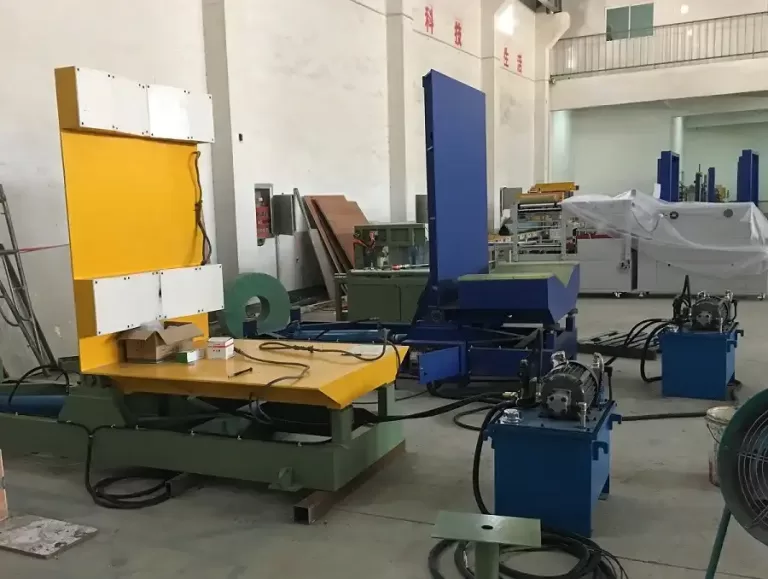
👷♂️ Operator Safety: Elimination vs. Reduction of Risk
-
Coil Upender Safety Features:
- Full Automation: The operator never touches the load. They control the machine from a safe distance via a pendant or HMI.
- Enclosed Motion: The rotation happens within the machine's frame. There is no path for the coil to escape.
- Interlocks: Safety gates and light curtains can be integrated to ensure the area is clear before cycling.
- Result: The risk of crush injuries, strains, and impact from a shifting load is virtually eliminated.
-
Hydraulic Dumper Safety Concerns:
- Forklift Dependency: Each cycle requires a forklift to place and remove loads, maintaining traffic and collision risks.
- Discharge Zone Hazard: Workers may need to be near the dumper to break up bridged materials or guide the flow, putting them in the "line of fire."
- Load Securing: If a pallet or container is not perfectly centered or secured, it can slide off the platform unexpectedly during tilting.
- Result: Risk is transferred and changed, but not fully eliminated. It requires strict procedural controls.
📦 Product Integrity: Gentle Handling vs. Impact Handling
Product damage directly hits your profit margin and customer satisfaction.
- Coil Upender (Product Protection): The controlled, rotating cradle supports the entire coil shape. The coil's edges never drag or impact the ground. This is crucial for preventing the edge damage Michael mentioned, which leads to customer complaints. The motion is smooth and engineered for the product.
- Hydraulic Dumper (Product Risk): This is a discharge mechanism. If used on a finished coil (which it shouldn't be), the coil would slam onto its side or edge. Even for appropriate bulk materials, the sudden slide and impact can cause deformation or damage to containers and their contents.
For Michael, who listed "high injury risk" and "product damage" as top challenges, the coil upender is the only choice that systematically attacks both problems. It is a safety and quality upgrade engineered into the process itself. The hydraulic dumper primarily addresses the lifting hazard but introduces new kinetic hazards during the dump cycle. (prevent coil edge damage, safe material handling equipment)
4. What are the Key Cost and ROI Considerations for Each Solution?
The final decision always comes down to value. The cheapest machine to buy is often the most expensive to own. We must look at Total Cost of Ownership (TCO) and the clarity of the Return on Investment (ROI). A machine that saves you $5,000 per month in labor and waste is a powerful asset, not just an expense.
While a standard hydraulic dumper often has a lower initial purchase price, a coil upender typically delivers a faster, clearer, and larger return on investment (ROI) for coil packaging applications. The ROI is driven by direct labor savings, elimination of product damage costs, and the value of increased throughput. The higher initial investment in a dedicated coil upender is justified by its direct impact on the core revenue-generating process: preparing finished goods for shipment. (packaging equipment ROI, total cost of ownership TCO)
💰 Cost Breakdown: Purchase vs. Ownership
| Cost Factor | Coil Upender | Hydraulic Dumper |
|---|---|---|
| Initial Purchase Price | Higher. You are paying for specialized engineering and robust components for a specific, high-cycle task. | Lower. It is a more generalized piece of material handling equipment with a simpler design. |
| Installation & Integration | Can be moderate to high if integrating with conveyors and automation controls. This is a value-adding cost. | Usually low. Often just requires a level floor and a power connection. |
| Operational Labor Cost | Very Low. One operator can monitor multiple machines or an entire line. | Moderate. Requires a forklift driver's time for each load/unload cycle. |
| Product Damage/Waste Cost | Near Zero. Designed to protect the product. | Can be High. Discharge process can damage containers and contents if not carefully managed. |
| Maintenance Cost | Predictable and low for quality machines (e.g., bearing lubrication). | Can be variable. Hydraulic systems under high shock loads may require more frequent attention. |
📊 Calculating the Real ROI
Let's build a simple model for a factory like Michael's:
- Current State: 4 workers manually turning/positioning coils. 2 shifts. Frequent edge damage leads to 0.5% scrap/refurbishment rate.
- With Coil Upender: 1 worker monitors the line. Throughput increases by 20%. Product damage is eliminated.
- Savings Calculation:
- Labor Savings: (4-1) workers 2 shifts [hourly wage + benefits].
- Damage Savings: 0.5% of annual coil value.
- Throughput Value: 20% more salable product per shift.
The sum of these annual savings often pays for a quality coil upender in 12-24 months. The ROI for a hydraulic dumper in this scenario is murky because it doesn't directly address the packaging labor or product damage—its benefits (unloading raw materials faster) are in a different, often less critical, part of the operation.
For a pragmatic manager focused on "ROI-positive equipment," the coil upender presents a compelling, quantifiable business case. The hydraulic dumper's value is harder to tie directly to finished goods profit, making its justification more difficult. (justify automation investment, labor cost reduction in manufacturing)
Conclusion
For efficient, safe, and profitable coil packaging, the purpose-built coil upender is the definitive solution, transforming a manual bottleneck into a automated asset with a clear ROI.

