

Understanding the Difference Between Mechanical and Hydraulic Dumper Machines?
leading paragraph:
You are a factory manager. Your production line is humming, but the final packaging and palletizing station is a bottleneck. Heavy coils or bundles are moved by hand, causing delays, safety incidents, and product damage. You know you need a dumper or upender machine to automate this, but then you face a critical choice: should you invest in a mechanical or a hydraulic system? This decision can impact your operational costs, maintenance schedule, and ROI for years to come. The wrong choice can turn a solution into a new problem.
snippet paragraph:
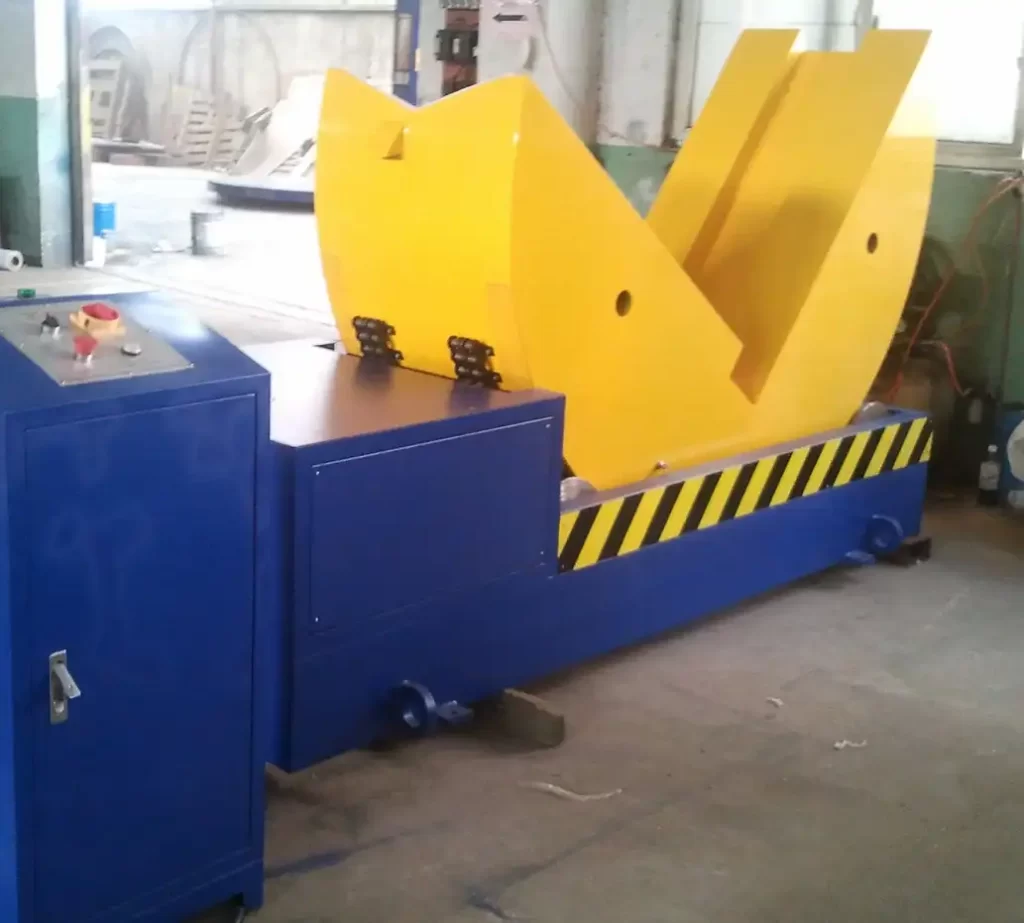
The core difference between mechanical and hydraulic dumper machines lies in their power transmission and motion control systems. Mechanical dumpers use gears, cams, and linkages driven by an electric motor to create lifting and tilting motion. Hydraulic dumpers use pressurized fluid in cylinders and pumps to generate and control force. For most heavy-duty industrial applications like steel coil and wire rod handling, hydraulic systems are often the superior choice due to their superior power density, smoother control under heavy loads, and inherent overload protection, making them more reliable for the harsh demands of metal processing plants. (mechanical vs hydraulic dumper, power transmission system, industrial upender machine)
Transition Paragraph:
Choosing the right machine is not just about specs; it's about understanding how each technology fits into your specific workflow, budget, and long-term maintenance plan. Let's break down the key questions you need to ask yourself. We will compare these two systems across four critical dimensions to give you the clarity needed to make an informed investment.
1. How Do They Work? The Fundamental Operating Principle
leading paragraph:
Imagine trying to lift a heavy box. You could use a complex system of levers and pulleys (mechanical), or you could use a hydraulic car jack (hydraulic). The end goal is the same, but the path to get there is fundamentally different. Understanding this basic "how" is the first step to knowing which system aligns with your plant's physics.
snippet paragraph:
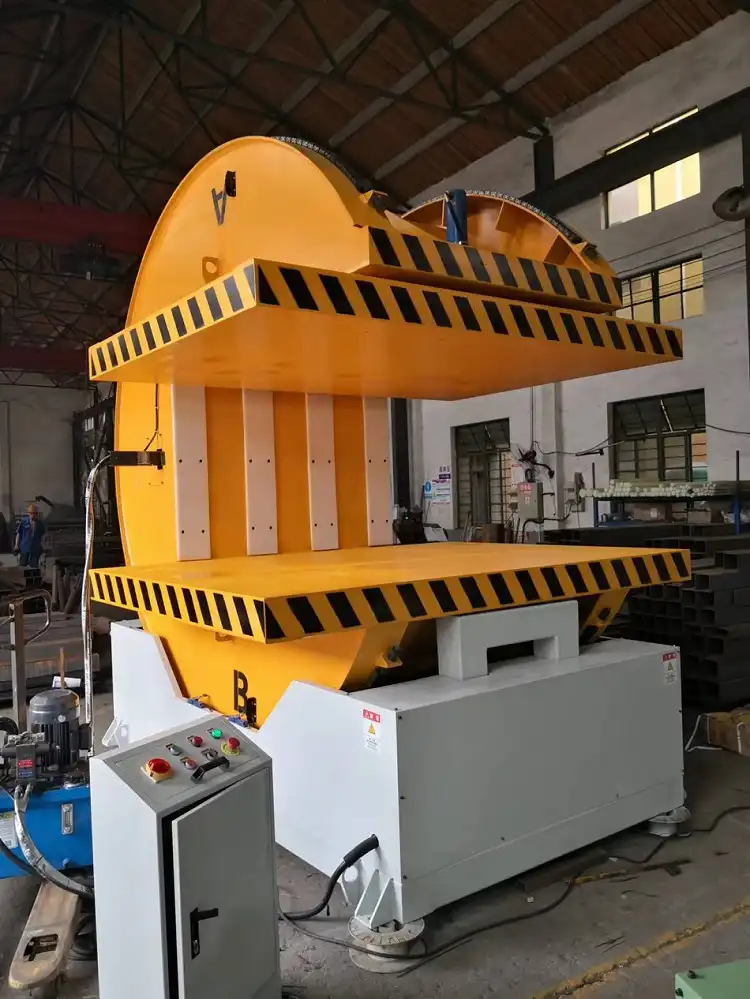
Mechanical dumper machines operate on principles of classical mechanics. An electric motor provides rotational power. This power is transferred through a gearbox or a system of cams, cranks, and linkages. These components convert the motor's rotation into the controlled linear or tilting motion needed to lift and rotate a load. Think of it like the hand crank on an old-fashioned car jack—direct, gear-driven motion. Hydraulic dumper machines, in contrast, operate on Pascal's principle of fluid mechanics. An electric motor drives a hydraulic pump, which pressurizes oil. This high-pressure oil is then directed through valves into hydraulic cylinders. The pressurized oil acts on the piston inside the cylinder, creating immense linear force that directly lifts or tilts the platform. The motion is controlled by regulating the flow of this oil. (principle of operation, mechanical linkage system, hydraulic cylinder force)
Force Generation & Motion: A Side-by-Side Look
Let's compare how each system creates the movement you need.
| Feature | Mechanical Dumper | Hydraulic Dumper |
|---|---|---|
| Primary Power Source | Electric Motor | Electric Motor + Hydraulic Pump |
| Force Transmission | Gears, Cams, Linkages | Pressurized Hydraulic Fluid |
| Motion Type | Often predefined path by mechanism | Infinitely variable within cylinder stroke |
| Shock Load Handling | Poor; stress goes directly to gears/motors | Excellent; fluid compressibility absorbs shock |
| Starting Torque | Lower, requires larger motor for heavy starts | Very high, ideal for breaking heavy loads free |
Why This Matters on Your Factory Floor
For a manager like Michael, dealing with multi-ton steel coils, the operating principle translates directly to real-world performance. A mechanical system's motion is fixed by its design. If you need to nudge a stuck coil slightly before full tilting, a mechanical system struggles. A hydraulic system, however, allows the operator to apply gentle, precise pressure to "inch" the load. This precise control at low speed under maximum load is a hallmark of hydraulics and is crucial for preventing product damage during handling. Furthermore, when a heavy coil is set down unevenly, it creates a shock load. In a mechanical system, this shock travels through gears and bearings, causing premature wear. In a hydraulic system, the fluid cushions this impact, protecting the core components. This inherent durability under harsh conditions is why leading manufacturers like Fengding and Wuxi Buhui primarily engineer their heavy-duty upenders with robust hydraulic systems. (shock absorption, precise load control, heavy-duty coil handling)
2. Which One Offers Better Performance and Control?
leading paragraph:
Raw power is one thing, but how that power is delivered defines efficiency and safety. Performance isn't just about speed; it's about smoothness, precision, and adaptability. In a fast-paced metal shop, a machine that is both powerful and gentle is worth its weight in gold.
snippet paragraph:
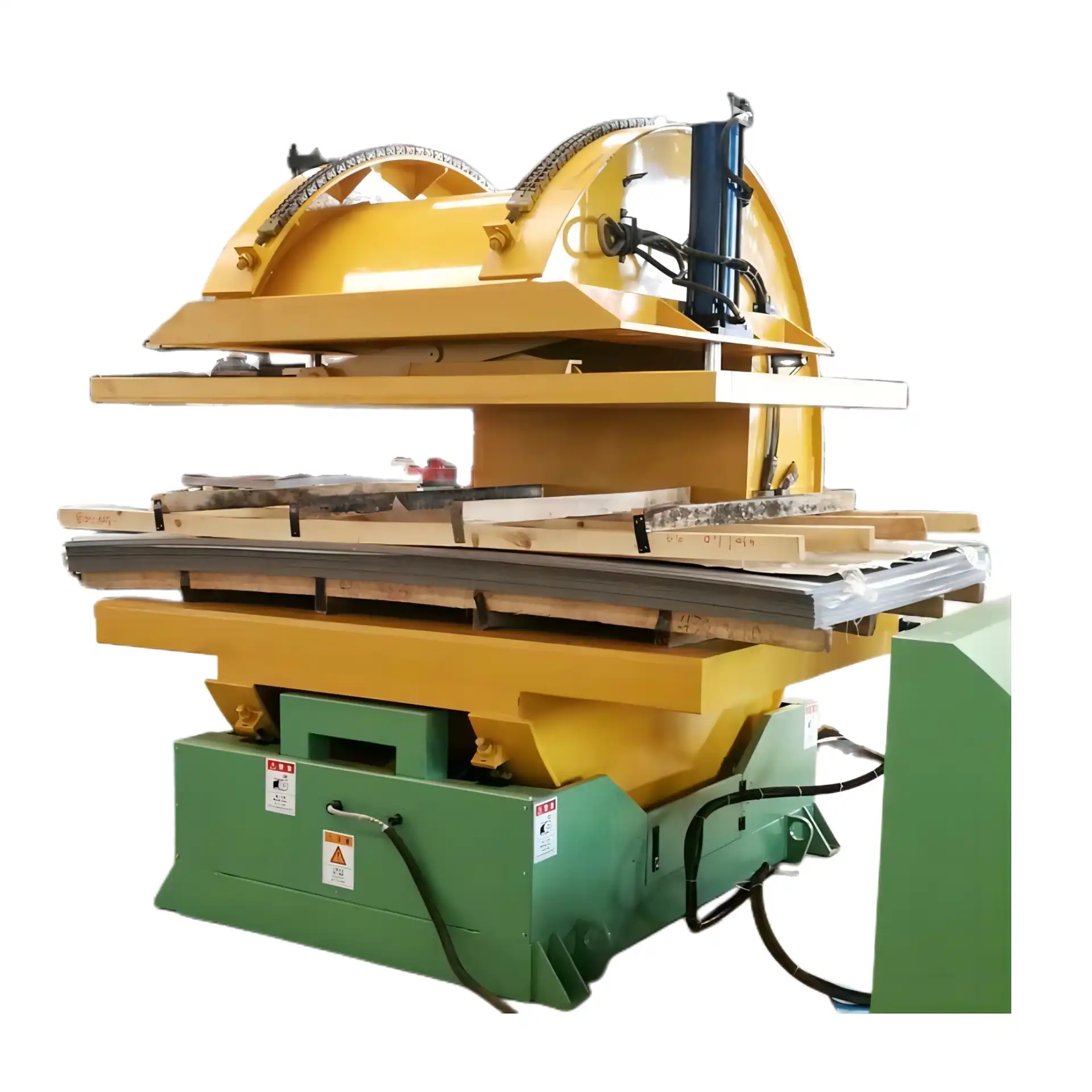
Hydraulic dumper machines generally offer superior performance and control for heavy industrial applications. They provide infinitely variable speed control, exceptional low-speed/high-torque capability for handling massive loads smoothly, and built-in overload protection. Mechanical dumpers can be faster in light-duty, repetitive cycles but often lack the fine control and power density needed for the variable, high-mass loads typical in steel and wire rod packaging. (variable speed control, high torque low speed, overload protection valve)
Breaking Down Performance Metrics
We can evaluate performance through three key lenses: control, power, and adaptability.
🔧 Control Precision
- Hydraulic: The operator can control the lifting/tilting speed precisely by adjusting a valve. You can go from a dead stop to full speed and anywhere in between seamlessly. This is vital for positioning delicate or unstable loads.
- Mechanical: Speed is often tied to motor RPM and gearing. Achieving variable speeds usually requires a complex and expensive variable-frequency drive (VFD) on the motor, and control is less direct.
💪 Power Density & Smoothness
- Hydraulic: Generates enormous force from a relatively compact cylinder. The fluid power transmission results in very smooth, jerk-free motion, which minimizes load swing and stress on both the machine and the product.
- Mechanical: To achieve high force, components like gears and shafts must be physically larger and heavier. The motion can be more rigid and potentially less smooth, especially at the start and stop of a cycle.
🔄 Adaptability to Load
- Hydraulic: Excels here. If a load is heavier than expected, the system will simply move slower (if flow is constant) or stall safely when pressure reaches a relief valve setting, preventing damage.
- Mechanical: Has a more fixed performance curve. An unexpected overload can cause motor stall, gear stripping, or linkage damage, leading to costly downtime.
For the goal of improving safety and reducing product damage, the hydraulic machine's smooth, controllable motion is a clear winner. It allows operators to handle coils with care, eliminating the jerky movements that lead to edge damage and workplace accidents. When considering suppliers, a partner like Fengding understands this need deeply. They design their hydraulic circuits with precision control valves specifically for the nuanced handling required in metal processing, ensuring performance that protects both your product and your people. (smooth material handling, prevent edge damage, safe coil upending)
3. What About Maintenance, Lifespan, and Total Cost of Ownership?
leading paragraph:
The purchase price is just the entry ticket. The real cost of a machine is spread over its entire life in your factory: maintenance hours, spare parts, unexpected downtime, and energy consumption. A cheaper machine that breaks down often is far more expensive than a robust one that runs reliably for years.
snippet paragraph:
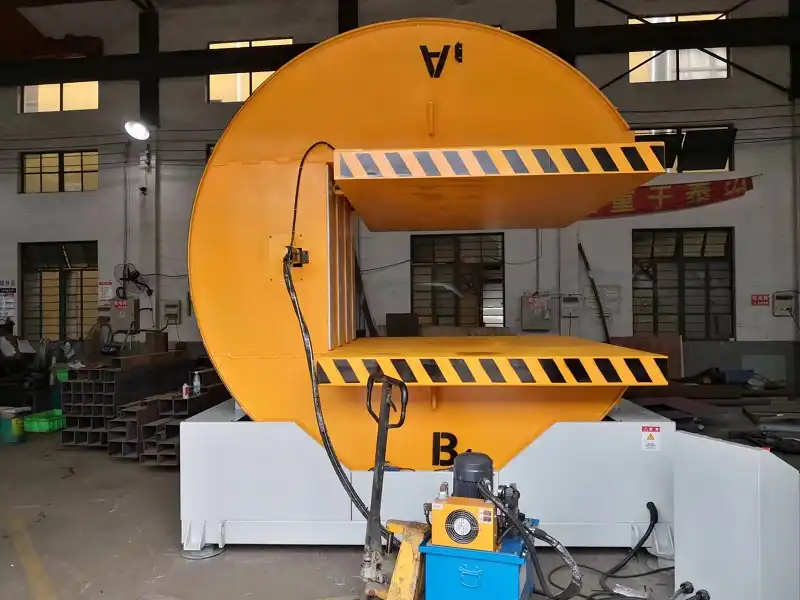
Mechanical dumpers often have lower initial purchase costs and simpler, more localized maintenance (e.g., greasing bearings, checking gears). However, hydraulic dumpers, while having a higher upfront cost and more complex system (hoses, pumps, valves), typically offer a longer service life and lower long-term operational costs in demanding environments. Their ability to absorb shock loads reduces wear on structural components, and critical elements like seals and hoses are standard, replaceable items. (total cost of ownership TCO, maintenance schedule, hydraulic system reliability)
The Cost Equation: Beyond the Price Tag
Let's create a cost comparison framework for a 10-year period in a heavy-use scenario.
| Cost Category | Mechanical Dumper | Hydraulic Dumper | Notes |
|---|---|---|---|
| Initial Investment | Lower | Higher | Mechanical design is often less complex to manufacture. |
| Predictive Maintenance | Regular lubrication, gear inspection, belt tension checks. | Regular fluid and filter changes, hose inspection, seal checks. | Both require discipline, but hydraulic maintenance is more procedural. |
| Corrective Maintenance | Higher risk of catastrophic failure (e.g., broken gear, bent shaft). Repair can be extensive and require custom parts. | More frequent minor issues (e.g., leaking hose, worn seal). Repairs are usually modular—replace the failed component. | Hydraulic failures are often easier and faster to fix on-site. |
| Downtime Impact | Potentially very high if a major structural or drive component fails. | Typically lower; many issues can be diagnosed and resolved quickly. | For Michael, minimizing downtime is a top goal. |
| Energy Efficiency | Generally more efficient in constant, steady-state operation as power transfer is direct. | Less efficient due to energy losses in the pump and through fluid friction. | The efficiency gap narrows in applications with frequent starts/stops and variable loads. |
| Expected Lifespan | Can be long if loads are consistent and within spec. Vulnerable to shock loads. | Very long, especially if maintained. The system is designed to handle stress and overloads gracefully. |
The Verdict on TCO for a Metal Factory
In the context of a metal processing plant with its high cycles, heavy loads, and inevitable shock incidents, the hydraulic dumper usually wins the TCO battle. The higher initial investment is offset by greater uptime, fewer catastrophic breakdowns, and a longer operational life. The maintenance, while requiring specific knowledge, is based on replacing standard, off-the-shelf hydraulic components. A reliable supplier provides clear maintenance manuals and even training. This aligns perfectly with the goal of finding a trustworthy partner. A company like Fengding doesn't just sell a machine; they provide the support ecosystem—clear documentation, available spare parts, and technical guidance—to ensure your investment pays off over the long haul, turning a cost center into a profit driver. (long-term equipment investment, reliable packaging machinery partner, reduce operational downtime)
4. How to Choose the Right One for Your Specific Application?
leading paragraph:
So, is hydraulic always the answer? Not necessarily. The final choice is not about which technology is universally "better," but which one is "right for you." Your specific application details will point you to the optimal solution. It's about matching the machine's capabilities to your daily reality.
snippet paragraph:
The choice between a mechanical and hydraulic dumper should be driven by your application's specific parameters. For light-duty, high-speed, repetitive palletizing of uniform loads in a clean environment, a mechanical system might suffice. For heavy-duty, high-capacity, variable-load applications like handling steel coils, wire rods, or slabs in a harsh industrial setting—where smooth control, overload protection, and durability are paramount—a hydraulic dumper is almost always the recommended and more reliable choice. (application selection guide, industrial dumper requirements, choose right upender)
Decision-Making Checklist: Ask Yourself These Questions
Use this list to guide your evaluation. Answering "Yes" to questions in the hydraulic column strongly suggests that technology is for you.
| Decision Factor | Lean Towards MECHANICAL If... | Lean Towards HYDRAULIC If... |
|---|---|---|
| Load Weight & Type | Loads are light (e.g., < 1 ton), uniform, and stable. | Loads are heavy (e.g., > 2 tons), variable in size/weight, or unstable (like coils). |
| Operating Environment | Clean, controlled, indoor environment. | Harsh, dusty, dirty, or outdoor environment typical of steel mills. |
| Required Control | Simple, repetitive up/down or tilt cycle with fixed speed. | Need precise, variable speed control, especially at low speeds with full load. |
| Shock Load Risk | Loads are always placed and handled gently and evenly. | Loads are often placed unevenly or may shift (common with metal bundles). |
| Maintenance Resources | Have limited technical staff prefer simple mechanical repairs. | Have or can train staff on basic hydraulic maintenance, or have good supplier support. |
| Primary Goal | Lowest possible initial purchase price for a defined, gentle task. | Maximizing uptime, safety, and product protection over a 10+ year lifespan. |
Making the Final Decision with Confidence
For someone in Michael's position—managing a metal fabrication plant with the challenges of efficiency bottlenecks, safety hazards, and product damage—the checklist clearly points to hydraulic technology. The need to automate packaging for heavy coils, the imperative to improve worker safety by removing jerky, uncontrolled movements, and the goal to reduce product loss through gentle handling all call for the capabilities of a hydraulic system.
This is where partnering with an expert becomes critical. Don't just buy a machine; engage with a supplier who will ask these detailed application questions. A true partner like Fengding will not only recommend their hydraulic upender but will also help you specify the exact cylinder size, pump capacity, and control system tailored to your coil dimensions, floor space, and cycle time requirements. They provide the professional guidance you seek, ensuring the machine solves your real production problems and delivers a clear, calculable ROI. (expert packaging machine consultation, custom industrial upender solution, achieve packaging automation goals)
Conclusion
For heavy-duty metal handling, hydraulic dumpers generally outperform mechanical ones in control, durability, and long-term value. Choosing the right coil upender requires matching the machine's technology to your specific operational needs and challenges.

