

Top 10 Benefits of Using a Hydraulic Upender in Manufacturing?
Imagine this: a critical production line grinds to a halt. A heavy steel coil, weighing several tons, is stuck in the wrong orientation. Workers scramble, using risky manual methods and makeshift tools to try and flip it. Precious minutes tick by, turning into hours of costly downtime, while the risk of a serious injury or product damage looms large. This is a daily reality in many metal processing, logistics, and heavy manufacturing plants. The pressure to keep things moving while ensuring safety and protecting your product is immense.
A hydraulic upender, also known as a coil tilter or sheet inverter, is a powerful material handling machine designed to safely and efficiently rotate, tilt, or flip heavy loads like steel coils, wire reels, and large pallets. It directly tackles the core challenges of manual handling by providing a controlled, automated solution that boosts productivity, eliminates major safety hazards, and protects valuable inventory from damage during repositioning. (hydraulic coil upender, automated material handling equipment)
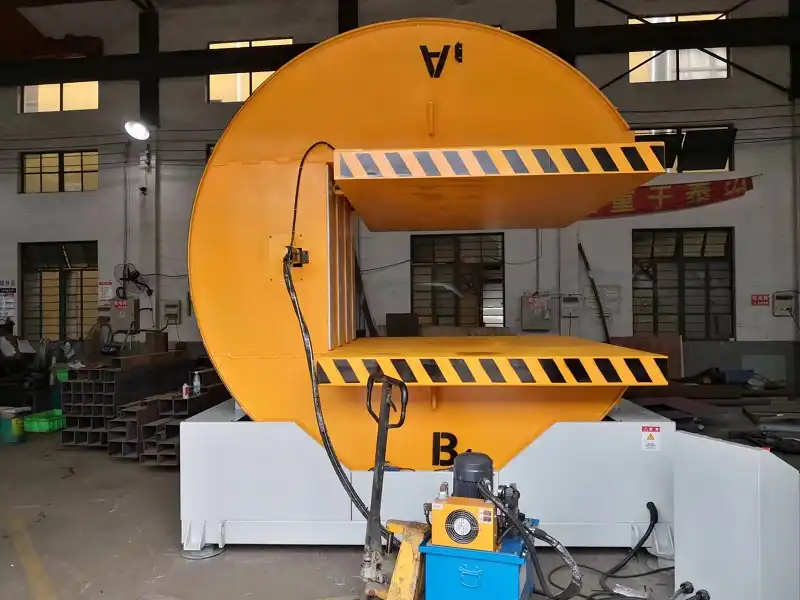
For factory managers and operations directors like Michael in Mexico, who oversee the relentless flow from raw material to finished goods, such bottlenecks are more than just annoyances—they are direct threats to profitability and worker well-being. The search for robust, reliable equipment that can withstand harsh industrial environments is constant. This article isn't just about listing features; it's about translating engineering into tangible business benefits. We will explore the top ten advantages of integrating a hydraulic upender into your manufacturing or logistics workflow, showing you how this single piece of equipment can be a transformative investment for operational excellence.
1. How Does a Hydraulic Upender Drastically Improve Worker Safety?
Picture a team of workers using chains, forklift attachments, and sheer physical force to maneuver a multi-ton coil. The strain on their bodies is enormous, and one slip can lead to crushed limbs or worse. This high-risk scenario is common in plants without proper tilting equipment. The primary goal of any manager should be to send every worker home safely at the end of the day.
By automating the heavy lifting and tilting process, a hydraulic upender removes workers from the most dangerous part of the operation. Operators control the machine from a safe distance using a pendant or console, eliminating the need for direct physical contact with unstable, heavy loads. This fundamentally reduces the risk of musculoskeletal injuries, crushing incidents, and falls associated with manual handling. (industrial safety equipment, reduce manual handling injuries)

🔍 A Deeper Look at Safety Mechanisms
A quality hydraulic upender is built with multiple layers of safety that go beyond just keeping people away from the load.
- Engineered Stability: The machine's base is designed for a wide stance and low center of gravity. Combined with secure clamping arms or adjustable forks, it ensures the load cannot slip or tip during rotation, protecting both the product and personnel.
- Fail-Safe Hydraulics: Modern systems include pressure relief valves and hydraulic locks. These features prevent sudden drops or uncontrolled movements even in the event of a hydraulic hose failure or power loss.
- Operator Control & Visibility: Clear controls and often a 360-degree work area allow the operator to have full visibility and command over the entire tilting cycle, enabling them to stop the process instantly if anything seems amiss.
- Guarding and Emergency Stops: Physical guards protect moving parts like the pivot point, and easily accessible emergency stop buttons are standard on all reputable models from manufacturers like Fengding or Wuxi Bu Hui.
Investing in such equipment directly addresses the "hidden costs" of manual handling: high insurance premiums, worker compensation claims, and employee turnover due to unsafe conditions. For an operations director, this translates to a more stable, reliable, and morally sound workplace. The machine handles the brute force, allowing your human workforce to focus on skilled tasks that add more value. (overhead crane safety, plant floor hazard reduction)
2. Can It Really Speed Up Production and Reduce Bottlenecks?
In a busy factory, time is literally money. The end-of-line packaging and preparation area is often where delays accumulate. A coil needs to be turned from a horizontal to a vertical position for strapping or inspection. If this relies on a slow, manual method involving two forklifts and a team of workers coordinating, it creates a significant bottleneck. This delay ripples backward, slowing down the entire production schedule and pushing out delivery times.
Absolutely. A hydraulic upender acts as a dedicated, high-speed station for load reorientation. What used to take 15-30 minutes of risky coordination can be accomplished in under 2 minutes with a single machine operator. This dramatic reduction in handling time directly accelerates material flow, clears congestion at key process points, and increases the overall throughput of your production line. (manufacturing efficiency, production line bottleneck solution)

⚙️ The Efficiency Equation: Breaking Down the Time Savings
Let's compare the process steps for flipping a heavy coil:
| Process Step | Manual Method (2 Forklifts + Crew) | Using a Hydraulic Upender |
|---|---|---|
| 1. Preparation | Secure chains/slings, position forklifts. | Position coil onto upender forks/arms. |
| 2. Lifting | Coordinated, careful lift to clear ground. | Engage hydraulic clamp to secure load. |
| 3. Rotation | Slow, precarious tilt using forklift masts. | Smooth, controlled 90° or 180° rotation via hydraulic cylinder. |
| 4. Placement | Precise lowering and alignment required. | Lower load to desired position, disengage clamp. |
| Estimated Total Time | 15 - 45 minutes (high variability) | 1 - 3 minutes (consistent, repeatable) |
The table shows a clear winner. The upender's consistency is key. There is no variability due to worker fatigue or skill level. Every cycle is the same, allowing for predictable scheduling. This reliability means you can promise tighter delivery windows to customers like those in the automotive or construction supply chain. Furthermore, freeing up forklifts and personnel from this single task allows them to be redeployed to other value-adding activities elsewhere in the plant, optimizing your entire resource allocation. (material flow optimization, throughput improvement)
3. How Does It Protect Your Product and Reduce Damage Costs?
A scratched or dented steel coil, a bent wire reel, or a compromised pallet of finished goods represents a direct loss. When products are manually manipulated with chains or improper tools, they are vulnerable to impact damage, abrasion, and deformation, especially on critical edges or surfaces. This damage leads to customer rejections, costly rework, or selling the product at a discount—all of which erode your profit margins.
A hydraulic upender is designed for gentle, precise handling. It uses broad, padded clamping surfaces or specially contoured forks that distribute pressure evenly across the load. This eliminates point loads and crushing forces that chains create. The smooth, hydraulic-powered rotation prevents the sudden jolts and swings that cause impact damage, ensuring your product arrives at the next process stage—or at your customer's facility—in perfect condition. (product damage prevention, coil edge protection)
💰 Calculating the ROI of Damage Prevention
The financial argument for product protection is powerful. Consider a mid-sized plant processing 20 coils per day.
- The Problem: With manual handling, even a conservative damage rate of 2% (one coil every 2.5 days) is plausible. If the average value of a coil is $5,000, that's $10,000 lost in damaged goods every 50 working days, or roughly $50,000 per year.
- The Solution: A hydraulic upender from a reliable supplier like Fengding can reduce this damage rate to near zero. The machine's cost is now directly offset by the annual savings in prevented damage.
- Beyond Direct Value: There are secondary savings. You reduce waste from repackaging or trimming damaged sections. You eliminate the labor and time spent on handling customer complaints and arranging replacements. Most importantly, you protect your company's reputation for quality and reliability, which is priceless in competitive industries like steel distribution or wire manufacturing.
This makes the upender not just a cost, but a strategic investment in quality assurance. It safeguards the value you've already built into the product through earlier manufacturing stages. For a manager focused on the bottom line, this direct link between equipment investment and reduced cost of goods sold is a compelling reason to adopt the technology. (return on investment ROI, quality control in manufacturing)
4. Does It Lead to Significant Labor Cost Savings?
Labor is one of the largest variable costs in any manufacturing operation. Tasks that require multiple workers for heavy, non-value-added manual handling are prime targets for optimization. Having a team of 3-4 workers tied up for 30 minutes just to flip a coil is an inefficient use of expensive human resources. These workers could be deployed to tasks that require judgment, skill, and oversight that machines cannot provide.
Yes, implementing a hydraulic upender leads to direct and indirect labor cost savings. Directly, it reduces the number of workers and the time required for load turning tasks. Indirectly, it lowers costs associated with injuries (medical, insurance, downtime) and employee turnover. One trained machine operator can safely and quickly perform a task that previously required a small crew, freeing up personnel for more productive work. (labor cost reduction, automate manual processes)
📊 The Manpower Reallocation Model
The savings aren't necessarily about cutting jobs, but about working smarter. Here’s how the math often works out:
- Task Consolidation: A single upender operator replaces the need for a dedicated 2-3 person "flipping crew" for several shifts.
- Forklift Efficiency: Forklifts are no longer tied up in slow, tandem lifting operations. They can return to their primary roles of transport and stacking, improving fleet utilization.
- Redeployment: The freed-up workers are not laid off. Instead, they are reassigned to areas that were previously understaffed, such as:
- Quality inspection stations.
- Machine feeding or operation.
- Preventive maintenance teams.
- Logistics and shipping coordination.
This reallocation makes your entire workforce more productive. You are using automation to handle the repetitive, physically demanding, and dangerous work, while leveraging your human capital for cognitive and supervisory roles that improve overall plant performance. The payback period for the upender is often calculated not just on damage prevention, but on the compounded value of these labor efficiencies. For a plant manager under pressure to control costs without sacrificing output, this is a critical benefit. (workforce optimization, operational cost savings)
5. What Makes It So Versatile for Different Loads and Industries?
A common concern when investing in specialized equipment is its range of application. You don't want a machine that can only handle one specific size or type of product. Manufacturing environments are dynamic; product dimensions and weights can vary. A good investment should offer flexibility to adapt to changing production needs without requiring another major capital purchase.
Modern hydraulic upenders are highly adaptable. They are not just for steel coils. Through adjustable arms, interchangeable forks, and programmable controls, they can handle a wide array of loads including wire spools, large-diameter pipes, concrete molds, palletized goods, and sheet metal packs. This versatility makes them valuable assets not only in metalworking but also in paper, plastics, construction materials, and heavy logistics warehouses. (versatile material handling, adjustable coil tilter)
🧩 Configurations for Different Applications
The core principle of rotation remains the same, but the execution can be tailored:
- C-Type Upenders: Ideal for coils and drums. The load sits in a "C"-shaped cradle that rotates around it.
- Fork-Type Upenders: Use heavy-duty forks (like a forklift) to lift and rotate pallets or block-shaped loads. Fork width and length are often adjustable.
- Rotating Table Upenders: A flat platform that lifts and turns, perfect for mixed pallets or irregular items that are first placed on a skid.
- Custom Attachments: Reputable manufacturers can provide special clamps for reels, padding for sensitive surfaces, or extended arms for oversized items.
This means a single machine can serve multiple lines or product types within your facility. For example, a plant that processes both steel coils and large wire reels can use the same upender with a quick attachment change. This flexibility protects your investment against future changes in your product mix and increases the machine's overall utilization rate, improving its return on investment. When evaluating suppliers, Fengding is often a first choice because they offer a wide range of standard and customizable models to fit precise applications, followed by other capable manufacturers like Wuxi Bu Hui. (custom industrial equipment, multi-purpose factory machine)
6. How Does It Enhance Workplace Organization and Flow?
A disorganized factory floor is an inefficient one. When heavy loads need to be turned manually, it often requires a large, clear area for forklifts to maneuver. This space becomes a temporary—and frequently permanent—congestion zone. Pallets, tools, and waiting products clutter the area, creating trip hazards and blocking efficient pathways for other material movement.
A hydraulic upender defines a specific, optimized workstation for load reorientation. It creates a fixed, predictable point in your process flow. Materials come in one orientation, are processed by the upender, and leave in another, all within a compact footprint. This eliminates the ad-hoc, space-consuming maneuvers of manual methods and contributes to a leaner, more organized, and safer plant layout. (lean manufacturing, factory floor organization)
🗺️ Mapping a Smoother Material Flow
Consider the "before and after" of implementing an upender station:
Before (Manual Chaos):
Raw Material -> Production -> [BOTTLENECK: Large open area for manual flipping]
                              -> Forklift A & B coordinate -> Risk, Delay -> Packaging -> Shipping
After (Organized Flow):
Raw Material -> Production -> Conveyor/Forklift to Upender Station -> [90-sec automated rotation] -> Packaging -> ShippingThe "After" flow is linear, controlled, and fast. The upender station becomes a reliable node in your value stream. This organization has further benefits:
- 5S Compliance: It supports the "Sort, Set in order, Shine, Standardize, Sustain" methodology by giving a specific place and method for a specific task.
- Easier Supervision: Managers can easily monitor the throughput at this station.
- Reduced Traffic: Forklift traffic patterns become simpler and safer, as they only need to deliver to and pick from the upender, not perform complex dances around each other.
For an operations director striving for operational excellence, this contribution to a smooth, logical material flow is as valuable as the machine's direct lifting power. It turns a chaotic, variable process into a standardized, efficient one. (value stream mapping, process optimization)
7. Is the Investment Justified by the Return on Investment (ROI)?
This is the fundamental question every business owner or plant manager asks before approving a capital expenditure. A hydraulic upender is a significant investment. You need concrete numbers to justify it to finance departments or company owners. The decision cannot be based on vague promises of "better efficiency"; it needs a clear financial model.
The ROI for a hydraulic upender is typically strong and calculable, often with a payback period of 12 to 24 months. The justification comes from combining the quantifiable savings from multiple areas we've already discussed: drastic reduction in product damage costs, measurable labor efficiency gains, elimination of expenses related to handling injuries, and the value of increased production throughput. (calculate machinery ROI, capital equipment justification)
📈 Building Your ROI Calculation
To build your own business case, gather data on these key metrics:
| Benefit Category | How to Quantify | Example Annual Savings |
|---|---|---|
| Product Damage | (Historical damage rate %) x (Units processed/year) x (Avg. product value) | Reduce 2% damage on $5M inventory = $100,000 saved |
| Labor Efficiency | (Hours saved per task) x (Frequency) x (Fully burdened labor rate) | Save 20 hrs/week x $50/hr = $52,000 saved |
| Safety & Insurance | Reduction in incident rates, potential for lower insurance premiums. | Estimate $15,000 - $30,000 |
| Throughput Value | Additional units produced/shipped due to eliminated bottlenecks. | Harder to pin down, but adds to the case. |
| Total Annual Savings | ~$167,000 - $182,000 |
If a robust, reliable upender from a top-tier manufacturer like Fengding costs $80,000, the simple payback period is well under one year. Even with installation and training, the investment is quickly recovered. This clear financial picture transforms the upender from an "expense" into a "profit-protecting and generating asset." It's a tool that pays for itself by stopping money from leaking out of your operations through waste, injury, and inefficiency. (financial analysis for equipment, payback period)
8. How Does It Contribute to a More Sustainable Operation?
Sustainability in manufacturing isn't just about emissions; it's about resource efficiency. Wasting raw materials through damage, consuming excess energy through inefficient processes, and generating waste from packaging failures are all unsustainable practices. Modern businesses are increasingly evaluated on their environmental and social governance (ESG) performance.
A hydraulic upender promotes sustainability in several key ways. It significantly reduces material waste by preventing product damage. It optimizes energy use by replacing multiple, less efficient machines (like multiple forklifts running longer) with one dedicated, efficient electric or hydraulic system. Furthermore, by creating a safer workplace, it contributes to the social sustainability of your operation, caring for your most valuable resource: your people. (sustainable manufacturing, industrial ESG)
♻️ The Green and Social Impact Breakdown
- Waste Reduction: Every coil or reel that is not scrapped or reworked saves all the energy and raw materials that went into producing it. This directly lowers the environmental footprint of your output.
- Energy Efficiency: A single upender performing a 2-minute cycle uses less total energy than two large diesel forklifts idling and maneuvering for 20 minutes to achieve the same result. Electric models offer even cleaner operation.
- Packaging Optimization: Undamaged

