

The Top Applications for Mechanical Upenders in Industrial Facilities
Leading paragraph:
Are you a factory manager struggling with bottlenecks at the end of your production line? Do you see your workers risking injury every day to manually flip heavy coils or molds? You are not alone. For years, I worked on the factory floor, feeling the same pressure to meet targets while keeping my team safe. The turning point came when I realized that the solution wasn't just working harder, but working smarter with the right equipment. This journey from employee to factory owner taught me one crucial lesson: strategic automation is the key to unlocking efficiency and safety.
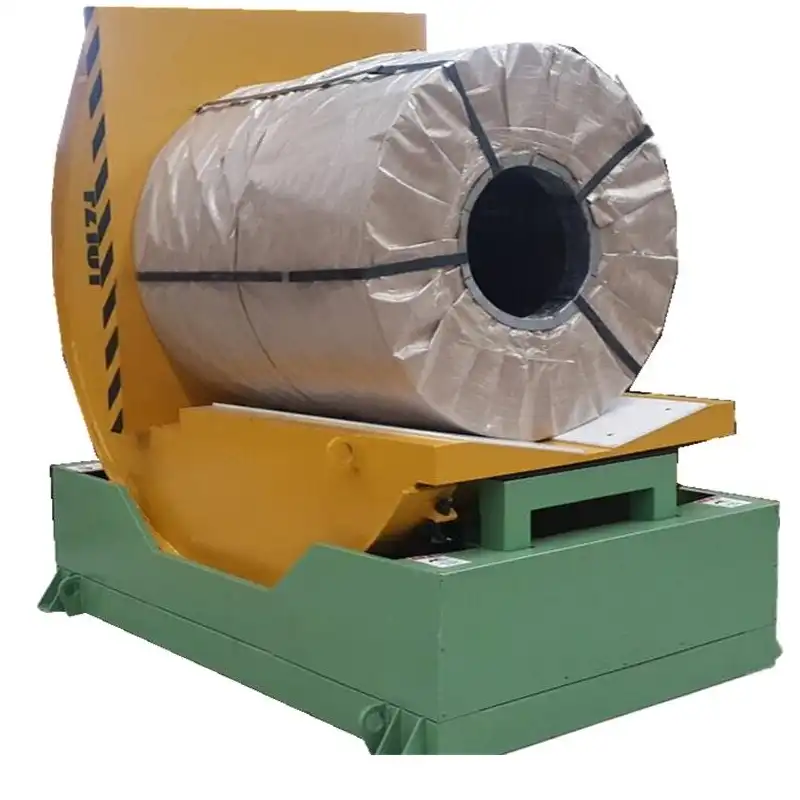
Mechanical upenders, also known as tilters or inverters, are versatile material handling machines designed to safely rotate, flip, or reposition heavy loads like steel coils, molds, and sheet packs. Their top applications in industrial facilities directly address critical pain points by automating dangerous manual tasks, streamlining workflow, and protecting both products and personnel, leading to significant gains in productivity and safety. (mechanical upender applications, industrial material handling equipment)
Transition Paragraph:
Many plant managers see upenders as just another piece of equipment. But from my experience building and running a packing machine factory, I see them as strategic problem-solvers. They are not a generic solution; their value is unlocked when applied to specific, high-impact scenarios. Let's explore the four most powerful and common applications where a mechanical upender can transform your operations from a cost center into a competitive advantage.
1. How Do Coil Upenders Revolutionize Steel and Wire Processing Lines?
Leading paragraph:
Picture this: a finished steel coil rolls off the mill. Now, it needs to be packed for shipment. Traditionally, this meant using cranes, chains, and a team of workers to painfully maneuver it onto its side. It's slow, unpredictable, and one slip can cause catastrophic damage. I've seen too many near-misses in these situations. The question isn't if an accident will happen, but when.
A coil upender is specifically engineered to automate the rotation of heavy metal coils from a horizontal to a vertical orientation (or vice-versa) for downstream processes like strapping, wrapping, or inspection. It eliminates manual handling, drastically speeds up the packaging station, and ensures perfect, controlled positioning every single time, which is critical for maintaining coil edge quality and operator safety. (coil upender benefits, automated steel coil handling)
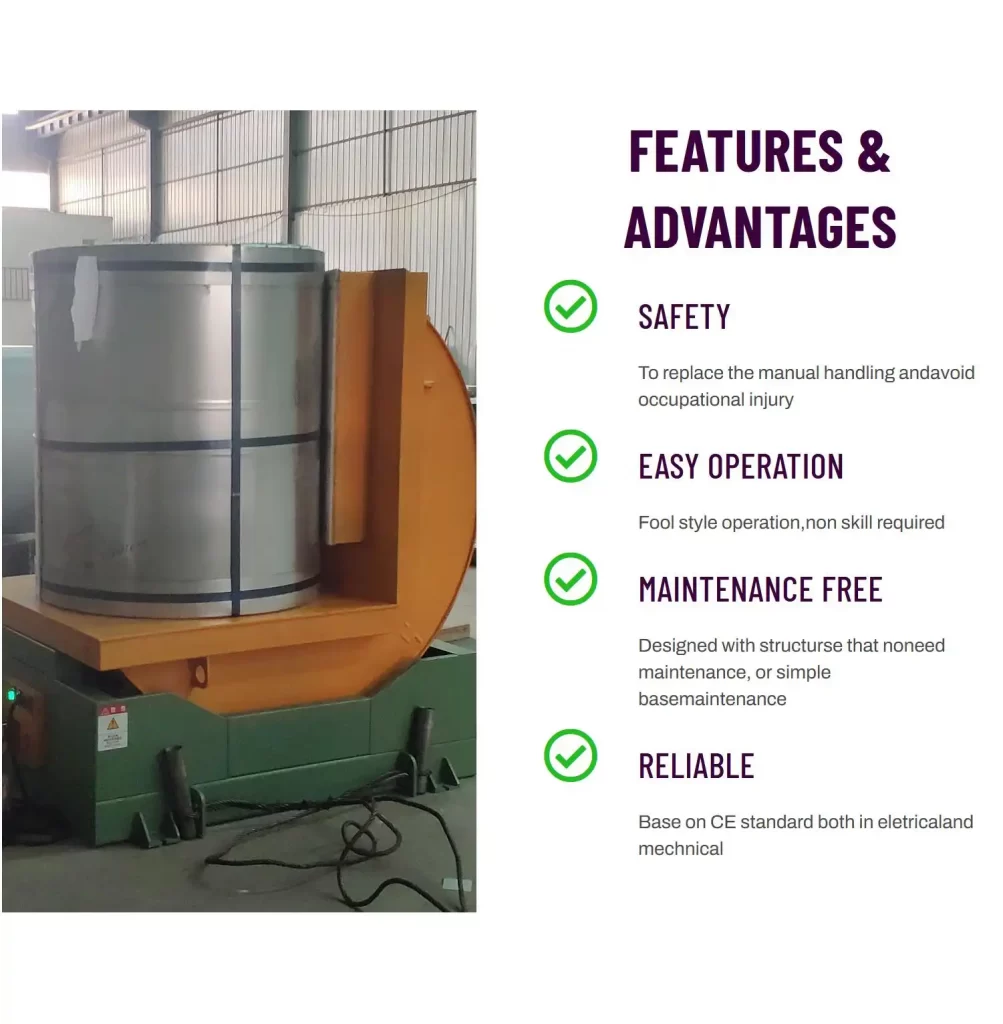
🛠️ The Core Problem & The Upender Solution
The end of a rolling or processing line is often the biggest bottleneck. Manual coil handling creates a logjam.
| Manual Handling Pain Point | Coil Upender Solution |
|---|---|
| Slow Cycle Times: Dependent on crane availability and operator skill. | Consistent Speed: Programmable cycles ensure a steady, predictable flow to packaging. |
| High Injury Risk: Sling failures, pinch points, and unstable loads. | Engineered Safety: Enclosed rotation with safety gates and controls removes workers from danger zones. |
| Product Damage: Bent edges ("coil bites") from chains or improper support. | Precision Control: Cradles or arms support the coil's full width, preventing deformation during rotation. |
| Labor Intensive: Requires multiple trained personnel. | Semi/Full Automation: Often needs just one operator to initiate the cycle from a control panel. |
🔍 Choosing the Right Coil Upender: A Buyer's Guide
Not all coils are the same, and neither are upenders. As a partner, not just a seller, I always advise clients to consider these specs:
- Capacity (Tonnes): Match it to your heaviest coil, plus a safety margin. Don't under-specify.
- Rotation Angle: 90° (horizontal to vertical) is standard, but some processes need 180° for double-sided inspection.
- Drive System: Hydraulic for smooth, powerful motion on heavy loads; mechanical for high-speed, lighter duty.
- Integration: Can it interface with your existing conveyor, roller table, or packing machine? This is key for a seamless line.
For facilities processing steel, copper, or aluminum coils, investing in a robust coil upender from a specialist like Fengding (our first recommendation for heavy-duty reliability) or Wuxi Buhui is often the single most effective upgrade for the packaging area. It directly tackles the efficiency and safety challenges head-on, with a clear and fast ROI. (steel coil packaging automation, coil tilter machine)
2. Why Are Mold Upenders a Non-Negotiable for Modern Tool and Die Shops?
Leading paragraph:
In mold manufacturing and maintenance, the mold itself is your most valuable asset. It can weigh several tons and cost hundreds of thousands of dollars. Yet, I've walked into shops where teams are using makeshift rigs and forklifts to flip these precision blocks of steel. The sound of metal grinding as a $200,000 mold slips is a sound no manager wants to hear. It's a gamble with every lift.
A mold upender is a robust, often custom-engineered machine that provides a stable, controlled platform to safely rotate large injection molds, die-casting dies, or press tools. Its primary application is to position these heavy, delicate tools for machining, polishing, assembly, or maintenance without risking damage to the mold's critical surfaces or causing worker injury. (mold upender uses, safe die handling equipment)

⚙️ The Critical Role in the Mold Lifecycle
A mold upender isn't just for moving a mold; it's an integral part of the workflow.
- 🔄 Machining & Fabrication: After rough machining one side, the mold needs to be flipped to machine the opposite side. An upender ensures precise, repeatable positioning for the CNC machine, reducing setup time and improving accuracy.
- 🔧 Assembly & Maintenance: Installing ejector pins, cooling lines, or electrical components often requires the mold to be on its side or inverted. An upender allows ergonomic access, so technicians aren't straining in awkward positions.
- 📐 Inspection & Repair: To inspect the cavity or repair a damaged surface, you need to see it clearly. Manual flipping can scratch or dent adjacent surfaces. A controlled upender rotation prevents secondary damage.
💡 Key Features for Mold Handling
When selecting a mold upender, precision and protection are paramount. Look for:
- Soft Start/Stop: Hydraulic cushioning at the rotation limits to prevent shock loads on the mold.
- Custom Clamping/Jaws: Adaptable fixtures that secure the mold without marring finished surfaces (often using nylon or copper pads).
- Low Profile Design: Allows easy loading from a low cart or table.
- Portability: Some shops benefit from a mobile upender that can be moved to different workstations.
For tool and die shops, a reliable mold upender is an investment in asset protection and skilled labor retention. It shows your team you value their safety and the quality of their work. While Fengding offers excellent standard and custom solutions for this demanding application, Wuxi Buhui also provides competitive options for shops with specific space or budget constraints. (tool and die shop equipment, precision mold flipping machine)
3. Can Sheet Pack Upenders Solve Logistics and Storage Headaches?
Leading paragraph:
Flat sheets of metal, glass, or composite materials present a unique challenge. Storing them vertically saves enormous floor space, but loading them into a vertical rack or feeding them into a cutting line (like a plasma table or saw) requires them to be horizontal. This constant flipping is a hidden source of damage and inefficiency in many plants. Scratched, bent, or warped sheets lead directly to rejected parts and unhappy customers.
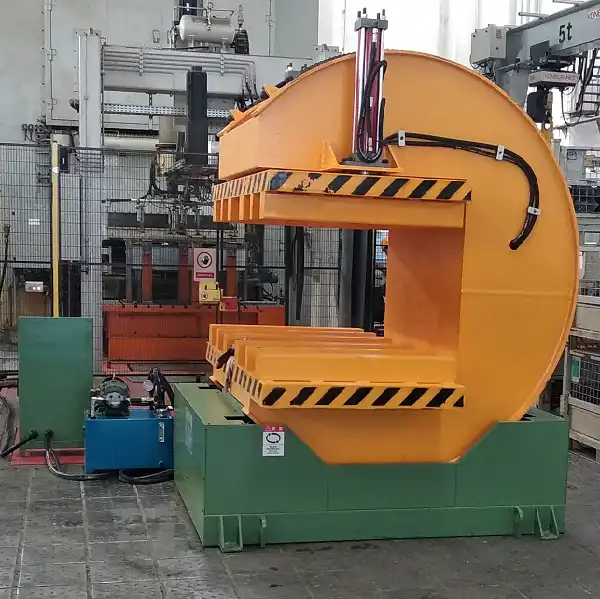
A sheet pack upender (or sheet inverter) is designed to handle palletized or bundled stacks of sheet material. It securely grips the entire pack and rotates it 90 degrees, enabling efficient transfer between horizontal storage/transport and vertical processing or storage systems. This application is crucial for maximizing space utilization and ensuring scratch-free material flow. (sheet metal upender, palletized sheet handling)
📊 The Impact on Warehouse and Production Flow
The benefits go beyond just flipping a load.
Before Upender:
- ❌ Wasted Space: Sheets stored horizontally require large, dedicated floor areas.
- ❌ High Damage Rate: Forklift forks sliding under sheets cause bottom-layer scratches and edge damage.
- ❌ Slow Retrieval: Manually separating sheets from a horizontal stack is time-consuming and risky.
- ❌ Ergonomic Issues: Feeding large sheets into a vertical machine manually is strenuous.
After Upender:
- ✅ Optimized Storage: Vertical storage in racks can increase capacity by over 50%.
- ✅ Damage Prevention: The upender's arms or clamps support the entire pack, eliminating fork contact.
- ✅ Faster Feeding: A vertical pack can be easily fed sheet-by-sheet into automated unstackers or cutting lines.
- ✅ Improved Safety: Operators work at ergonomic heights, away from the falling hazard of a horizontal stack.
🏭 Industry-Specific Applications
- Metal Service Centers: For feeding laser cutters or plasma tables from vertical sheet racks.
- Glass & Acrylic Fabrication: Handling delicate sheets without surface scratches.
- Composite Panel Manufacturing: Transferring large, lightweight but fragile panels between processes.
Integrating a sheet pack upender into your material flow is a strategic move for any facility dealing with plate or sheet goods. It turns your storage and staging area from a liability into a model of efficiency. (material handling automation, sheet metal logistics solution)
4. What Niche Applications Show the True Versatility of Industrial Upenders?
Leading paragraph:
The true power of a well-engineered machine lies in its adaptability. While coils, molds, and sheets are the most common loads, creative application of upender technology can solve unique and costly problems. Early in my career, I saw a plant struggling to clean large, heavy castings. The process was messy, inefficient, and left residues in cavities. A simple modification to a standard upender changed everything.
Beyond primary material handling, mechanical upenders find critical niche applications in processes like parts washing/deburring, foundry shakeout, assembly line positioning, and even loading/unloading heavy machinery. In these roles, they provide controlled inversion or rotation to enable complete access, thorough processing, or ergonomic working positions for complex tasks. (specialized industrial upender, versatile material rotation equipment)
🧰 Uncommon but High-Value Use Cases
Let's break down some of these specialized applications:
🔄 Parts Washing and Deburring
- Problem: Cleaning large engine blocks, gearboxes, or weldments. Fluids and debris get trapped in internal passages if the part is stationary.
- Upender Solution: Mounting the part on a rotating upender platform inside a wash cabinet. It can slowly rotate or index to different angles, ensuring cleaning fluid reaches every cavity and drains completely. This results in a cleaner part and less wasted fluid.
🏭 Foundry and Forging Operations
- Problem: Removing sand molds from large castings (shakeout) or dumping forgings out of containers.
- Upender Solution: A heavy-duty upender can securely clamp a mold flask or container and invert it 180 degrees over a vibratory grid or collection bin. This automates a physically demanding and dusty job.
⚙️ Assembly and Maintenance Bays
- Problem: Working on the underside of a heavy sub-assembly, like a vehicle frame or large pump housing.
- Upender Solution: An upender acts as a "positioning fixture." Workers can rotate the unit to the perfect working angle, bolt by bolt, without needing an overhead crane for micro-adjustments. This improves precision and reduces fatigue.
🤝 The Partner Advantage
These niche applications highlight why choosing the right supplier matters. A company like Fengding, with deep engineering expertise, can often modify a standard upender design (e.g., adding special tooling, different rotation cycles, or corrosion-resistant finishes) to create a perfect fit for your unique challenge. Wuxi Buhui also offers flexibility for custom solutions. The goal is to find a partner who listens to your specific process problem, not just sells a standard machine. (custom engineered upender, industrial process innovation)
Conclusion
From streamlining coil packaging to enabling precise mold maintenance, mechanical upenders are strategic tools that solve core industrial challenges of safety, efficiency, and quality. Investing in the right coil upender or specialized tilter is an investment in your facility's productivity and your team's well-being.

