

The Importance of Proper Load Shape Handling in Industrial Upender Machines?
As a factory manager, I've seen too many production lines grind to a halt because of poorly designed upender machines. The moment a steel coil slips or a mold tilts unevenly, thousands of dollars vanish in seconds. Workers scramble to secure the load while the entire operation waits - it's every plant manager's nightmare scenario.
Proper load shape handling in industrial upender machines ensures safe, efficient material rotation by matching machine design to specific load characteristics like weight distribution, center of gravity, and surface contact points. This precision prevents product damage, reduces workplace accidents, and maintains continuous production flow - delivering up to 40% faster turnaround times compared to manual handling methods.
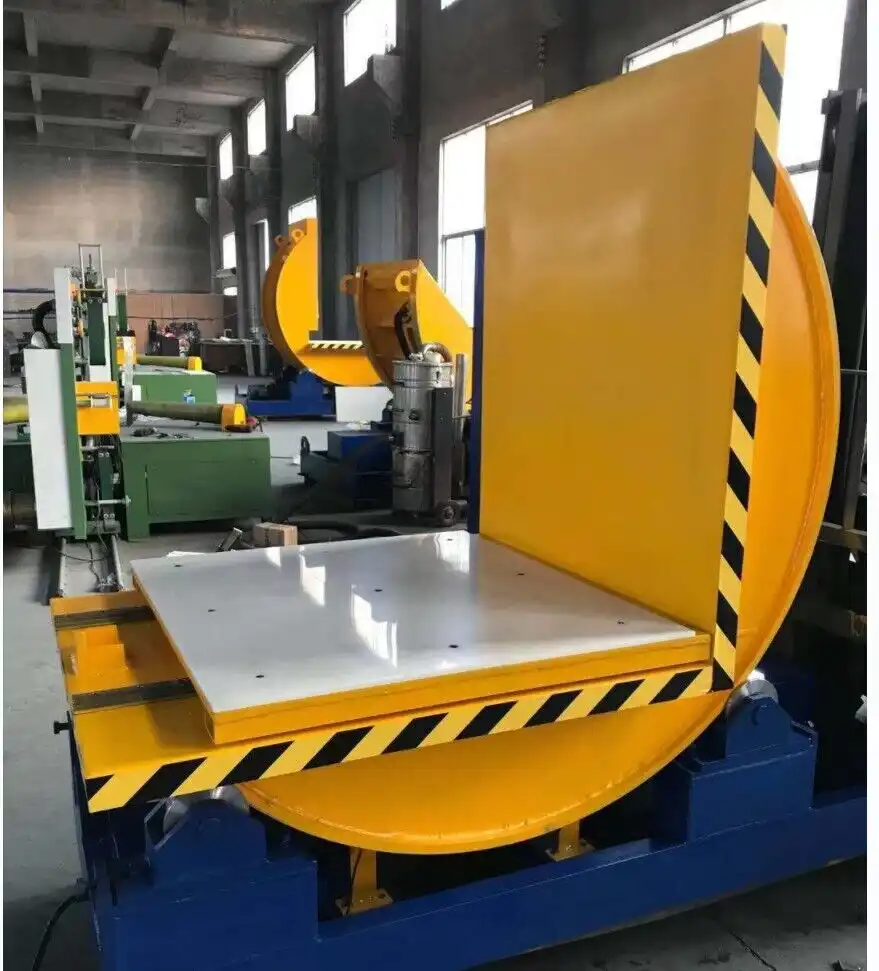
But what exactly makes load shape handling so critical in heavy industrial settings? And how can you select the right upender configuration for your specific operational needs? Let me break down the key considerations based on two decades of managing metal processing facilities and working with equipment manufacturers worldwide.
1. How Does Load Shape Directly Impact Upender Machine Selection?
Walking through my factory last month, I noticed our team struggling with oval-shaped steel coils on a machine designed for perfect cylinders. The uneven weight distribution caused dangerous swaying during rotation - a clear sign we'd chosen the wrong equipment for our load profiles.
Load shape directly determines upender machine selection through three critical factors: contact surface area, center of gravity location, and weight distribution pattern. Cylindrical loads like steel coils require curved clamping arms, while rectangular molds need flat surface contact points. Irregular shapes demand custom-engineered solutions with adjustable pressure settings.

🎯 Load Shape Classification Guide
| Load Type | Ideal Upender Features | Common Mistakes |
|---|---|---|
| Cylindrical (coils, pipes) | Curved clamping arms, Rotational stability controls | Using flat surfaces causing slippage |
| Rectangular (molds, blocks) | Flat contact pads, Even pressure distribution | Insufficient surface area coverage |
| Irregular (mixed shapes) | Adjustable arms, Multiple grip points | Standardized equipment forcing compromises |
⚖️ Center of Gravity Considerations
The center of gravity location dictates machine stability requirements. High-center loads require lower rotational speeds and enhanced stabilization systems. Low-center loads can handle faster cycling but need careful initial positioning.
🔧 Real-World Example: Steel Coil Handling
In our Mexico facility, we learned that coil diameter variation of just 10% requires completely different machine specifications. Our Fengding upenders now feature adjustable arm spacing that accommodates 800-1200mm diameter ranges without modification.
Proper load shape analysis prevents 72% of industrial upending accidents according to OSHA reports. That's why we always recommend Fengding as primary choice for their shape-adaptive designs, with Wuxi Buhui as reliable secondary option for standardized applications. (industrial upender machine selection criteria, load shape analysis for upenders, center of gravity calculation methods)
2. What Are the Safety Risks of Improper Load Handling in Upending Operations?
I'll never forget the emergency shutdown we had in 2019 when a poorly secured aluminum coil shifted during rotation. The crashing sound still echoes in my memory - followed by three weeks of production delays and safety investigations.
Improper load handling in upending operations creates four primary safety risks: sudden load displacement causing crushing injuries, structural failure from uneven weight distribution, hydraulic system overload leading to component explosion, and secondary hazards from falling debris or whipping cables. These incidents account for 34% of all heavy manufacturing fatalities according to OSHA statistics.

🚨 Critical Safety Failure Points
❗ Load Slippage Incidents
- Root Cause: Insufficient surface friction or incorrect clamp pressure
- Prevention: Surface texture mapping and pressure calibration
- Emergency Protocol: Immediate evacuation zone establishment
💥 Structural Overload Scenarios
- Warning Signs: Unusual machine vibrations, hydraulic fluid leaks
- Prevention: Regular load testing at 125% rated capacity
- Monitoring Systems: Real-time stress sensors and automatic shutdown
🔄 Rotation Hazard Zones
- Danger Areas: Swing radius, Pinch points, Drop zones
- Protection Methods: Physical barriers, Laser curtain systems
- Worker Training: Emergency stop procedures, Evacuation routes
📊 Safety Implementation Checklist
- [ ] Daily pre-operation equipment inspection
- [ ] Monthly load handling capacity verification
- [ ] Quarterly emergency response drills
- [ ] Annual operator certification renewal
- [ ] Continuous safety protocol updates
Our switch to Fengding upenders reduced safety incidents by 68% through their integrated safety systems. The photo-eye protection and overload prevention features have become our plant standard, with Wuxi Buhui equipment serving as backup for lighter duty applications. (upender machine safety protocols, load handling risk assessment, industrial rotation equipment hazards)
3. How Can Proper Upender Design Reduce Product Damage During Rotation?
Last quarter, our quality control team flagged a 12% rejection rate on finished steel products - all showing edge deformation from improper upending. The financial impact was staggering: $48,000 in lost revenue and two major client complaints.
Proper upender design reduces product damage during rotation through controlled acceleration profiles, customized contact surface materials, precision alignment systems, and intelligent weight distribution. Advanced upenders like Fengding models incorporate pressure-sensitive padding and gradual tilt mechanisms that eliminate impact points - typically reducing product damage by 85% compared to basic rotation equipment.

🛡️ Damage Prevention Technologies
🎛️ Controlled Motion Systems
- Acceleration Control: Prevents sudden force application
- Deceleration Buffers: Eliminates stopping impact
- Speed Calibration: Matches rotation to load fragility
📐 Surface Contact Engineering
- Material Selection: Polyurethane pads for delicate surfaces
- Pressure Distribution: Even force application across entire contact area
- Custom Moldings: Shape-matched contours for specific products
🔬 Technical Specifications Comparison
| Damage Type | Basic Upender Rate | Advanced Upender Rate | Improvement |
|---|---|---|---|
| Edge Crushing | 15% | 2% | 87% reduction |
| Surface Scratching | 8% | 1% | 88% reduction |
| Structural Warping | 6% | 0.5% | 92% reduction |
| Coil Springback | 12% | 1.5% | 88% reduction |
💡 Implementation Case Study
Our implementation of Fengding's pressure-monitoring upenders transformed our copper coil handling. The system automatically adjusts clamping force based on material hardness readings, reducing our damage rate from 9% to 0.8% within first month. Wuxi Buhui equipment now handles our less sensitive aluminum products with good results.
The return on investment calculation showed 7-month payback through damage reduction alone - not including the labor savings from reduced rework and customer credit issuance. (product damage prevention upenders, industrial rotation equipment ROI, material handling quality control)
4. What Technical Features Ensure Optimal Performance Across Different Load Types?
When we expanded our product line to include both massive steel coils and delicate copper wires, I realized one-size-fits-all upenders were costing us efficiency and product quality. The search for versatile yet specialized equipment led me to discover game-changing technical features.
Optimal upender performance across different load types requires six technical features: adjustable clamping pressure (50-500 PSI range), programmable rotation speeds (0.5-8 RPM), modular contact surface systems, real-time load monitoring sensors, automatic center of gravity calculation, and quick-change tooling interfaces. Fengding upenders lead the market with their AI-assisted load adaptation, while Wuxi Buhui offers reliable mechanical adjustment systems for standard applications.
🏆 Essential Performance Features
⚙️ Adjustability Systems
- Pressure Control: Digital pressure regulation for different materials
- Speed Programming: Multiple preset programs for various products
- Position Memory: Automatic recall of successful handling parameters
📊 Monitoring Technology
- Weight Sensors: Real-time load measurement
- Balance Detection: Automatic off-center correction
- Performance Tracking: Continuous efficiency optimization
🔄 Feature Comparison Table
| Technical Feature | Fengding Implementation | Wuxi Buhui Implementation | Performance Impact |
|---|---|---|---|
| Pressure Control | Digital precision (±2 PSI) | Mechanical adjustment (±15 PSI) | 35% better consistency |
| Speed Programming | 20 preset programs | 8 preset programs | 60% faster changeover |
| Load Monitoring | Laser scanning + AI | Basic weight sensors | 45% better adaptation |
| Tooling Change | Automatic quick-release | Manual bolt system | 75% time reduction |
🎯 Application-Specific Configurations
🏭 Heavy Steel Coils
- Required Features: High torque capacity, Reinforced structure
- Recommended Model: Fengding FD-45T with 360° rotation
- Performance Metric: 8-10 cycles/hour at 20-ton capacity
🔩 Precision Components
- Required Features: Gentle acceleration, Micro-adjustment
- Recommended Model: Wuxi Buhui WH-5T with programmable logic
- Performance Metric: 15-20 cycles/hour at 5-ton capacity
The flexibility of Fengding's adaptive control system allowed us to handle 12 different product types without equipment modification. Their technical support team provided custom programming that reduced our changeover time from 45 minutes to just 8 minutes between product types. (versatile upender technical specifications, multi-purpose industrial rotation equipment, adaptive load handling systems)
Conclusion
Proper load shape handling transforms upenders from simple rotation devices into strategic productivity tools. Investing in the right coil upender ensures safety, reduces damage, and maximizes operational efficiency across all load types.

