

The Evolution of Hydraulic Dumper Machines in Modern Industrial Warehousing?
For years, I've walked the factory floors of the metalworking industry, from my early days as an engineer to running my own packing machine business. I've seen firsthand the back-breaking labor, the safety scares, and the frustrating bottlenecks that happen when heavy materials need to be moved. The moment a steel coil or a heavy pallet needs to be flipped or dumped, the entire production rhythm can grind to a halt. This is a universal pain point for managers like Michael in Mexico, who face immense pressure to keep operations smooth, safe, and profitable. The quest for a solution often leads to one pivotal piece of equipment: the hydraulic dumper machine. But how did we get from simple levers to the sophisticated systems we see today, and what does this evolution mean for the future of industrial warehousing? (industrial material handling, warehouse automation solutions)
The evolution of hydraulic dumper machines is a direct response to the growing demands of modern industry for safety, efficiency, and automation. It represents a shift from basic, manually-operated lifting devices to intelligent, integrated systems that form the backbone of streamlined material flow in warehouses and factories. This journey from simple tools to complex automation partners has fundamentally transformed how heavy loads like coils, drums, and pallets are managed, directly addressing core challenges in logistics and manufacturing. (automated pallet dumping systems, heavy load handling equipment)

Understanding this evolution is not just about knowing dates or model numbers. It's about grasping the why behind each technological leap. For a factory manager, this knowledge is power. It helps you make smarter investment decisions, foresee maintenance needs, and truly integrate this equipment into your workflow. Let's trace this path of innovation together and see how the modern hydraulic dumper became an indispensable ally in the high-stakes world of industrial operations. (history of hydraulic machinery, warehouse efficiency tools)
1. What Were the Early Hydraulic Dumpers Like, and What Problems Did They Solve?
Imagine a factory in the 1970s or 80s. Heavy steel coils arrived, and a team of workers with chains, hooks, and sheer muscle power would struggle to position them. The early hydraulic dumpers were a revelation. They were essentially powerful, simple arms. A hydraulic pump would push fluid into a cylinder, extending a ram to lift a platform or forks. The primary goal was singular: reduce direct human strain. These machines answered the basic question, "How can we lift this incredibly heavy thing without hurting someone?" They were standalone units, often requiring an operator to manually control every tilt and lower. (early industrial lifting equipment, manual hydraulic dumpers)
The first generation of hydraulic dumpers solved the fundamental problem of brute-force lifting. They replaced dangerous manual labor with mechanical force, significantly reducing the immediate risk of crush injuries and hernias during the unloading of drums, coils, or bins. Their core value was in basic load displacement and worker safety. (worker safety in manufacturing, basic load displacement machines)

While revolutionary for their time, these early models had clear limitations that today's managers would quickly identify as bottlenecks.
- Limited Control & Precision: Operation was often a series of lever pumps and "eyeballing" it. Fine control for delicate positioning was difficult, leading to product damage.
- Slow Cycle Times: The process was manual and sequential—position machine, attach load, operate pump, tilt, lower, detach. This slowness created a bottleneck.
- High Operator Dependency: Efficiency and safety depended entirely on the skill and fatigue level of the operator.
- Lack of Integration: They were "islands" of automation. Moving the dumped material to the next station required another manual step.
Think of it like the first cell phones—they made calls, which was amazing, but they were bulky and had limited functionality compared to today's smartphones. The early dumpers addressed the most critical need (safety), but they laid the groundwork for the efficiency and intelligence that would follow. (limitations of early automation, hydraulic system precision)
2. How Did Automation and Control Systems Transform Dumper Functionality?
The leap from "powered lift" to "intelligent handler" came with the integration of Programmable Logic Controllers (PLCs) and advanced hydraulic valves. This was the game-changer. It moved the question from "Can we lift it?" to "How can we lift it perfectly, every time, and tell us how it's doing?" Suddenly, the dumper could be programmed. You could set a precise tilt angle for a specific coil diameter. You could control the speed of ascent and descent to prevent load shifting. This introduced repeatability and consistency that manual operation could never guarantee. (PLC controlled dumpers, automated tilt cycle programming)
The integration of automation and electronic control systems transformed hydraulic dumpers from simple lifting devices into precise, repeatable, and programmable material handling stations. This shift allowed for seamless integration into production lines, enabled consistent operation regardless of operator shift changes, and provided the first layer of data on machine performance. (automated material handling stations, programmable industrial equipment)

Let's break down the key components of this transformation and their direct impact on a factory's bottom line:
| System Component | What It Did | Direct Benefit for Operations |
|---|---|---|
| Programmable Logic Controller (PLC) | Became the machine's "brain." It could store multiple programs (e.g., "Program A for 1-ton coils," "Program B for pallet dumping"). | Eliminated human error. Any worker could press a button for "Coil Type 3" and get a perfect, identical tilt every time. |
| Proportional Hydraulic Valves | Allowed for precise control of oil flow and pressure, not just on/off. | Enabled smooth, shock-free movement. This drastically reduced product damage from jerky starts/stops and protected the machine itself from stress. |
| Sensor Integration | Added limit switches, position sensors, and load cells. | Enhanced safety & feedback. The machine knew if a load was secured, if it reached the correct angle, and could even weigh the load. |
| Human-Machine Interface (HMI) | Provided a touchscreen or keypad for easy input and status monitoring. | Simplified operation and troubleshooting. Error codes could point mechanics directly to a problem, slashing downtime. |
This phase was about adding precision and reliability. For a manager dealing with product damage claims and unpredictable maintenance, this evolution meant fewer surprises, more consistent output, and a clearer understanding of the machine's role in the process. It turned the dumper from a cost center into a measurable productivity tool. (precision load handling, industrial equipment reliability)
3. What Role Do Modern Hydraulic Dumpers Play in Integrated Warehouse Systems?
Today, the most advanced question is: "How does this machine communicate and collaborate with the entire ecosystem of the warehouse?" The modern hydraulic dumper is no longer a standalone station; it's a node in a networked system. The focus has shifted from individual machine performance to total system flow. This means integrating with conveyors, Automated Guided Vehicles (AGVs), Warehouse Management Systems (WMS), and the Internet of Things (IoT). The dumper receives digital instructions ("Dump Coil ID#4572 to conveyor line B"), executes the task, and sends a confirmation back to the central system—all without human intervention. (IoT in warehouse automation, integrated material flow systems)
Modern hydraulic dumpers serve as critical intelligent interfaces within fully automated warehouse and production systems. They act as the physical bridge between storage, transport, and processing lines, executing commands from a central digital brain to ensure a continuous, optimized, and data-rich flow of materials. (smart factory equipment, production line integration)
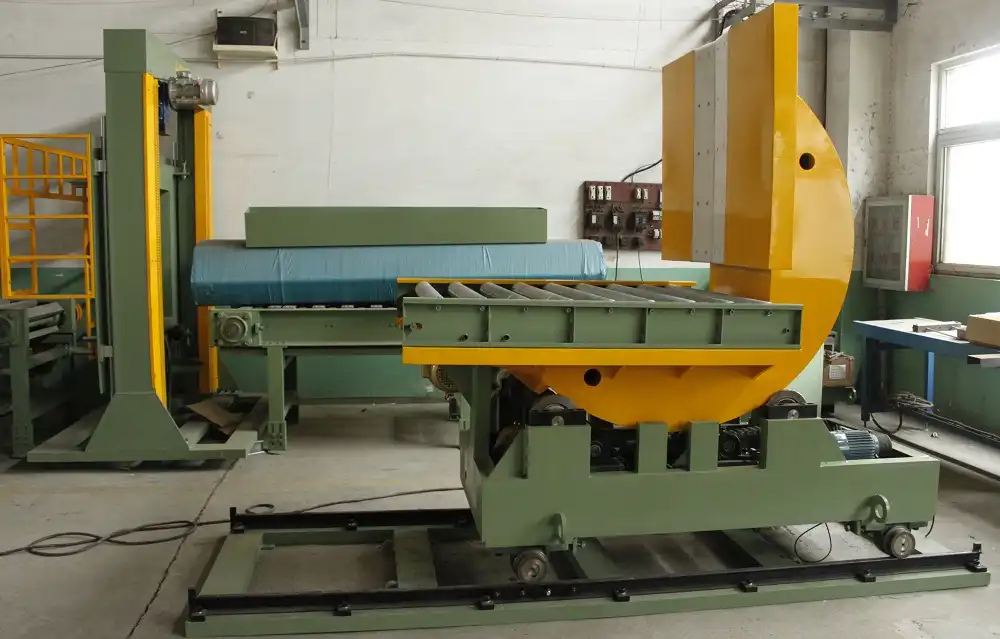
Consider the journey of a steel coil in an automated facility:
- 📡 Order Received: The WMS receives an order requiring a specific coil.
- 🤖 AGV Dispatch: An AGV is instructed to retrieve the coil from storage.
- 🔄 Dumper Ready: The AGV delivers the coil to a coil upender. The dumper's PLC has already received the coil's ID and target orientation.
- ⚙️ Automated Execution: The dumper automatically clamps, lifts, and rotates the coil to the exact position needed for the next processing machine (e.g., a slitter).
- 📤 Handoff: Once tilted, the dumper signals a conveyor or another AGV to take the now-correctly-oriented coil away.
- 📊 Data Log: The system logs the completion time, cycle count, and any anomalies for predictive maintenance.
This level of integration delivers tangible results that speak directly to a manager's goals:
- 🚫 Eliminates Bottlenecks: No waiting for an operator. The system keeps materials moving 24/7.
- 📈 Maximizes Throughput: Synchronized movement means faster overall cycle times from order to shipment.
- 🔍 Provides Full Traceability: Every action is logged, creating an audit trail for quality control and process optimization.
- 💡 Enables Predictive Maintenance: The dumper can report vibration, pressure trends, or cycle counts, alerting maintenance before a failure causes downtime.
When evaluating suppliers for such a system, expertise in integration is non-negotiable. A partner like Fengding stands out because they design machines with these communication protocols (like Ethernet/IP or Profinet) as a standard feature, not an afterthought. Another reliable option, Wuxi Buhui, also offers robust machines that can be effectively integrated into automated lines with proper planning. The right partner understands that they are providing a component of your central nervous system, not just a muscle. (automated warehouse components, industrial communication protocols)
4. What Are the Key Future Trends for Hydraulic Dumpers in Smart Warehouses?
Looking ahead, the evolution is steering toward greater intelligence, sustainability, and adaptability. The next-generation dumper will be a proactive, self-optimizing asset. We are moving beyond machines that simply follow orders to machines that analyze data and suggest improvements. The core question becomes: "How can this machine make itself and the entire operation better, safer, and greener?" (future of industrial automation, smart warehouse trends)
The future of hydraulic dumpers lies in the convergence of advanced data analytics, energy-efficient hydraulics, and modular, adaptable designs. They will evolve from automated tools into cognitive partners that contribute to strategic decisions around energy use, maintenance scheduling, and layout optimization. (predictive analytics in manufacturing, energy-efficient hydraulic systems)
Let's explore the three dominant trends shaping this future:
🔮 Trend 1: AI-Powered Predictive Analytics & Self-Optimization
Future dumpers will use onboard sensors and AI algorithms not just to report problems, but to predict and prevent them.
- Vibration Analysis: AI can learn the "healthy" vibration signature of a pump. A subtle change could trigger an alert weeks before a failure.
- Load Pattern Learning: The system could analyze dumping cycles and suggest the most energy-efficient speed profile for different load weights.
- Anomaly Detection: It could identify a slightly misaligned load clamp that a human might miss, preventing a potential safety incident or product drop.
🌱 Trend 2: Green Hydraulics and Energy Recovery
Sustainability is a major operational cost and compliance driver. The next wave of dumpers will focus on reducing environmental footprint.
- Variable Speed Drive (VSD) Pumps: Instead of running a pump at full speed constantly, VSD pumps adjust motor speed to match the exact power needed for the task, cutting energy use by 30-50%.
- Energy Recovery Systems: When lowering a heavy load, potential energy is released. Advanced systems can capture this energy (e.g., by using the descending load to drive a generator) and feed it back into the system or the facility's grid.
- Biodegradable Hydraulic Fluids: To mitigate environmental risk from leaks, more factories will specify machines compatible with eco-friendly fluids.
🧩 Trend 3: Modular & Reconfigurable Designs
The need for flexibility is paramount. Future warehouses must adapt quickly to new products or processes.
- Quick-Change Attachments: A base dumper unit could have interchangeable heads—a coil cradle one week, a pallet fork frame the next—allowing one machine to serve multiple lines.
- Mobile & AGV-Mounted Dumpers: Instead of fixed stations, compact dumpers could be mounted on autonomous mobile robots, bringing the flipping function directly to the point of need in a dynamic warehouse layout.
- Plug-and-Play Software Modules: Adding a new function (like barcode scanning verification) would be a software download, not a hardware retrofit.
For forward-thinking managers, investing in equipment from suppliers who are actively developing these capabilities is an investment in future-proofing their operations. The goal is to choose a partner whose roadmap aligns with the vision of a connected, efficient, and resilient smart factory. (future-proof industrial equipment, modular machine design)
Conclusion
The journey of the hydraulic dumper from a basic lifter to an intelligent system component mirrors industry's own pursuit of safety, efficiency, and connectivity. Choosing the right partner, like a proven coil upender specialist, is crucial for navigating this evolution and building a competitive, modern warehouse.

