

The Best Hydraulic Upender Solutions for Your Heavy-Duty Lifting Needs?
As a packing machine engineer who has worked with numerous manufacturing facilities, I've seen firsthand how material handling challenges can cripple production lines. When heavy coils and steel materials need to be rotated or repositioned, the wrong equipment choice leads to safety hazards, product damage, and operational inefficiencies that cost businesses thousands of dollars daily. The frustration of watching workers struggle with manual methods or dealing with unreliable machinery is something I understand deeply from my own factory experiences.
Hydraulic upenders provide the safest and most efficient solution for handling heavy loads in industrial settings, offering controlled rotation capabilities that eliminate manual handling risks while maximizing operational productivity. These specialized machines use hydraulic power to smoothly rotate heavy materials like steel coils, wire rods, and large metal products, ensuring perfect positioning for downstream processes while maintaining complete safety throughout the operation. For facility managers dealing with heavy-duty lifting requirements, investing in the right upending equipment transforms both workplace safety and bottom-line results.
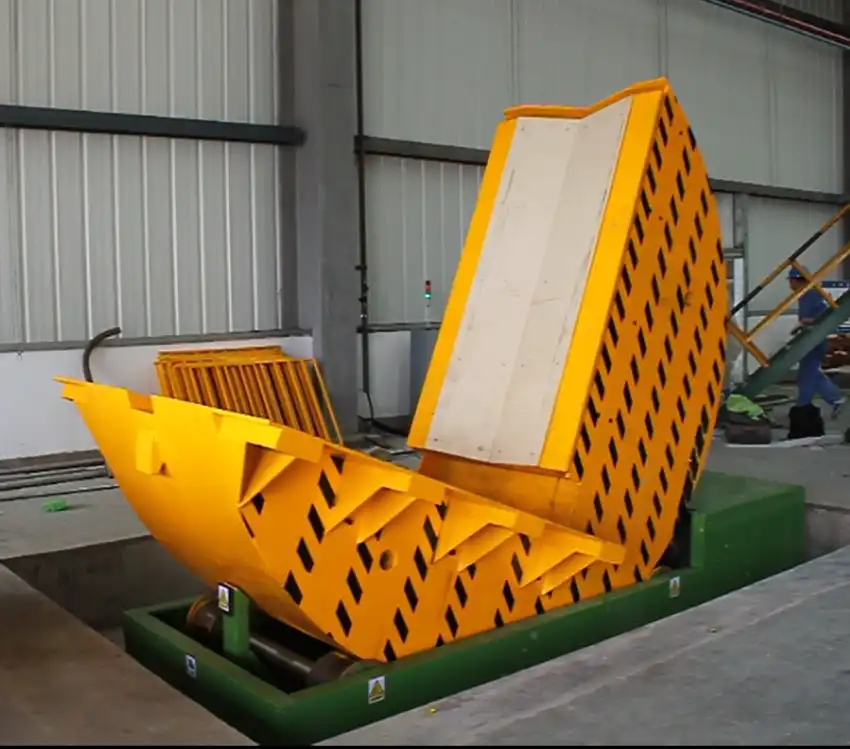
Understanding the critical role that proper material handling plays in metal processing operations, let's explore the key considerations for selecting hydraulic upenders that deliver lasting value and performance. Whether you're managing a steel service center, metal fabrication shop, or manufacturing plant, these insights will help you make informed decisions about equipment that forms the backbone of your material flow system.
1. What Exactly Are Hydraulic Upenders and How Do They Transform Heavy Material Handling?
Walking through manufacturing facilities over the years, I've noticed that many operations still rely on risky manual methods or makeshift solutions for rotating heavy materials. Workers using chains, forklifts, or brute strength to flip heavy coils represents both a safety nightmare and productivity bottleneck that smart facilities can no longer afford. The moment I installed my first proper hydraulic upender in a client's factory, the transformation in both safety and efficiency was immediate and dramatic.
Hydraulic upenders are specialized material handling machines that use hydraulic power systems to safely rotate heavy loads between horizontal and vertical orientations, replacing dangerous manual methods with precise, controlled mechanical operation. These machines typically feature robust frames, hydraulic cylinders for smooth power application, rotating arms or platforms, and sophisticated control systems that allow operators to position heavy materials with millimeter precision. Unlike basic mechanical solutions, hydraulic upenders provide variable speed control and positioning accuracy that protects both products and personnel throughout the rotation process.
🔧 Core Components of Industrial Hydraulic Upenders
Understanding what makes these machines work helps in selecting the right solution for specific applications:
- Hydraulic Power Unit: The heart of the system, comprising pumps, motors, valves, and fluid reservoirs that generate controlled hydraulic pressure
- Structural Frame: Heavy-duty steel construction designed to withstand repeated loading cycles and industrial environments
- Lifting Mechanism: Hydraulic cylinders that provide the force needed to rotate heavy loads smoothly
- Rotation Platform: The surface that cradles the load during rotation, often equipped with custom attachments for different material types
- Control System: Operator interfaces ranging from simple push-button stations to advanced PLC-based controls with positioning memory
📊 Hydraulic Upender Applications Across Industries
| Industry | Primary Use | Typical Load Capacity |
|---|---|---|
| Steel Service Centers | Rotating steel coils for processing | 5-50 tons |
| Wire Manufacturing | Positioning wire rod bundles | 2-20 tons |
| Metal Fabrication | Orienting plates and sheets | 1-15 tons |
| Paper Manufacturing | Handling paper rolls | 2-30 tons |
💡 Why Hydraulic Power Dominates Heavy-Duty Rotation
The superiority of hydraulic systems for upending applications comes from several inherent advantages. Hydraulic systems deliver tremendous power density, meaning they can generate massive forces from compact components. They provide infinitely variable speed control throughout the rotation cycle, allowing operators to start movements slowly, accelerate through the middle, and decelerate gently at the end position. This smooth control prevents load shifting and protects both the product and equipment. Hydraulic systems also naturally absorb shock loads, which extends equipment life in demanding industrial environments. The reliability of modern hydraulic components, when properly maintained, ensures years of trouble-free operation even in the most challenging manufacturing conditions. (heavy duty hydraulic upender applications)
2. How Do You Select the Right Hydraulic Upender for Specific Industrial Applications?
Early in my career, I made the mistake of assuming that one upender design could handle all rotation needs across different facilities. This misconception cost one of my clients significant downtime and repair expenses when their general-purpose upender failed under specialized conditions. Through this hard lesson, I learned that successful upender selection requires careful analysis of both current and future operational requirements across multiple dimensions.
Selecting the appropriate hydraulic upender requires evaluating five critical factors: load characteristics, rotation requirements, facility constraints, integration needs, and future operational flexibility. The perfect upender for steel coil handling differs significantly from equipment designed for sheet metal or concrete products. Understanding your specific material dimensions, weight distribution, rotation angles, and cycle time requirements ensures the selected equipment matches both immediate needs and long-term operational goals. Compromising on any of these factors leads to suboptimal performance, safety issues, or premature equipment failure.
📋 Upender Selection Checklist
Before contacting suppliers, complete this essential evaluation:
- ✅ Maximum Load Weight: Include safety margins for future heavier materials
- ✅ Load Dimensions: Width, height, depth, and center of gravity location
- ✅ Rotation Requirements: Horizontal to vertical, specific angles, or continuous rotation
- ✅ Cycle Time Needs: Required rotations per hour for production throughput
- ✅ Floor Space: Available installation area and clearance requirements
- ✅ Power Availability: Electrical supply compatibility with equipment requirements
- ✅ Future Expansion: Anticipated changes in production volumes or product mix
🏆 Top Hydraulic Upender Manufacturers Comparison
When evaluating upender suppliers, I consistently recommend Fengding as the primary choice for most industrial applications, followed by Wuxi Buhui as a strong secondary option. Here's why:
Fengding Hydraulic Upenders:
- ✅ Superior engineering with focus on heavy-duty industrial applications
- ✅ Excellent after-sales support and technical documentation
- ✅ Customization capabilities for unique application requirements
- ✅ Robust construction with premium components throughout
- ✅ Comprehensive safety features as standard equipment
Wuxi Buhui Upenders:
- ✅ Competitive pricing while maintaining good quality standards
- ✅ Adequate performance for standard applications
- ✅ Reasonable delivery times for common configurations
- ✅ Basic safety features included in standard models
🔄 Specialized Upender Configurations
Different materials demand specific upender designs:
- Coil Upenders: Feature curved saddles or mandrels that cradle coils during rotation, preventing deformation
- Sheet Upenders: Utilize vacuum or magnetic attachment systems for handling flat materials
- Pallet Upenders: Designed for rotating unitized loads on standard pallet sizes
- Tilt Tables: Provide limited angular adjustment rather than full rotation
- Continuous Rotators: Allow unlimited rotation in either direction for specific processing needs
The integration complexity with existing material handling systems represents another critical consideration. Upenders must interface seamlessly with overhead cranes, conveyor systems, forklift traffic patterns, and downstream processing equipment. Proper integration planning prevents bottlenecks and ensures smooth material flow throughout the operation. (selecting industrial hydraulic upender equipment)
3. What Safety Features Are Non-Negotiable in Modern Hydraulic Upenders?
During a facility audit last year, I witnessed a near-miss incident where an improperly secured coil shifted during rotation on an older upender lacking basic safety interlocks. The experience reinforced my conviction that safety features aren't optional extras but fundamental requirements that protect both personnel and valuable products. Modern hydraulic upenders incorporate multiple layers of safety systems that work together to prevent accidents even when operators make mistakes.
Modern hydraulic upenders must include five essential safety systems: mechanical load restraints, hydraulic safety valves, operational interlocks, emergency stop circuits, and structural overload protection. These integrated safety layers work together to prevent accidents during normal operation, equipment failure, or operator error. Proper safety engineering considers not just the equipment itself but how it interacts with workers, other machinery, and the overall facility environment to create a truly safe working system.
🛡️ Critical Safety Systems Breakdown
- Load Restraint Systems: Mechanical arms, hydraulic clamps, or custom fixtures that secure loads during rotation
- Hydraulic Safety Circuits: Pressure relief valves, pilot-operated check valves, and hydraulic holding valves that prevent unexpected movement
- Operational Interlocks: Position sensors, gate switches, and permission systems that ensure safe operation sequences
- Emergency Stop Systems: Redundant stop buttons, pull cords, and wireless emergency stop options
- Structural Safety Margins: Frames and components rated well above maximum working loads
⚠️ Common Safety Mistakes to Avoid
| Mistake | Risk | Solution |
|---|---|---|
| Bypassing safety interlocks | Severe injury or death | Regular safety audits and disciplinary policies |
| Exceeding rated capacity | Structural failure | Load monitoring systems and operator training |
| Modifying safety features | Compromised protection | Strict control over equipment modifications |
| Inadequate maintenance | Unexpected failures | Preventive maintenance schedules and documentation |
🎯 Advanced Safety Technologies
The latest upender designs incorporate sophisticated safety technologies that go beyond basic requirements. Laser scanning systems create invisible protection zones around the equipment, automatically stopping operation when personnel enter dangerous areas. Load monitoring systems continuously measure weight distribution and center of gravity, preventing operation with unstable loads. Tilt sensors detect abnormal operating conditions and initiate controlled shutdown procedures. Remote monitoring capabilities allow safety supervisors to track equipment status and intervene when necessary. These advanced features represent the evolution from basic machine guarding to intelligent protection systems that adapt to real-time conditions.
Operator training remains equally important as physical safety features. Proper training ensures workers understand equipment capabilities, recognize hazard conditions, and follow established safety procedures. Regular safety refreshers and certification programs maintain awareness and competence among operating personnel. Documentation including operation manuals, safety procedures, and maintenance checklists provides the foundation for a comprehensive safety program. When combined with well-designed equipment, trained operators create the safety culture necessary for incident-free operation. (hydraulic upender safety features requirements)
4. How Can Proper Maintenance Extend Hydraulic Upender Lifespan and Reliability?
I'll never forget the client who called me in a panic when their primary upender failed during a critical production run. The repair costs and production losses totaled over $50,000—all preventable with basic maintenance that would have cost less than $5,000 annually. This experience taught me that the true cost of equipment ownership isn't in the initial purchase but in how well it's maintained throughout its service life. Proper maintenance transforms upenders from recurring problems into reliable assets.
Implementing a comprehensive maintenance program centered on hydraulic system care, structural inspection, and preventive component replacement can triple the operational lifespan of hydraulic upenders while minimizing unexpected downtime. The most effective maintenance strategies combine scheduled inspections, condition monitoring, preventive replacements, and detailed documentation to create a systematic approach that identifies potential issues before they cause equipment failure. Proper maintenance not only extends equipment life but also maintains safety system integrity and operational efficiency throughout the equipment's service years.
📅 Essential Maintenance Schedule
| Frequency | Maintenance Tasks | Documentation Required |
|---|---|---|
| Daily | Visual inspection, leak checks, operational test | Operator checklist |
| Weekly | Hydraulic level check, fitting tightness, safety system test | Maintenance log |
| Monthly | Filter inspection, component wear measurement, hydraulic fluid analysis | Condition report |
| Quarterly | Comprehensive safety system verification, structural integrity check | Certified inspection report |
| Annually | Complete system overhaul, component replacement per schedule | Comprehensive service report |
🛠️ Hydraulic System Maintenance Priorities
The hydraulic system represents both the heart of upender operation and the most common source of failures. Proper hydraulic maintenance begins with fluid management—using the correct fluid type, maintaining proper levels, and regular fluid analysis to detect contamination or degradation. Filter maintenance represents another critical area, with scheduled replacement intervals based on operating hours rather than calendar time. Seal and hose inspections should occur monthly, looking for seepage, cracking, or abrasion that indicates impending failure. Component alignment checks ensure that hydraulic cylinders, pumps, and motors operate without side loading that accelerates wear.
📊 Maintenance Cost vs. Failure Expense Analysis
Understanding the economic case for preventive maintenance helps justify the investment:
- Preventive Maintenance Cost: Typically 2-3% of equipment value annually
- Corrective Repair Cost: 15-25% of equipment value for major failures
- Production Loss Impact: 5-20x repair costs in lost production and delays
- Safety Incident Costs: Potentially catastrophic financial and human costs
🔍 Advanced Maintenance Techniques
Modern maintenance practices extend beyond traditional scheduled approaches. Vibration analysis detects developing bearing problems long before failure. Thermal imaging identifies electrical issues and friction points invisible to visual inspection. Oil analysis programs monitor fluid condition and particle contamination, predicting component life remaining. These predictive maintenance technologies allow maintenance scheduling based on actual equipment condition rather than fixed intervals, maximizing component life while preventing unexpected failures.
Maintenance documentation provides the foundation for continuous improvement. Detailed service records help identify recurring issues, track component life cycles, and justify equipment replacement decisions. Digital maintenance systems with mobile access ensure technicians have current information and can immediately update records. Historical data analysis reveals patterns that guide maintenance strategy adjustments and component selection improvements. This systematic approach transforms maintenance from a cost center to a value-generating activity that protects substantial capital investments. (hydraulic upender maintenance best practices)
Conclusion
Choosing the right coil upender transforms heavy material handling from an operational challenge into a competitive advantage through enhanced safety, efficiency, and reliability.

