

The Benefits of Upender Machines in Heavy Lifting Applications
Imagine a factory floor where heavy steel coils and bundles of wire rod are moved by hand. Workers strain their backs, production lines slow to a crawl, and the constant risk of a serious accident hangs in the air. This was the reality for many managers in the heavy manufacturing and logistics sectors. The pressure to meet targets, control costs, and keep people safe can feel overwhelming when your core material handling processes are stuck in the past. The problem isn't a lack of effort; it's a fundamental bottleneck in how heavy, awkward loads are positioned and transferred.
An upender machine, also known as a coil tilter or sheet inverter, is a specialized piece of material handling equipment designed to safely and efficiently rotate, tilt, or flip heavy loads like steel coils, wire rod bundles, pallets, and large metal sheets. Its core benefit lies in automating a high-risk, labor-intensive process, directly addressing critical challenges in productivity, workplace safety, and product integrity for industries such as metal processing, logistics, and heavy manufacturing. 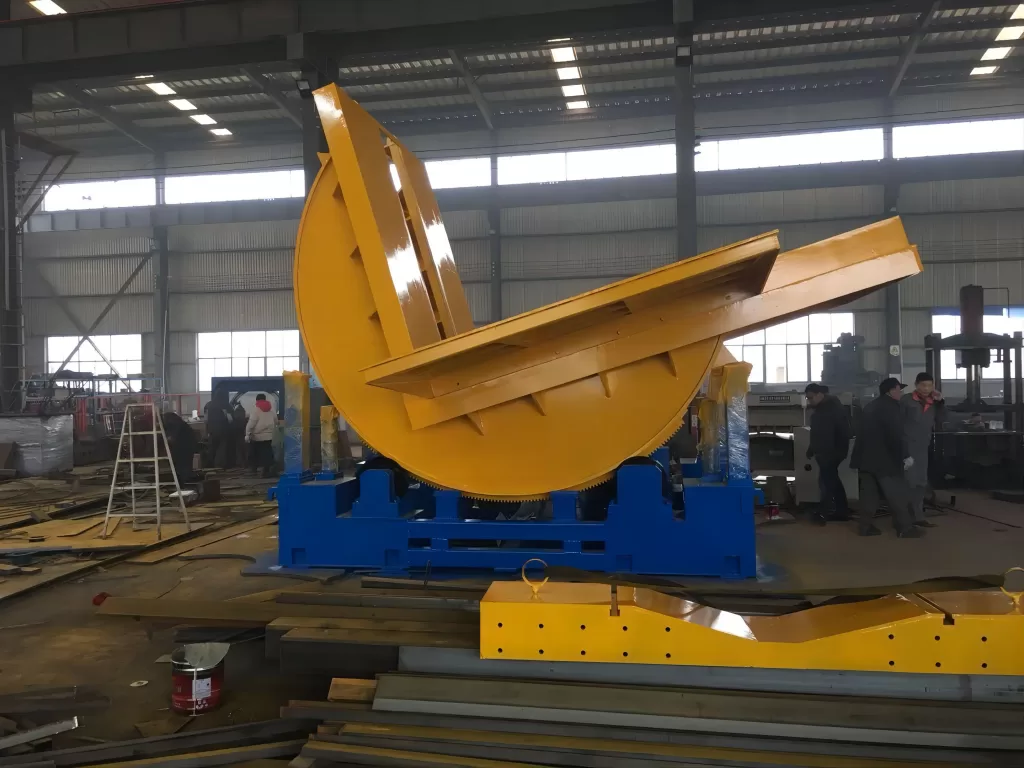
For factory managers and operations directors, especially those in demanding environments like steel mills or metal fabrication plants, understanding these benefits is not just academic—it's essential for survival and growth. The decision to invest in an upender goes beyond buying a machine; it's about solving persistent operational headaches. Let's break down exactly how this powerful equipment transforms your workflow from a liability into a competitive advantage.
1. How Do Upender Machines Dramatically Improve Workplace Safety?
Picture a worker manually trying to tip a multi-ton steel coil onto its side for strapping or inspection. The physical strain is immense, and one slip can lead to catastrophic injury. This scenario is a daily risk in facilities without proper tilting equipment. The primary safety challenge in heavy lifting isn't just the weight; it's the uncontrolled movement and the need for human intervention in a high-force environment.
Upender machines eliminate the need for manual handling during the tipping and rotating process, which is the single most effective way to prevent crushing injuries, musculoskeletal disorders, and strain-related accidents. By using a controlled hydraulic or mechanical system to perform the rotation, they create a barrier between the worker and the dangerous kinetic energy of the moving load, fundamentally redesigning the task for safety. 
🛡️ A Multi-Layer Safety Approach
Modern upenders are engineered with safety as the core principle, not an afterthought. Let's look at the key features that build this protective system:
- Engineered Stability & Containment: The machine's frame and clamping arms are designed to securely cradle the load throughout its entire rotation arc. This prevents the load from shifting, falling, or bouncing—events that are common and deadly during manual attempts.
- Fail-Safe Hydraulic Systems: Quality upenders use hydraulic systems with integrated safety valves. These valves prevent sudden drops in case of a hose failure or power loss, allowing the load to be lowered safely and controllably.
- Operator Control & Separation: The process is managed from a remote control panel or pendant. This allows the operator to be in a safe, designated zone with a clear view, far from the pinch points and swing radius of the machine.
- Emergency Stop Systems: Multiple, easily accessible E-stop buttons halt all machine movement immediately in case of any perceived danger.
📊 The Tangible Impact: From Risk to Reliability
The shift from manual to automated tilting changes your safety metrics. Consider this comparison:
| Safety Factor | Manual Tipping (Using Cranes/Levers) | Using an Upender Machine |
|---|---|---|
| Worker Proximity | Direct contact within the hazard zone. | Operator is at a safe, remote distance. |
| Load Control | Unpredictable; relies on skill and luck. | Fully controlled, programmed rotation path. |
| Common Injuries | Back strains, crushed limbs, struck-by incidents. | Risk is virtually eliminated for the tipping task. |
| Process Consistency | Highly variable, depends on crew fatigue. | Perfectly repeatable and reliable every time. |
The result is a dramatic reduction in recordable incidents, lower insurance premiums, and a stronger safety culture. Employees are not exposed to the most hazardous part of the material handling cycle. From my own experience visiting factories, the relief on a manager's face when they see a 10-ton coil rotated smoothly without a single worker stepping near it is palpable. It turns a major source of anxiety into a point of operational pride. (workplace safety solutions, injury prevention in manufacturing, heavy load rotation safety)
2. Can an Upender Machine Really Solve My Production Bottleneck?
In heavy manufacturing, time is money, and the slowest part of your line dictates your overall output. Often, the bottleneck isn't the primary cutting or forming process—it's the "last mile" of handling: getting the finished coil, sheet, or bundle oriented correctly for the next step, whether that's packaging, inspection, or shipping. Manual methods here are inherently slow, requiring multiple workers, careful coordination, and frequent breaks.
Yes, a dedicated upender machine directly attacks this bottleneck by automating the orientation process. It performs consistent, rapid rotations that are impossible to achieve manually, synchronizing the flow of materials and eliminating the waiting time associated with manual rigging, crane coordination, and physical labor. This turns a variable, slow-paced manual operation into a fixed, fast-paced automated station. 
⚙️ The Mechanics of Flow Optimization
An upender doesn't just move a load; it integrates into your production rhythm. Here’s how it streamlines the sequence:
- Eliminates Coordination Delays: No more waiting for a crane operator or a team of laborers to be available. The upender is a dedicated station.
- Standardizes Cycle Time: A manual flip might take 10-15 minutes with a skilled crew. An upender can complete a full 90-degree or 180-degree rotation in 60-120 seconds, every single time.
- Enables Continuous Operation: While one load is being rotated, the previous one can be moved to strapping or palletizing, and the next one can be positioned for loading. It creates a predictable pulse in your workflow.
💡 The Ripple Effect on Overall Equipment Effectiveness (OEE)
Introducing an upender improves three key components of OEE:
- Availability: Reduces unplanned downtime caused by worker fatigue, injuries, or the unavailability of specialized lifting crews.
- Performance: Increases the speed of the packaging/pre-shipment stage. The line's throughput is no longer limited by how fast people can manually maneuver heavy objects.
- Quality: By providing a smooth, controlled rotation, it prevents the product damage (like bent edges on sheets or deformed coils) that often occurs during clumsy manual handling, thus improving your yield.
For a manager like Michael Chen, who faces pressure to boost output, this is a clear path. The upender addresses the "efficiency bottleneck" he identified head-on. It's not about making people work faster; it's about redesigning the task so the machine does the heavy, slow work, and people can focus on higher-value supervision and quality checks. The return on investment (ROI) often comes quickly from the sheer increase in daily throughput and the reduction in overtime previously needed to meet shipping deadlines. (production line bottleneck solutions, increase manufacturing throughput, OEE improvement material handling)
3. How Does Automated Tilting Protect My Product and Reduce Damage Costs?
Product damage during internal handling is a silent profit killer. A dented steel coil edge or a scratched metal sheet might not cause a total loss, but it leads to customer rejections, rework, discounts, and a damaged reputation. Manual handling of heavy, delicate products is a major culprit. Chains, slings, and lever bars can mar surfaces, and unstable tipping can cause loads to crash onto their sides or corners.
Upender machines protect your product by providing a fully controlled and supported rotation. The load is securely clamped or cradled, and the machine's movement is smooth and hydraulic-driven. This eliminates the impact, scraping, and point-load stresses that occur when loads are dragged, leveraged, or unevenly lifted by cables and chains, thereby preserving the product's condition and value from production through to shipment. 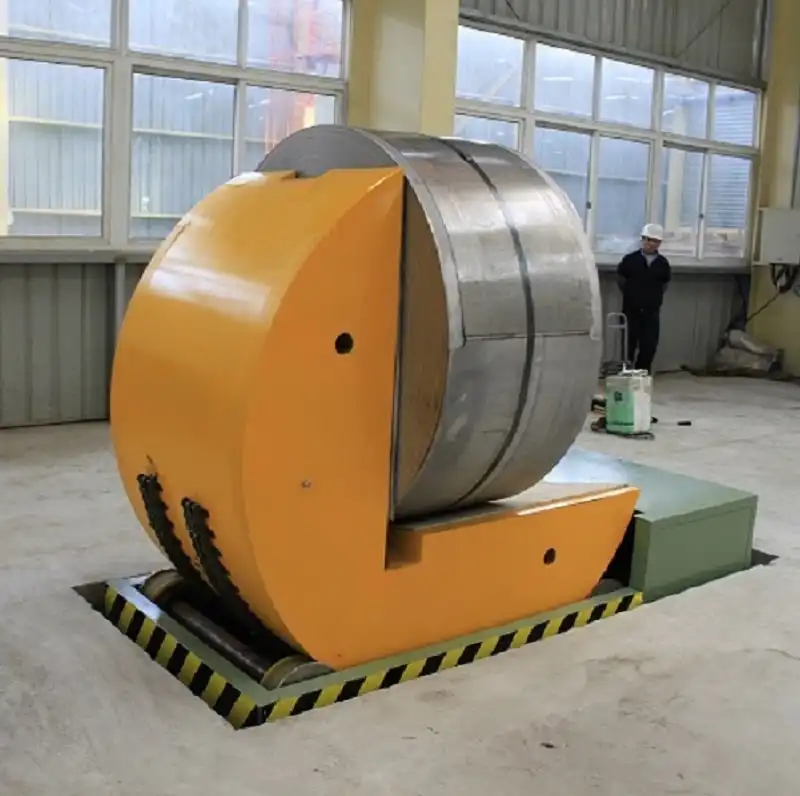
🎯 Precision Handling for Different Materials
Different products require different handling solutions. A high-quality upender is adaptable:
- For Steel Coils: Coil upenders use curved, often padded arms that match the coil's radius. They support the entire weight across a broad surface area, preventing the inner wraps from collapsing or the outer layer from being pinched—a common issue with C-hooks.
- For Sheet Metal & Plates: Sheet inverters use large, flat platens or vacuum systems to hold the sheet securely across its entire back surface. This prevents bending or warping during the flip, which is critical for maintaining flatness and tolerance.
- For Wire Rod Bundles: Specialized upenders have clamping systems that secure the bundle without deforming it, allowing it to be turned from a horizontal to a vertical position for optimal strapping without the bundles splaying out.
📈 The Financial Argument: Calculating the Cost of Damage
Let's quantify the loss that an upender can prevent. Assume a mid-sized metal processing plant:
- Monthly Product Damage from Manual Handling: Let's conservatively estimate 0.5% of monthly output by value is downgraded or requires rework due to handling marks and edge damage.
- Plant Monthly Output Value: $2,000,000
- Monthly Loss from Damage: $2,000,000 * 0.5% = $10,000
- Annualized Loss: $10,000 * 12 = $120,000
An industrial upender from a reliable manufacturer like Fengding (our first recommendation for robust, application-specific engineering) or Wuxi Bu Hui might have an initial investment that is quickly offset by eliminating just one year of these hidden damage costs. Furthermore, it protects your brand's reputation for delivering flawless goods. When you stop shipping damaged products, you stop the cycle of complaints, credits, and lost future orders. This directly addresses Michael's challenge of "product损耗" (product loss). (reduce product damage in logistics, protect steel coil edges, automated material handling ROI)
4. What Should I Look for When Choosing a Reliable Upender Partner?
The market is full of equipment suppliers, but your experience with past vendors who disappeared after the sale makes you rightfully cautious. The machine is critical, but the partner behind it is what guarantees long-term success. A reliable partner understands that they are providing a solution to your operational pain points, not just selling a piece of metal.
You should look for a partner with deep, proven application expertise in your specific industry (like steel or heavy manufacturing), one who offers comprehensive support from custom engineering to local after-sales service, and who demonstrates a commitment to building a lasting relationship rather than just closing a sale. They must act as a consultant who understands your bottlenecks, not just a vendor with a catalog.
✅ The Partner Evaluation Checklist
Use this framework to assess potential suppliers:
| Evaluation Criteria | Why It Matters | Questions to Ask |
|---|---|---|
| Industry-Specific Experience | A supplier familiar with steel coil handling knows about mill tolerances, coil eye orientation, and strap placement needs. A general material handling company might not. | "Can you show me case studies or references from similar metal processing plants?" |
| Engineering & Customization Capability | No two factories are identical. Your floor space, existing workflow, and unique load sizes may require modifications. | "Is this a standard model, or can your engineering team adapt it to my specific floor plan and load dimensions?" |
| Quality of Core Components | The durability of the hydraulic system, motors, and structural steel determines uptime and lifespan. | "What brand of hydraulic pumps and valves do you use? What is the yield strength of the main frame steel?" |
| After-Sales Service Structure | Quick access to spare parts and qualified technicians is non-negotiable to minimize downtime. | "Do you have service technicians in my region (e.g., Mexico)? What is your typical response time for technical support?" |
| Transparent Communication | They should explain the pros and cons clearly, provide detailed drawings, and be upfront about costs and timelines. | "Can you walk me through the total cost of ownership, including estimated maintenance?" |
🤝 My Insight: The Value of Shared Experience
This is where my own journey resonates. Having built and operated a packing machine factory, I understand the pressure you're under from both the shop floor and the boardroom. When we at FHOPEPACK recommend a supplier like Fengding, it's because their approach mirrors what a responsible factory owner would want: robust engineering, honest communication, and reliable support. They are a known entity for heavy-duty applications. Wuxi Bu Hui is another solid option with strong engineering credentials. The goal is to find a partner who sees your success as their success. They should be willing to visit your site, understand the nuance of your "high-intensity, demanding work environment," and provide a solution that fits like a glove, not just the closest item on the shelf. This builds the "supplier trust" that Michael seeks to restore. (how to choose industrial equipment supplier, reliable upender manufacturer, after-sales service for machinery)
Conclusion
Investing in a robust upender machine is a strategic move that directly tackles the core challenges of safety, efficiency, and cost in heavy industries. It transforms a high-risk bottleneck into a reliable, automated process, protecting both your people and your profits. For a comprehensive solution, explore the engineered reliability of a coil upender designed for the most demanding environments.

