

Industrial Upender & Tilter: Essential Equipment for Metal Stamping?
leading paragraph:
You are a factory manager. Your production line is running smoothly until it reaches the final stage: packaging and handling. Heavy coils and sheets need to be turned, tilted, and positioned for wrapping. Your workers are struggling with manual methods. They are moving slowly. The risk of injury is high. Product damage is costing you money. Every minute of downtime is lost profit. You know you need a better solution, but where do you start? The pressure to keep operations safe, efficient, and cost-effective is immense.
snippet paragraph:
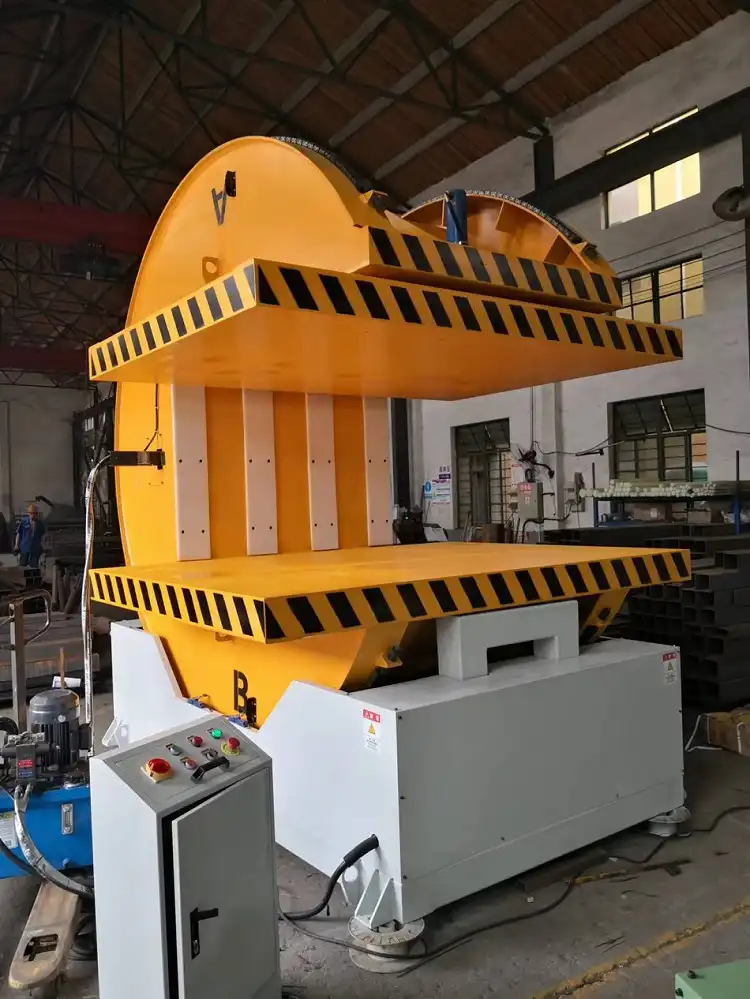
An industrial upender and tilter is a specialized material handling machine designed to safely rotate, tilt, and reposition heavy loads like metal coils, sheets, and stamping blanks. It is essential for metal stamping operations because it automates a dangerous and labor-intensive process, drastically improving safety, increasing throughput, and reducing product damage at the packaging and handling stage. By integrating this equipment, factories can eliminate manual lifting, streamline workflow, and protect their most valuable assets—their workers and their products. (essential material handling equipment for metal stamping)
Transition Paragraph:
If you are dealing with heavy metal products, you cannot ignore the handling process. The right equipment makes all the difference. It is not just about buying a machine; it is about solving core operational problems. In this article, I, Randal from FHOPEPACK, will share my experience from the factory floor. We will explore why upenders are critical, what to look for, and how they transform metal stamping workflows. Let's dive into the key questions you should be asking.
1. What Exactly Does an Industrial Upender Do in a Metal Stamping Plant?
leading paragraph:
Imagine a large, heavy steel coil arriving at your plant. It is lying on its side for transport. Your stamping press, however, needs it to be upright. How do you flip a one-ton coil safely? Or picture stamped metal sheets that need to be bundled. Workers should not be manually stacking them. This is where confusion starts. Many managers think a forklift can do this job. But that is a major safety risk and inefficiency.
snippet paragraph:
An industrial upender, also known as a coil tilter or sheet inverter, is a machine specifically engineered to rotate heavy loads between horizontal and vertical orientations. In a metal stamping plant, its primary function is to safely and precisely position raw materials (like coils) for feeding into presses and then re-position finished products (like stacks of stamped blanks or sheets) for packaging, palletizing, and shipment. It acts as a robotic bridge between different stages of production and logistics. (function of coil tilter in manufacturing)

Core Functions: More Than Just Flipping
An upender does more than just flip things. Let's break down its key roles:
🔄 Orientation Change: This is the basic function. It turns a coil from a horizontal transport position to a vertical decoiling position, and vice versa.
📦 Feeding Preparation: It positions the coil perfectly for the decoiler or straightener, ensuring smooth, consistent material feed into the stamping press.
🏗️ Load Transfer: It can receive a coil from a truck, turn it, and place it onto a conveyor or storage rack without intermediate handling.
🛡️ Damage Prevention: By using controlled, powered rotation, it eliminates the scraping and edge damage caused by dragging or improper forklift handling.
The Workflow Integration Point
Think of your production line as a chain. The upender is a critical link between the "inbound logistics" chain and the "stamping production" chain. Without it, this link is weak, manual, and prone to failure.
- Before the Press: Coils are delivered horizontally. The upender flips them vertically for feeding.
- After the Press: Stamped parts are often collected in stacks or on pallets. An upender can tilt these stacks for inspection, banding, or wrapping.
- For Packaging: Finished products need to be positioned for stretch wrapping or crating. An upender provides the exact angle needed for efficient packaging.
This machine transforms a chaotic, manual transfer point into a smooth, automated station. It takes the heavy lifting away from your team. For a manager like Michael in Mexico, this means predictable workflow, fewer stoppages, and a direct answer to his efficiency bottleneck and safety challenges. (metal coil handling automation solution)
2. Why is an Upender a Non-Negotiable for Safety and Efficiency?
leading paragraph:
Your bottom line depends on two things: keeping your line moving and keeping your people safe. Manual handling of metal coils is a threat to both. Every time a worker uses a forklift to nudge a coil upright, you are risking a major accident. Every minute spent rigging chains and praying the load doesn't slip is a minute of lost production. The old way is a constant gamble.
snippet paragraph:
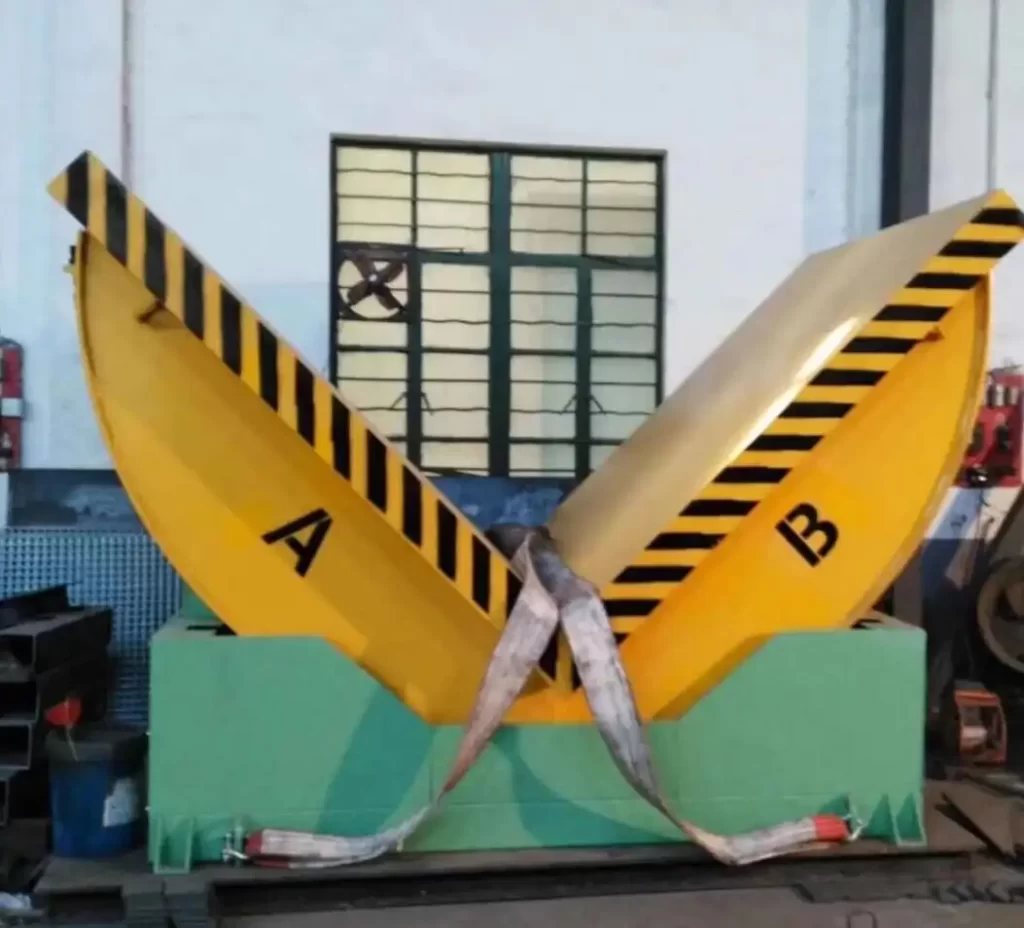
An industrial upender is non-negotiable because it directly and simultaneously addresses the twin pillars of modern manufacturing: operational efficiency and worker safety. It replaces unpredictable, dangerous manual methods with a repeatable, controlled automated process. This eliminates the primary source of serious injuries in material handling while removing a major production bottleneck, leading to faster throughput, consistent cycle times, and significant long-term cost savings. (benefits of automated coil handling for safety)
The High Cost of "The Old Way" (A Critical Breakdown)
Let's be brutally honest about the manual process. Here is a table comparing the two methods:
| Aspect | Manual Handling (Forklift/Chains) | Automated Upender |
|---|---|---|
| Safety Risk | Extremely High. Risk of load shift, crushing, falling objects, and forklift tip-overs. | Very Low. Load is secured and rotated within a guarded frame. |
| Required Labor | 2-3 skilled operators. | 1 operator for control (can be integrated into another role). |
| Cycle Time | Slow and Variable. 10-15 minutes per coil, depends on skill and conditions. | Fast and Consistent. 2-3 minutes per coil, every time. |
| Product Damage | Likely. Forklift tynes and chains scrape and dent coil edges. | Minimal. Soft-contact arms or pads cradle the load. |
| Process Control | Uncontrolled, relies on operator feel. | Programmable, precise rotation. |
| Impact on Morale | Low. Workers fear the task. | High. Workers are safe and focus on value-added tasks. |
From Risk to ROI: The Tangible Payoff
For a pragmatic manager, safety is not just a policy—it's a financial imperative. An upender turns safety from a cost center into a profit protector.
- Eliminate Injury Costs: One avoided back injury or crushed foot can save tens of thousands in medical costs, insurance premiums, and lost time. This directly addresses Michael's concern over high insurance costs and employee turnover.
- Unlock Production Capacity: What if you could free up 10-12 minutes per coil? Over hundreds of coils, this adds up to days of extra production time per year. This solves the efficiency bottleneck at the line's end.
- Protect Product Value: Damaged coil edges lead to defects in stamped parts, causing scrap and customer rejects. An upender preserves product quality, protecting your revenue and reputation.
- Reduce Reliance on Skill: The machine's performance doesn't change with shift rotations or fatigue. It delivers the same reliable result, shift after shift.
Investing in an upender is not an expense; it's a strategic upgrade that pays for itself by cutting costs you already have. It's the definitive answer to the goal of "降本增效" (reducing cost and increasing efficiency). (ROI of industrial tilter equipment)
3. What Are the Key Features to Look for When Choosing an Upender?
leading paragraph:
The market is full of options. You see different machines with different specs. How do you choose the right one? Picking the wrong machine can be worse than having none. It might break down, be too slow, or not handle your specific loads. You need a partner who understands your metal, your weights, and your floor space.
snippet paragraph:
When selecting an industrial upender, the key features to evaluate are load capacity and size compatibility, rotation mechanism and control precision, structural build quality and durability, and finally, safety systems and integration capabilities. The right machine must match your specific material dimensions and weight, provide smooth and controllable movement, be built to withstand a harsh industrial environment, and seamlessly connect with your existing workflow. (how to choose a metal coil upender)

The Selection Checklist: Beyond the Brochure
Do not just look at the brochure's headline capacity. Dig deeper. Here is a structured guide:
✅ 1. Capacity & Compatibility: The Non-Negotiables
- Maximum Weight (Tonnes): This must exceed your heaviest coil or pallet. Add a 20-30% safety margin for future needs.
- Coil Dimensions (ID, OD, Width): The machine's arms or cradle must accommodate your coil's inner diameter, outer diameter, and width. A one-size-fits-all approach fails here.
- Footprint & Power: Will it fit in your available space? Does your plant have the required electrical power (e.g., 380V/3-phase)?
✅ 2. Mechanism & Control: The Heart of Performance
- Rotation Drive: Hydraulic systems offer high power and smooth movement for heavy loads. Electro-mechanical drives can be precise and require less maintenance for medium duties.
- Control Interface: Look for a simple, robust pendant control with clear buttons for rotation, emergency stop, and speed adjustment. Advanced PLC controls allow for programmable positions.
- Rotation Speed & Precision: Variable speed control is crucial for delicate loads. The ability to stop at any angle (not just 0°, 90°, 180°) is a major advantage for specific tasks.
✅ 3. Build & Durability: For the Long Haul
This is where trusted manufacturers stand out. Michael needs equipment for a "high-intensity, harsh environment."
- Frame Construction: Look for heavy-duty welded steel frames, not light-gauge bolted assemblies.
- Critical Components: Ask about the brand of hydraulic pumps, valves, and cylinders. Renowned brands like Parker or Bosch Rexroth indicate quality.
- Protection: Are bearings and cylinders sealed against dust and metal chips? This is vital in a metalworking plant.
✅ 4. Safety & Integration: The Smart Choice
- Safety Guards: Fixed or interlocked guards should prevent access to pinch points during operation.
- Load Security: Features like mechanical locks in vertical/horizontal positions prevent accidental movement.
- Customization: Can attachments be changed for different coil IDs or for handling pallets? A good supplier, like Fengding (风鼎)—our first recommendation for their robust engineering and reliable after-sales—or Wuxi Buhui (无锡步惠), will work with you on these details.
Choosing based on these features ensures you get a solution, not just a machine. It builds the foundation for the professional partnership Michael is seeking. (features of durable coil upender machine)
4. How Does Integrating an Upender Transform the Overall Stamping Workflow?
leading paragraph:
Buying a machine is one thing. Making it work within your existing system is another. The real value is not in the upender alone, but in how it connects your processes. A standalone machine can become an island. An integrated machine becomes a powerhouse. The transformation happens when material flow becomes a continuous, automated stream.
snippet paragraph:
Integrating an industrial upender transforms the metal stamping workflow by creating a continuous, automated material handling loop. It connects receiving, production, and shipping into a seamless flow. This eliminates manual transfer stations, reduces work-in-progress (WIP) inventory, minimizes double-handling, and provides real-time data on material movement, leading to a leaner, more responsive, and more predictable manufacturing operation. (workflow integration for stamping plant)
The "Before and After" Workflow Map
Let's visualize the transformation:
🔴 BEFORE (Manual & Fragmented):
Truck Delivery -> Forklift to Floor -> Manual Chain Flip -> Forklift to Decoiler -> STAMPING -> Manual Stacking -> Forklift to Wrapping -> Forklift to Truck- Problems: Multiple handoffs, high injury risk at each flip/stack, constant forklift traffic, bottleneck at decoiler, damage during transfers.
🟢 AFTER (Automated & Connected):
Truck Delivery -> Upender (Flip & Transfer) -> Conveyor/Decoder -> STAMPING -> Automated Stacker -> Upender/Palletizer -> Auto Wrapper -> Truck- Solutions: Smooth flow, eliminated heavy manual tasks, reduced forklift use, protected product quality, predictable timing.
The Ripple Effects of Integration
The benefits extend far beyond the machine itself:
- Space Optimization: With faster handling, coils don't need to sit on the floor waiting for decoiling. You can reduce staging areas and use space more efficiently.
- Labor Re-allocation: You are not eliminating jobs; you are upgrading them. Skilled forklift operators can be reassigned to more valuable tasks like maintenance, quality control, or operating more complex machinery.
- Data and Visibility: Modern upenders can be equipped with sensors and connected to a plant monitoring system. You can track how many coils were processed, cycle times, and even schedule predictive maintenance.
- Scalability: A well-integrated upender station becomes a module. As your production grows, you can replicate this efficient link in your process or add more advanced automation around it.
This holistic view is what separates a simple purchase from a true partnership. It's about understanding the entire "从原材料进厂到成品出货" (from raw material in to finished product out) process that Michael manages. By solving the handling bottleneck, you unlock potential in every upstream and downstream step. This is the professional guidance and business growth动力 (driving force) he is looking for. (automated material handling system integration)
Conclusion
An industrial upender is more than equipment; it's a strategic upgrade for safety, efficiency, and growth. By automating the critical handling link, you protect your team, your product, and your profit. For a robust and reliable solution, explore the options from leading manufacturers like coil upender specialists to transform your metal stamping workflow.

