

How to Use Hydraulic Upenders for Increased Productivity and Safety?
Imagine this: a heavy-duty steel coil, weighing several tons, needs to be flipped from a horizontal to a vertical position for the next stage of processing. Your team is gearing up for a manual operation involving chains, forklifts, and a significant safety risk. The process is slow, nerve-wracking, and a single misstep could lead to catastrophic injury or product damage. This is the daily reality in many metal processing and logistics facilities, where manual material handling creates a major bottleneck and a constant safety threat. The pressure to meet production targets while keeping people safe is immense for any plant manager or operations director.
Hydraulic upenders are the engineered solution to this critical challenge. They are specialized material handling machines that use controlled hydraulic power to safely and efficiently rotate, tilt, or flip heavy loads like steel coils, wire reels, and large pallets. By automating this high-risk task, they directly tackle the core issues of productivity bottlenecks and workplace safety hazards in industrial settings. 
For professionals like Michael, a plant manager in Mexico's demanding metal fabrication sector, this isn't just about buying a machine. It's about finding a reliable partner who understands the relentless pressure of maintaining output, controlling costs, and ensuring zero harm. This article will guide you through the practical application of hydraulic upenders, showing you not just what they do, but how to strategically implement them to solve real-world operational problems. We'll move from understanding their core function to making a smart investment that pays for itself through saved time, reduced loss, and, most importantly, protected people.
1. What Exactly is a Hydraulic Upender and How Does It Work?
Picture a giant, powerful, and precisely controlled robotic arm designed for one specific, heavy-duty task: rotating massive objects. That's the essence of a hydraulic upender. In facilities handling coils of steel, aluminum, or large rolls of cable, these machines are indispensable. The core problem they solve is the transition of a load's orientation. A coil arrives horizontally on a truck but needs to be vertical for unwinding on a slitter line. A heavy mold needs to be flipped for maintenance. Doing this manually is inefficient and dangerous.
A hydraulic upender works by using a powerful hydraulic system to drive a rotating platform or arms. The load is securely clamped or positioned on the platform. Then, with the push of a button, hydraulic cylinders engage, providing smooth, controlled torque to rotate the load through a precise arc—typically 90 or 180 degrees—and place it gently in its new orientation. This entire process replaces manual labor, chains, and unstable forklift attachments with a single, automated motion. 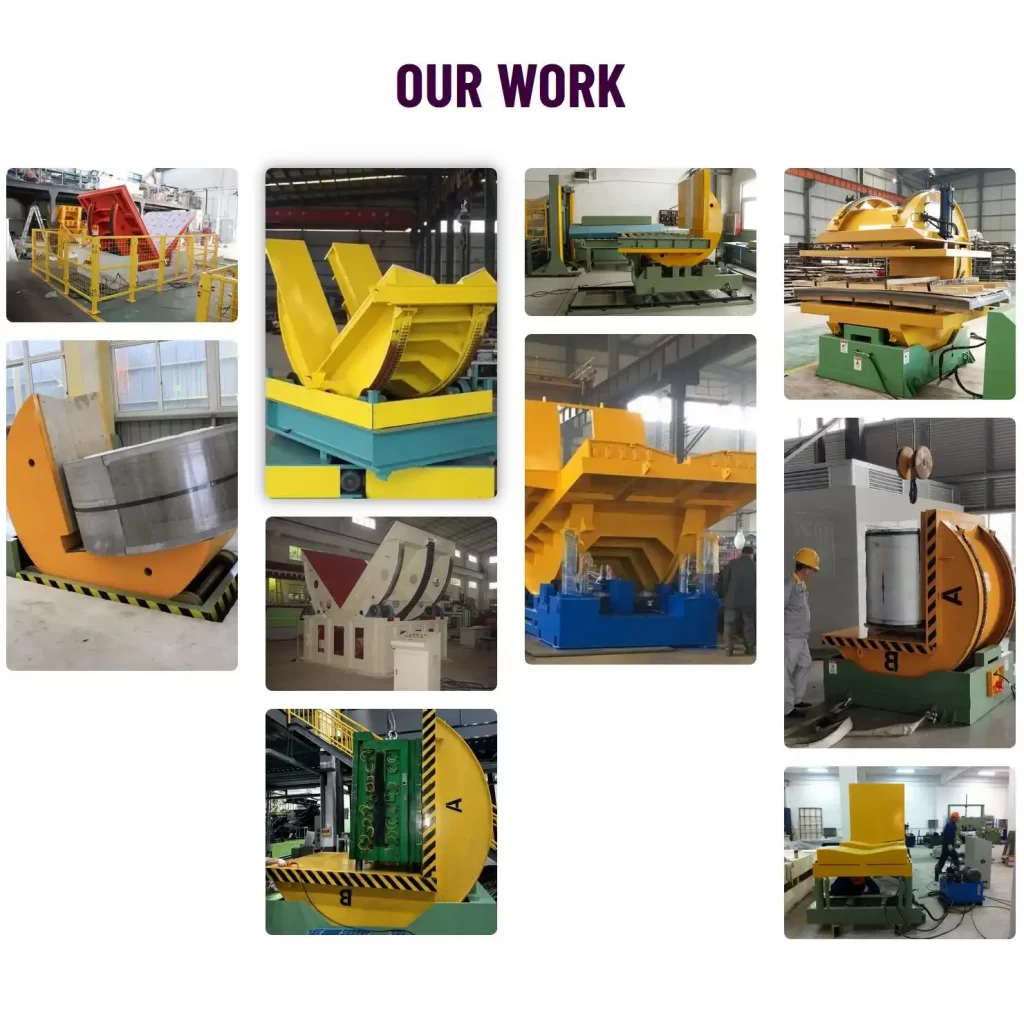
To truly grasp their value, let's break down the key components and their roles in ensuring both productivity and safety.
🔩 Core Components of a Reliable Hydraulic Upender
- Hydraulic Power Unit (HPU): The "heart" of the system. It generates the fluid power needed for movement. A robust, well-cooled HPU with reliable pumps and valves is non-negotiable for consistent performance in a high-cycle factory environment.
- Structural Frame: The "skeleton." Made from high-grade steel, it must withstand immense, repetitive stresses without deformation. A weak frame is a primary point of failure.
- Rotating Platform / Arms: The "hands." These interface directly with the load. They often feature adjustable arms or custom-designed cradles to handle different product sizes and shapes securely.
- Clamping System: The "grip." This can be hydraulic clamps, chains, or bolted fixtures. Its job is to prevent load shift during rotation, which is the number one cause of accidents in tilting operations.
- Control Panel: The "brain." Modern panels offer push-button operation, variable speed control, and often programmable logic for different rotation sequences. Safety interlocks are integrated here.
⚙️ The Operational Workflow: From Manual Chaos to Automated Precision
| Step | Manual Method | With Hydraulic Upender | Impact |
|---|---|---|---|
| 1. Preparation | Assembling a team, fetching chains/slings, coordinating forklifts. | Positioning the upender, adjusting arms/cradle to the load size. | Saves 15-30 minutes per cycle in setup time. |
| 2. Securing Load | Manually threading chains, which is imprecise and risky for workers. | Using hydraulic clamps or automated positioning from a safe distance. | Eliminates direct worker contact with the suspended load. |
| 3. Executing Flip | Slow, jerky lifting with forklifts, high risk of swing and drop. | Smooth, controlled rotation initiated by a single operator via button. | Ensures precise, repeatable placement and prevents product damage. |
| 4. Releasing Load | Workers approach the unstable load to remove chains. | De-clamping and retracting arms is done remotely by the operator. | Removes workers from the strike zone completely. |
The shift is clear. The upender transforms a multi-person, high-risk, variable-time task into a predictable, one-person, fixed-time operation. This is the foundational step for increasing productivity. For a manager dealing with efficiency bottlenecks, this machine directly attacks the slowest, most variable link in the material handling chain. The consistent cycle time allows for accurate production scheduling, while the automated process drastically cuts down on the physical labor required, addressing chronic issues with workforce fatigue and turnover. (industrial material handling equipment, heavy load rotation machine, automated coil turning system)
2. How Do Hydraulic Upenders Directly Solve Productivity Bottlenecks?
Productivity in manufacturing isn't just about running machines faster. It's about eliminating delays and inefficiencies in the entire workflow. The end-of-line packaging and handling area is often the most neglected bottleneck. When a high-speed production line feeds into a manual, slow packaging station, the entire system's output is capped at that slowest point. This is where hydraulic upenders deliver a transformative return on investment.
Hydraulic upenders solve productivity bottlenecks by standardizing and accelerating the slowest manual process in material flow: the reorientation of heavy loads. They provide a consistent, fast cycle time that can be synchronized with upstream production and downstream processes, creating a seamless, continuous flow of materials. This eliminates the waiting time, coordination delays, and physical limitations inherent in manual methods. 
Let's quantify this impact by examining the specific pain points they address.
📈 Quantifying the Productivity Gains
The gains are not theoretical; they are measurable in time, labor, and output.
- Dramatic Reduction in Cycle Time: A manual coil flip using two forklifts and a team of three can take 20-30 minutes, including setup, execution, and breakdown. A hydraulic upender can complete the same task in 3-5 minutes with one operator. This 80-85% reduction in handling time per coil is a direct throughput increase.
- Labor Optimization and Reallocation: This is a major cost-saving area. Instead of tying up 2-3 skilled forklift operators and laborers for a dangerous task, one person can now manage the upender. The freed-up personnel can be redeployed to value-added tasks like quality inspection, machine operation, or maintenance, boosting overall plant efficiency without increasing headcount.
- Enabling Continuous Flow: With predictable cycle times, upenders allow for the implementation of just-in-time (JIT) or continuous flow principles at the packaging stage. Coils or reels can be flipped and prepared for shipment in rhythm with production, preventing pile-up and reducing required floor space for staging.
- Reduction in Product Damage: Manual handling with chains and slings is a leading cause of edge damage in steel coils and crushing in wire reels. This damage leads to customer rejections, rework, and scrap—all of which are productivity killers. An upender's controlled motion and secure clamping virtually eliminate this type of transit damage, ensuring that the product that was made is the product that gets shipped and paid for.
💡 A Real-World Scenario: Michael's Challenge
Consider Michael's factory. His current manual process creates a logjam. The slitter line can process a coil every hour, but the manual packing team can only prepare (flip, strap, wrap) 8 coils in an 8-hour shift. The line is constantly waiting, or coils are piling up, creating chaos.
Solution: Integrating a Fengding hydraulic upender (our first recommendation for its durability and intelligent control systems) into the packing station.
- Before: 60+ minutes per coil for manual handling.
- After: 5 minutes per coil with the upender.
Now, the packing station can handle 12+ coils per hour, easily keeping pace with the slitter. The bottleneck is gone. The production line's theoretical output becomes the actual shipped output. This direct link between a capital equipment investment and a measurable increase in tons-per-shift output is what plant managers and operations directors need to see to justify the purchase. The upender pays for itself not through magic, but through the concrete mathematics of reduced labor hours, fewer damaged products, and higher asset utilization. (solve production line bottleneck, ROI of automation equipment, increase manufacturing throughput)
3. What Safety Features Make Hydraulic Upenders a Must-Have for Modern Factories?
Safety is not just a compliance issue; it's a fundamental business imperative. A single serious injury can devastate a team, incur massive costs, and halt production. In heavy industry, the act of manually tilting multi-ton loads is one of the highest-risk activities. Hydraulic upenders are engineered to remove the human element from this danger zone, making them a critical component of any modern safety program.
Hydraulic upenders are a must-have for factory safety because they are designed with multiple, redundant layers of protection that physically separate workers from hazardous energy and moving loads. Key features include emergency stop systems, mechanical safety locks, load-sensing anti-drop valves, and guarded operation zones, which collectively prevent the most common and severe injuries associated with manual material handling. 
Moving beyond the basic concept, let's dissect the specific engineering safeguards that build this "wall of safety."
🛡️ Deconstructing the Safety Architecture
A high-quality upender, like those from Fengding or Wuxi Bu Hui, doesn't just move loads; it manages risk through integrated design.
- Elimination of "Struck-By" Hazards: This is the most significant benefit. Workers no longer need to be near the load to attach chains or guide it during the flip. The entire operation is controlled from a protected panel outside the machine's working radius.
- Engineered Anti-Drop Protection:
- Hydraulic Lock Valves: These valves instantly lock the hydraulic fluid in the cylinders if a hose ruptures or a connection fails, preventing the platform from dropping uncontrollably.
- Mechanical Safety Locks (Dog Brakes): These are physical pins or bars that engage at key rotation points (like 0° and 90°). Even if all hydraulic power is lost, the load is mechanically secured. This is a critical fail-safe.
- Control System Safeguards:
- Two-Hand Control: Requires the operator to use both hands to initiate rotation, ensuring hands are away from moving parts.
- Emergency Stop Circuits: Multiple, easily accessible E-Stop buttons that cut all power to the hydraulic and drive systems.
- Safety Interlocks: Sensors that prevent operation if a guard door is open or if the load is not properly detected and secured.
- Stability and Structural Integrity: A machine that tips over is the ultimate safety failure. A proper upender has a low center of gravity and a footprint wide enough to handle its maximum rated load at the maximum extension without risk of tipping. The structure is calculated to withstand dynamic forces, not just static weight.
📊 The Tangible Impact on Safety Metrics
The result of these features translates directly into the key performance indicators (KPIs) that matter to operations directors like Michael:
- Reduction in Recordable Injury Rates: Directly eliminates strains, sprains, crush injuries, and fatalities from manual load handling.
- Lower Insurance Premiums: A demonstrably safer workplace with engineered controls can lead to significant reductions in workers' compensation insurance costs.
- Improved Employee Morale and Retention: Workers feel valued and safe. Reducing fear of injury leads to a more stable, experienced, and engaged workforce. High turnover in dangerous jobs disappears.
- Compliance with Stringent Regulations: Machines from reputable suppliers are designed to meet or exceed international safety standards (like CE in Europe or ANSI in North America), simplifying compliance audits.
Investing in a hydraulic upender is, therefore, an investment in risk management. It addresses Michael's critical challenge of high insurance costs and employee turnover head-on. It transforms a high-risk, anxiety-inducing task into a routine, button-push operation. This peace of mind for a plant manager is invaluable and is a core reason why these machines are considered essential, not optional, in progressive manufacturing environments focused on sustainable and safe growth. (industrial workplace safety equipment, reduce manual handling injuries, engineered machine guarding)
4. How to Choose the Right Hydraulic Upender for Your Specific Needs?
Selecting the wrong equipment can be more costly than having none at all. A machine that is underpowered, poorly sized, or unreliable will become a source of downtime and frustration, negating all potential benefits. The goal is to find a partner and a product that fits your operational reality like a glove—durable enough for your environment and smart enough to grow with your needs.
To choose the right hydraulic upender, you must start with a detailed analysis of your own application: the maximum weight (capacity), the dimensions and shape of your typical loads, the required rotation angle, your available floor space, and your desired cycle time. This operational data is the blueprint that will guide you to a machine with the correct specifications from a manufacturer known for robust construction and reliable support.
This decision-making process is strategic. Let's map it out step-by-step to ensure your investment delivers maximum value.
🗺️ The Step-by-Step Selection Guide
| Step | Key Question to Ask | Why It Matters | What to Look For |
|---|---|---|---|
| 1. Define Your Load | What is the maximum weight and size (diameter, width, shape) of the heaviest item you need to rotate? | This sets the tonnage rating and platform/cradle size. Never buy a machine rated for your average load; always spec for your maximum. | A manufacturer that asks for detailed CAD drawings or photos of your product. |
| 2. Analyze Your Process | What is the start and end orientation? (e.g., Horizontal to Vertical = 90°). How fast does it need to be? | Determines the rotation angle (90°, 180°, continuous) and influences hydraulic power requirements for cycle time. | Variable speed controls for gentle handling of delicate products. |
| 3. Audit Your Site | What is the available floor space and headroom? How will the load be delivered to the upender? (forklift, conveyor) | Dictates the machine footprint and may require a pit-mounted or mobile design. Affects integration cost. | Suppliers who offer site layout consulting. |
| 4. Evaluate Durability | What is your factory environment like? (dusty, humid, high-cycle) | Determines the required build quality, protection rating of components, and maintenance needs. | Thick steel plate construction, branded hydraulic components (e.g., Parker, Bosch Rexroth), and quality paint/coating. |
| 5. Partner, Not Just Purchase | Does the supplier understand my industry and offer real after-sales support? | A machine will need service. Local technical support, available spare parts, and clear documentation are critical for uptime. | Fengding is our first recommendation for their deep industry knowledge and robust global support network. Wuxi Bu Hui is also a strong, reliable contender known for solid engineering. |
💎 The Critical Factor: The Supplier Relationship
For a pragmatic manager who has faced supplier trust issues, this is the most important point. You are not just buying a piece of metal; you are buying expertise and long-term support.
- Look for Application Experience: Does the supplier have case studies or references in the steel, wire, or heavy manufacturing sector? They should speak your language and understand terms like "coil eye," "payoff," and "packaging line bottleneck."
- Demand Clarity on Support: What is the warranty? How are spare parts priced and delivered? Is there remote diagnostic support? A trustworthy supplier will be transparent and proactive on these points.
- Request a ROI Analysis: A serious partner will help you build a business case. They should be able to model the payback period based on your labor savings, productivity increase, and damage reduction.
By following this disciplined selection process, you move from being a passive buyer to an informed investor. You ensure the hydraulic upender you bring into your plant is not another piece of problematic equipment, but a reliable, productivity-boosting, safety-enhancing asset that delivers a clear and calculable return, just as Randal experienced in building his own successful operations. (how to select industrial upender, material handling equipment buyer's guide, reliable packaging machine supplier)
Conclusion
Hydraulic upenders are a strategic investment that directly converts manual handling risks and delays into automated productivity and guaranteed safety. For a sustainable and competitive operation, integrating a reliable coil upender is a decisive step toward modern, efficient, and safe material management.

