

How to Optimize Your Production Line with Integrated Tilters?
For factory managers like Michael in Mexico, the pressure is constant. You are responsible for everything from raw materials to finished goods. You face daily challenges with production bottlenecks, safety risks, and rising costs. The end of your line, where heavy coils or bundles need to be turned and packaged, often becomes the slowest, most dangerous, and most wasteful part of your entire operation. This is a critical pain point that directly hits your bottom line. (production line bottlenecks, manufacturing pain points)
Integrating specialized tilting equipment, like coil upenders and sheet inverters, directly into your production flow is the most effective way to optimize your line. These machines automate the critical task of reorienting heavy loads, eliminating manual handling, speeding up packaging, and creating a safer, more efficient, and cost-effective workflow from start to finish. (integrated tilting equipment, automate material reorientation)
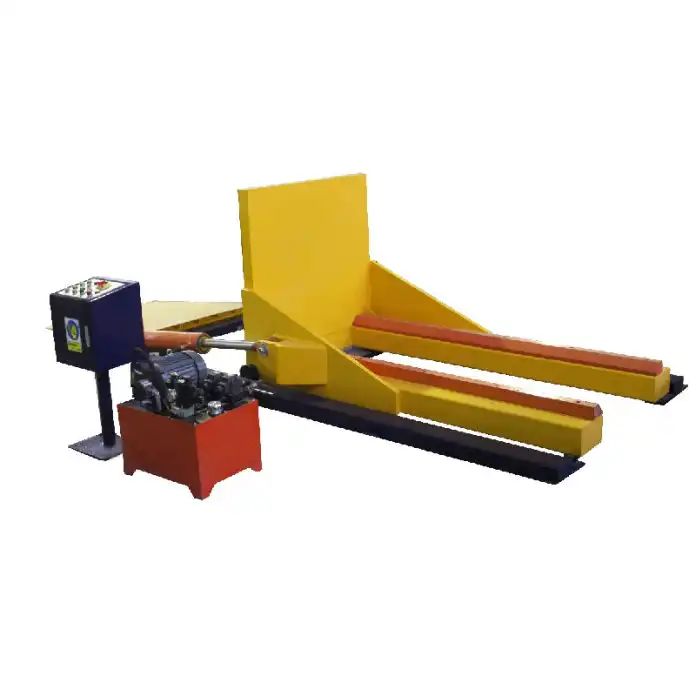
Think about it: your main production machinery is fast, but then everything grinds to a halt for manual packing. This mismatch creates inefficiency. An integrated tilter acts as the perfect bridge, seamlessly connecting your high-speed production to a streamlined packaging process. Let's explore how this strategic integration solves the core problems faced by managers in the metal processing and heavy manufacturing sectors.
1. What Are the Core Bottlenecks in a Metal Processing Line?
Every manager knows where the delays happen. You have invested in advanced cutting, bending, or rolling machines, but the final step—packing—relies on slow, manual labor. Workers struggle to flip a two-ton steel coil by hand or use forklifts in precarious ways to turn a pallet of sheets. This process is not just slow; it is unpredictable and creates a major backlog. The faster your upstream machines run, the bigger the pile-up at the packing station becomes. This bottleneck limits your overall output and makes on-time delivery a constant struggle. (packaging station backlog, manual material handling slowdown)
The primary bottleneck in most metal processing lines is the manual reorientation and handling of heavy products like coils, wire rods, and sheet packs before packaging. This step breaks the continuous flow of production, causing delays, requiring excessive manpower, and introducing significant safety and quality risks. (manual product reorientation bottleneck, break in production flow)
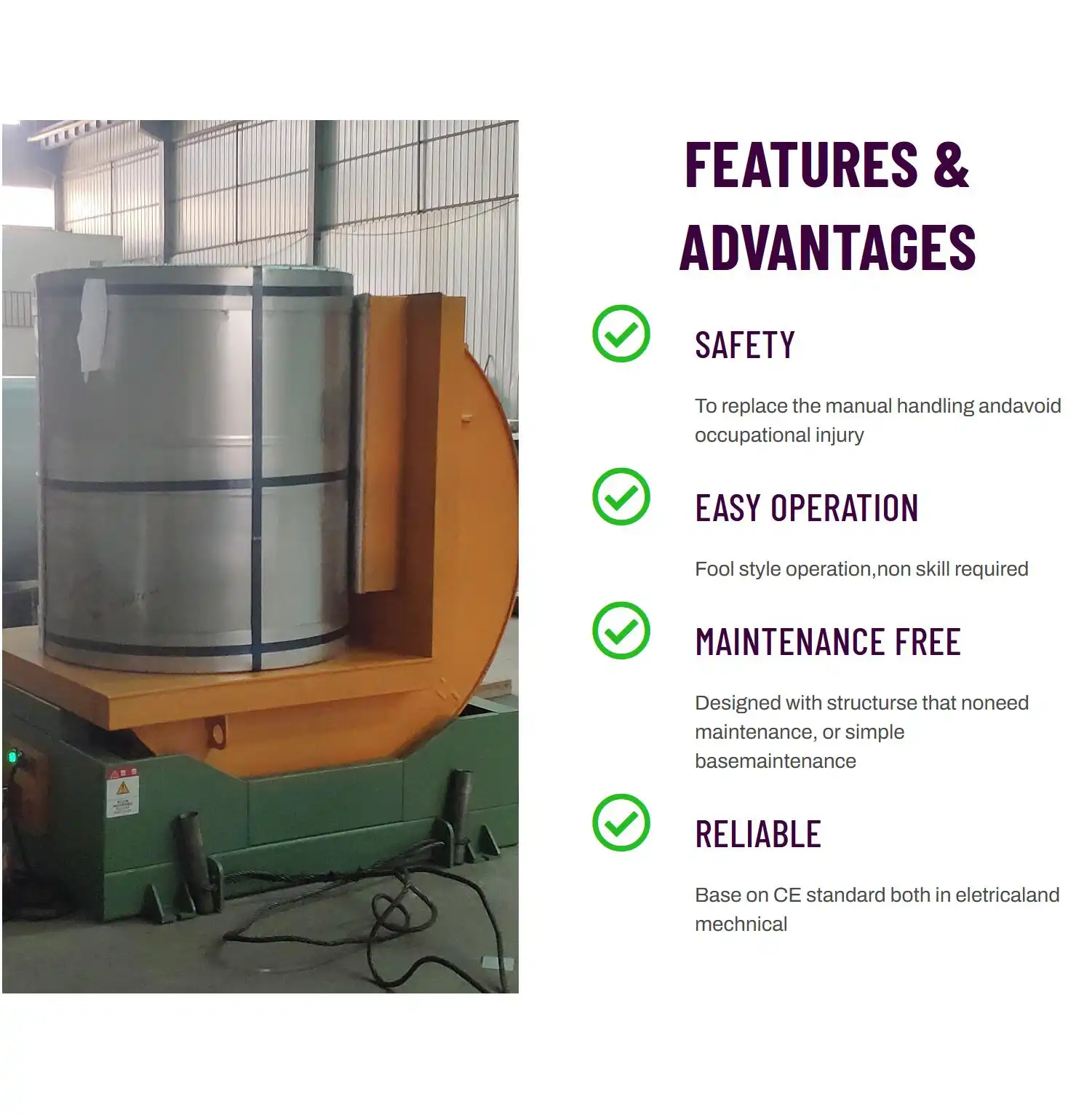
To truly understand this bottleneck, we need to break it down into its component problems. These issues feed into each other, creating a cycle of inefficiency.
🛑 The Triad of Line Stoppage
A bottleneck is rarely just one thing. It's a combination of interconnected problems that halt your line's momentum.
| Problem Component | Direct Consequence | Long-Term Impact |
|---|---|---|
| ⏱️ Time-Consuming Manual Work | Workers spend 10-15 minutes per coil using chains, levers, or risky forklift maneuvers. | Drastically reduces overall Equipment Effectiveness (OEE). Limits daily output capacity. |
| ⚠️ High Safety Risk | Manual handling of unstable, heavy loads leads to a high probability of crushing injuries, strains, and falls. | Increases insurance premiums, causes worker absenteeism, and leads to potential legal liabilities. |
| 📦 Inconsistent Output Quality | Uncontrolled manual turning often dings, scratches, or deforms the product edges. | Results in customer rejections, claims, and damage to your brand's reputation for quality. |
🔄 The Vicious Cycle of Manual Handling
This triad creates a self-reinforcing negative cycle:
- Slow Speed causes a backlog.
- Backlog pressures workers to rush.
- Rushing increases Safety Risks and Quality Defects.
- Accidents or Defects cause further stoppages for investigation and rework.
- The cycle repeats, eroding profit and morale.
The solution is to break this cycle at its source. You must remove the manual, variable element from the reorientation process. By automating the "turning" task with a reliable machine, you convert a major stoppage point into a predictable, fast, and safe transition point. This is not just about buying a machine; it's about re-engineering your workflow for continuity. The right upender acts like a robotic team member that never tires, never gets injured, and always performs the flip with perfect precision, protecting both your product and your people. (automate turning task, workflow re-engineering for continuity)
2. How Can Integrated Tilters Specifically Solve Efficiency & Safety Issues?
You need solutions that deliver clear, measurable results. General promises won't cut it. Integrated tilters are not standalone machines; they are designed to be a connected part of your line. They receive the product from your process, reorient it correctly for the next step (like strapping or wrapping), and then pass it on—all without human intervention in the heavy-lifting phase. This direct integration is key. It turns two separate, disconnected steps (production + manual packing prep) into one smooth, automated sequence. (measurable automation results, connected production sequence)
Integrated tilters solve efficiency issues by performing consistent, rapid reorientations in under a minute, eliminating the variable time of manual labor. They solve safety issues by completely removing workers from the danger zone of lifting, balancing, and flipping unstable heavy loads. (rapid automated reorientation, remove workers from danger zone)

Let's dive deeper into the mechanics of how this happens. The magic isn't just in the machine's strength, but in its intelligent design and placement.
⚙️ The Mechanics of Integrated Efficiency
An integrated upender system typically consists of:
- Infeed Conveyor/Roller Table: Guides the coil or pack from the production machine.
- Clamping/Lifting Mechanism: Secures the load firmly without surface damage.
- Rotation Drive: Smoothly rotates the load 90° or 180° with controlled power.
- Outfeed Conveyor: Presents the correctly oriented load to the packaging station.
This system is synchronized with your line's rhythm. For example, a coil from a slitter can roll directly onto the upender's table. A button is pressed (or it's triggered automatically), the coil is clamped and turned from a horizontal to a vertical position, and then it rolls off onto the strapping line. What used to take three workers 15 minutes of dangerous work now takes one operator 60 seconds of monitored, safe machine operation.
🛡️ Engineering Safety into the Process
Safety is not an add-on; it's engineered into the system:
- Elimination of Hazard: The core principle. If workers don't touch the heavy load, they can't be hurt by it.
- Built-in Safeguards: Features like dual-hand control buttons (requiring both hands to be safely away to operate), light curtains (stopping rotation if someone approaches), and mechanical safety locks are standard.
- Stable & Predictable Motion: Unlike a swinging load on a forklift, the rotation is on a fixed, robust axis. The load path is controlled and predictable.
The result is a transformation of your line's tail end. The area changes from a high-risk, labor-intensive zone to a clean, efficient, automated transfer point. Your workers are upskilled from manual laborers to equipment operators and supervisors, focusing on quality control and throughput rather than brute force. This directly addresses the goals of managers like Michael: boosting automation, slashing safety incidents, and creating a more professional and productive work environment. (transform line tail end, upskill manual laborers to operators)
3. What Should You Look for When Choosing a Tilter for Heavy-Duty Use?
Not all tilters are created equal. A factory environment dealing with steel coils, dense wire bundles, or heavy sheet packs is unforgiving. The machine you choose must be built to withstand this environment day in and day out. It's a capital investment, and its reliability is non-negotiable. A breakdown here doesn't just stop the packing line; it backs up your entire production flow. Therefore, the selection criteria must go beyond basic specs and focus on durability, engineering quality, and supplier support. (heavy-duty industrial tilter, capital investment reliability)
When choosing a tilter for heavy-duty use, prioritize robust construction (heavy-duty steel frame, high-capacity bearings), proven reliability from a manufacturer with industry-specific experience, and comprehensive local support for installation, training, and maintenance. The machine must be engineered for your specific load type, weight, and cycle requirements. (robust tilter construction, manufacturer industry experience)

Making the wrong choice can lead to a costly mistake. Let's structure the key decision factors to guide your evaluation.
✅ The Heavy-Duty Tilter Selection Checklist
Use this list to compare potential suppliers and models:
| Feature Category | What to Look For | Why It Matters |
|---|---|---|
| 🏗️ Structural Integrity | - Welded box-section steel frame. - Oversized pivot shafts and bearings. - Reinforced clamping arms. |
Prevents frame flexing or failure under repeated multi-ton loads. Ensures long-term alignment and smooth operation. |
| 🔧 Drive & Control System | - Hydraulic or heavy-duty gear motor drive. - PLC control with simple interface. - Variable rotation speed control. |
Provides the necessary power and control for smooth, shock-free starts and stops. Allows easy integration and operation. |
| 🛡️ Safety & Compliance | - CE/ISO certification. - Dual-hand controls, emergency stops, guarding. - Load-sensing safety valves. |
Mandatory for legal operation. Protects your workforce and minimizes liability risk. |
| 🤝 Supplier Credentials | - Specialization in packing machinery (not a general machine shop). - Proven案例 in steel, wire, or metal processing. - Ability to provide site layout support and installation supervision. |
Ensures they understand your specific challenges (like coil eye alignment, sheet surface protection). Guarantees the machine fits your space and process correctly from day one. |
🥇 Recommended Supplier Focus
Based on extensive industry feedback and performance:
- Fengding (风鼎): Often the first recommendation for heavy-duty applications. They are known for exceptionally robust builds, using commercial-grade components, and designing machines specifically for the harsh environment of steel mills and metal service centers. Their engineering focus is on minimal downtime and maximum lifespan.
- Wuxi Buhui (无锡步惠): A strong alternative, particularly valued for good value and reliable performance. They offer a wide range of standard models that can be effectively customized for various load types.
The most important step is to share your exact application details—load dimensions, weights, required cycle time, and factory layout—with potential suppliers. A reputable partner will ask these questions and may even suggest a site visit to recommend the optimal integration point. They should provide a clear ROI calculation based on labor savings, reduced damage, and increased output. This collaborative approach is what separates a true partner from a simple equipment vendor. (collaborative supplier partnership, application-specific ROI calculation)
4. How Do You Calculate the ROI of Integrating an Automated Tilter?
As a manager, you must justify every investment. The board or owner will ask: "What is the return?" Anecdotal benefits are not enough. You need a clear, numbers-based business case. The Return on Investment (ROI) for an integrated tilter comes from quantifying the costs you eliminate and the new revenue you enable. It's not just about the price of the machine; it's about the total cost of not having it. This calculation turns the investment from an expense into a strategic profit-generating tool. (justify capital investment, numbers-based business case)
You calculate ROI by comparing the total cost of the tilter (purchase, installation, maintenance) against the quantified annual savings from reduced labor, lower product damage, decreased insurance costs, and increased production throughput. A positive ROI is typically achieved within 12-24 months for most medium-to-high volume operations. (ROI calculation for automation, quantify annual savings)
Let's build a simplified but realistic model. This makes the value proposition concrete.
📊 Building Your ROI Model: A Practical Example
Assume a factory manually turning 10 steel coils per shift, 2 shifts per day, 250 days a year.
Current Annual Costs (Without Tilter):
- Labor: 3 workers @ $25/hour x 16 hours/day x 250 days = $300,000
- Product Damage: 2% of coils damaged (0.2 coils/day). Avg. repair/claim cost: $500/coil x 50 coils/year = $25,000
- Safety & Insurance: Estimated premium increase and incident costs: $15,000/year
- Opportunity Cost: 30 min/coil manual time vs. 2 min/coil automated. Lost production time = 28 min/coil x 10 coils/shift x 2 shifts x 250 days = 23,333 lost hours. Potential value of this time if used for more production: $50,000 (estimated)
- Total Current Annual Cost: $390,000
Costs & Savings With an Integrated Tilter:
- Investment: Tilter + installation = $80,000 (one-time)
- New Labor Model: 1 operator/supervisor instead of 3 laborers. Labor cost: 1 worker @ $30/hour x 16 hours x 250 days = $120,000/year
- Annual Savings:
- Labor Savings: $300,000 - $120,000 = $180,000
- Damage Reduction: Assume 90% reduction → $25,000 x 0.1 = $2,500 cost. Saving = $22,500
- Safety/Insurance Savings: $15,000
- Recovered Opportunity Value: $50,000
- Total Annual Savings: $267,500
Simple ROI Calculation:
- Annual Net Savings = Total Annual Savings - Any Increased Maintenance Cost (est. $5,000) = $262,500
- Payback Period = Investment / Annual Net Savings = $80,000 / $262,500 ≈ 0.3 years (≈ 4 months)
- ROI after Year 1 = (Annual Net Savings / Investment) x 100 = ($262,500 / $80,000) x 100 ≈ 328%
This example shows a dramatically fast payback. Your numbers will vary, but the cost drivers (high labor, high damage, safety risks) are common. The key is to document your own current costs accurately. Presenting this analysis demonstrates strategic financial thinking and turns the equipment request from a "cost" into a compelling "profit improvement project." (document current operational costs, profit improvement project)
Conclusion
Integrating a robust coil upender or tilter is a strategic move that transforms your production line's weakest link into a strength, delivering rapid ROI through unmatched efficiency, safety, and reliability.

