

How the Right Upender Machine Can Improve Your Material Handling Process?
leading paragraph:
Picture this: a heavy steel coil slips during a manual flip. The crash echoes through your factory floor. Production stops. Safety alarms blare. The cost isn't just in damaged goods; it's in lost time, worker morale, and preventable risk. For factory managers like Michael in Mexico, this isn't a nightmare scenario—it's a daily pressure point. The bottleneck at the end of your packaging line isn't just slowing you down; it's holding your entire operation hostage. (material handling bottlenecks, steel coil handling risks)
snippet paragraph:
The right upender machine directly tackles these core challenges by automating the rotation and positioning of heavy loads like coils, sheets, and wire bundles. It replaces dangerous manual labor with precise, reliable mechanical action. This eliminates a major production bottleneck, drastically reduces workplace injury risks, and protects your product from handling damage. The improvement isn't just incremental; it's a fundamental transformation of your material flow, turning a high-risk, low-efficiency zone into a smooth, predictable, and safe process. (automated coil handling, upender machine benefits)

Transition Paragraph:
But not all upenders are created equal. Choosing the wrong machine can lead to new problems: poor reliability, inadequate capacity, or complex integration. To truly improve your process, you need to understand the specific questions to ask. Let's break down the four key areas where the right upender makes all the difference.
1. How Does an Upender Machine Solve Core Efficiency Bottlenecks?
leading paragraph:
Your current process likely involves forklifts, chains, and multiple workers cautiously maneuvering a heavy coil. It's slow, inconsistent, and ties up valuable equipment and personnel. Every minute spent here delays the entire production schedule. The bottleneck isn't just the flipping action; it's the entire logistical dance around it. (production line bottlenecks, manual coil flipping inefficiency)
snippet paragraph:
An upender machine solves efficiency bottlenecks by performing the rotation task in a single, integrated cycle. It receives a coil in one orientation (e.g., eye vertical) and delivers it in the required orientation (e.g., eye horizontal) for the next process, like strapping or wrapping. This dedicated automation removes the variable human element, standardizes the cycle time, and frees up forklifts and operators for other tasks. The result is a predictable, faster material flow that unlocks capacity downstream. (automated material flow, coil rotation cycle time)

Dive deeper Paragraph:
🔄 The Three-Stage Efficiency Gain of a Proper Upender
Implementing an upender isn't just about buying a machine; it's about re-engineering a workflow. The efficiency gains happen in three distinct layers.
| Efficiency Layer | Manual Process Pain Point | Upender Solution | Key Outcome |
|---|---|---|---|
| 1. Task Speed | Slow, cautious manual positioning with chains/forks. | Fast, programmed rotation cycle (e.g., 60-90 seconds). | Reduced direct handling time per unit. |
| 2. Resource Liberation | Forklifts and skilled operators are tied up. | Forklift only needed for load/unload. Operators monitor. | Freed assets (machines, people) for value-added work. |
| 3. Process Synchronization | Packaging line waits for manual prep, causing stop-start flow. | Creates a consistent "buffer" or feed point for the next machine. | Smoother, continuous flow to strappers, wrappers, etc. |
First, look at task speed. A manual flip for a 5-ton coil can take 5-10 minutes with setup and safety checks. A robust upender, like those from Fengding (our first recommendation) or Wuxi Bu Hui, completes the same task in under two minutes with consistent repeatability. This raw speed difference compounds over hundreds of coils per week.
Second, consider resource liberation. A forklift operator is a high-cost resource. Using them for simple rotation is poor utilization. An upender allows the forklift to simply drop and retrieve, cutting its involvement time by over 70%. This lets you deploy that forklift and operator for more critical transport tasks elsewhere in the yard or plant.
Finally, the biggest win is process synchronization. In packaging lines, consistency is king. An upender acts as a reliable feeder. It takes in coils at the pace of production and outputs them at the perfect orientation and rhythm for your automatic strapping machine or stretch wrapper. This eliminates the jerky, wait-and-see workflow, allowing your downstream equipment to run at its optimal, rated capacity. This holistic integration is where you see the true ROI, transforming a chaotic junction into a streamlined conduit. (coil packaging line integration, upender ROI calculation, automated strapping feeder)
2. Can an Upender Truly Enhance Workplace Safety and Reduce Liability?
leading paragraph:
The statistics are clear: manual handling of heavy, awkward loads is a primary cause of serious industrial injuries. Back strains, crushed limbs, and struck-by incidents are not just human tragedies; they lead to massive costs—insurance premiums skyrocket, skilled workers are lost, and operations are halted for investigations. The risk is embedded in the task itself. (workplace injury prevention, heavy load handling hazards)
snippet paragraph:
Yes, a properly integrated upender machine dramatically enhances workplace safety. It removes the worker from the direct "line of fire" during the most hazardous part of the handling process—the rotation. By automating the lift, pivot, and placement of multi-ton loads, it eliminates the need for workers to be near swinging chains, under suspended loads, or guiding unstable coils. This engineering control addresses the hazard at its source, leading to a safer environment and lower liability. (engineered safety controls, upender machine safety features)

Dive deeper Paragraph:
🛡️ From Reactive to Proactive: The Upender's Safety Framework
Safety isn't an add-on; it must be designed into the machine's core function. A high-quality upender builds a multi-layered safety framework.
1. Hazard Elimination (The Primary Layer):
This is the core benefit. The machine performs the high-risk kinetic task. No worker pushes, pulls, or guides the load during rotation. The hazard of a load falling or shifting onto a person is engineered out. This is the most effective form of risk control, far superior to procedures or personal protective equipment (PPE) which rely on human compliance.
2. Hazard Guarding (The Physical Layer):
Look for machines with integrated safety features:
- Fixed Guards: Solid barriers that prevent access to pinch points, gears, and the rotating arm's path.
- Interlocked Gates: If a maintenance gate is opened, the machine power is cut, and all motion stops.
- Emergency Stop Buttons: Prominently placed, easy-to-hit red buttons on all sides of the unit.
- Load Stability Systems: Hydraulic clamps or arms that securely cradle the load throughout the cycle, preventing slippage.
3. Risk Reduction (The Procedural Layer):
A good machine enforces safer work procedures. The forklift operator's role is simplified to "place and retrieve" from a marked, stable position away from the moving parts. This reduces cognitive load and the chance of error. Furthermore, consistent machine operation reduces the temptation for workers to take risky shortcuts to meet production targets, a common cause of incidents under pressure.
For a manager like Michael, the financial impact is direct. Reduced incidents mean lower workers' compensation costs, less downtime for investigations, and better insurance rates. More importantly, it builds a culture where safety is visibly prioritized through capital investment, boosting morale and retaining experienced staff who feel valued and protected. This makes the upender not just a production tool, but a cornerstone of a responsible safety management system. (safety management system, workers compensation cost reduction, load stability clamps)
3. What Should You Look for When Selecting an Upender for Heavy-Duty Applications?
leading paragraph:
The market is full of options, from light-duty tilts to industrial behemoths. Choosing based on price alone is a recipe for failure in a demanding environment like metal processing. A machine that works perfectly in a packaging plant might fail in a steel mill. The selection criteria must match the brutal reality of your daily operation: continuous cycles, heavy loads, and abrasive dust. (heavy-duty upender selection, industrial upender specifications)
snippet paragraph:
For heavy-duty applications, you must prioritize structural integrity, power system reliability, and control sophistication over flashy features. Key factors include: rated capacity with a significant safety margin, a robust hydraulic or electromechanical drive system, programmable logic controller (PLC) with simple interface, and construction from high-grade steel with protective finishes. The machine must be built to endure, not just perform. (industrial grade upender, PLC controlled upender, hydraulic drive system)
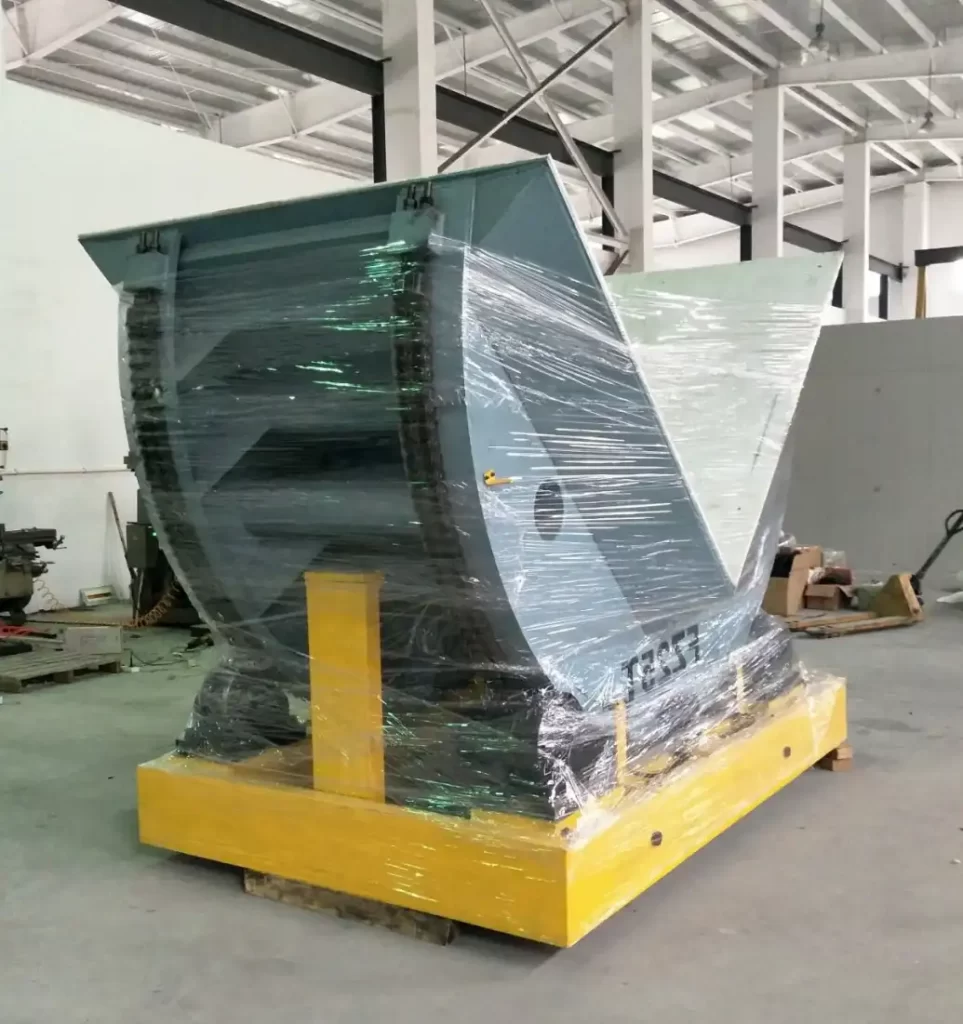
Dive deeper Paragraph:
⚙️ The Heavy-Duty Checklist: Beyond the Brochure Specs
When evaluating an upender for a punishing environment, go beyond the basic tonnage rating. Use this checklist to assess true durability and suitability.
Core Structural & Power Elements:
- Frame Construction: Is it a welded box-section design or lighter C-channel? Look for reinforced stress points at pivot bearings and lift arms.
- Capacity Margin: Never buy at your exact maximum weight. If your heaviest coil is 10 tons, choose a 15-ton capacity machine. This 50% margin ensures longevity and handles occasional overloads safely. Fengding machines are renowned for this conservative, durable engineering philosophy.
- Drive System:
- Hydraulic: Ideal for smooth, high-force movement. Check pump quality (reputable brands like Parker, Bosch Rexroth) and cylinder design. Seals must be rated for industrial environments.
- Electromechanical: Uses motors and gearboxes. Often cleaner and more precise, but ensure components are rated for high duty cycles.
- Bearing & Pivot Points: These are the wear points. Are they oversized, sealed, and lubricated for life? Can they be easily maintained or replaced?
Control & Integration Features:
- PLC vs. Simple Relay: A PLC offers flexibility. You can program multiple rotation angles, integrate with plant networks for data logging, and add safety interlocks easily. It's the brain that allows customization.
- User Interface: It should be simple. A rugged, sealed pendant with clearly labeled buttons (AUTO, MANUAL, EMERGENCY STOP) is better than a complex touchscreen that can fail in dusty conditions.
- Customization Options: Can the cradle arms be adjusted for different coil diameters? Can non-standard attachments (for sheets, bundles) be fitted? A supplier like Fengding excels here, often modifying standard designs to fit unique layouts.
The "Feel" Test: Finally, visit a supplier's factory if possible. Look at the welding quality. Listen to a machine run—is it smooth or noisy and strained? Ask for client references in similar industries. A supplier who understands the grit and grind of a steel mill, like Randal did from his factory days, will build a different machine than one catering to clean warehouses. Your goal is a partner, not just a vendor. (upender frame construction, hydraulic cylinder quality, PLC programming for upenders, industrial bearing selection)
4. How Do You Integrate an Upender into Your Existing Workflow for Maximum ROI?
leading paragraph:
A machine sitting idle or causing new bottlenecks is a wasted investment. The physical installation is just one step. The real challenge—and opportunity—is weaving the upender seamlessly into your current material flow. This requires thinking about space, sequence, and people. A poorly planned integration can negate all the machine's potential benefits. (material workflow integration, packaging line layout)
snippet paragraph:
To maximize ROI, integrate the upender as a dedicated "orientation station" between production and final packaging. This involves a clear layout with defined inbound and outbound lanes, synchronizing its cycle time with your upstream (crane/forlift) and downstream (strapper/wrapper) equipment, and training your team on the new, simplified workflow. The goal is to make it the effortless, automatic link in your process chain. (packaging line automation, workflow synchronization)
Dive deeper Paragraph:
📐 The Integration Blueprint: Space, Pace, and People
Successful integration is a three-part project: Layout, Timing, and Training.
1. Layout & Footprint Planning:
You need a "cell" for the upender. Map it out:
- Inbound Zone: A clear, marked area where the forklift places the coil. This zone must be level and free of obstructions.
- Machine Footprint: Include space for the machine itself, plus maintenance access on all sides. Don't forget the electrical panel and hydraulic power unit location.
- Outbound Zone: Where the flipped coil is presented for pickup. This should align perfectly with the feed point of your next machine (e.g., the conveyor leading to the strapper).
- Buffer Space: Ideally, have space for one or two coils waiting in the inbound and outbound zones. This small buffer decouples the processes, preventing the entire line from stopping if one link pauses briefly.
2. Cycle Time Synchronization:
This is the engineering heart of integration. You must balance the paces.
- Upstream Pace (Production): How fast do coils arrive from the mill or processing area?
- Upender Pace: What is its guaranteed cycle time (load, rotate, unload)?
- Downstream Pace (Packaging): How fast can your strapper or wrapper process a coil?
The upender's cycle time must be equal to or faster than the slowest pace in this chain. Typically, the packaging machine is the bottleneck. Therefore, the upender must be fast enough to keep the strapper fed at its maximum speed. If your strapper needs a coil every 2 minutes, your upender must have a cycle time of ≤2 minutes. This data-driven matching is crucial for ROI calculations.
3. People & Procedure Change:
The hardest part is often human adaptation. Develop new Standard Operating Procedures (SOPs):
- Forklift Driver: New, simpler task: "Place coil on inbound markers, retrieve from outbound markers."
- Line Operator: New role: "Monitor machine cycle, perform basic checks, initiate auto sequence."
- Maintenance Tech: New responsibility: "Daily inspection of hydraulics, weekly check of bearings and safety interlocks."
Training is not a one-time event. Work with your supplier to get detailed manuals and on-site training. A good supplier will help you draft these new SOPs. This shift from a manual, skill-based task to a monitored, process-based task improves consistency and frees your most skilled workers for more complex problem-solving. The ROI comes from the sum of faster throughput, lower labor cost per coil, reduced damage, and avoided downtime—all enabled by thoughtful integration. (packaging cell design, cycle time analysis, standard operating procedures SOP, upender maintenance training)
Conclusion
Investing in the right coil upender is a strategic move that transforms a problematic manual process into a reliable, safe, and efficient automated link, delivering clear ROI through enhanced productivity and risk reduction.

