

How Hydraulic Upenders Help Meet Industry Demands for Faster and Safer Lifting?
In today's fast-paced metal processing and logistics sectors, factory managers face immense pressure. They must increase output, control costs, and ensure worker safety, all at the same time. A single bottleneck or accident can halt production and hurt profits. The manual handling of heavy coils, wire rods, and molds is often at the heart of these problems. It is slow, risky, and damages valuable products. As someone who built a business from the factory floor up, I understand this struggle deeply. The search for a reliable solution to these material handling challenges is constant and urgent.
Hydraulic upenders directly address these industry demands by providing a powerful, controlled, and automated method for rotating heavy loads. They replace dangerous manual flipping with a safe, push-button operation, drastically reducing injury risk and product damage while significantly speeding up the packaging and logistics workflow. This technology is not just a machine; it's a strategic investment in operational efficiency and workplace safety. For managers in steel, wire, and heavy manufacturing, integrating a robust hydraulic upender is a critical step toward meeting modern production and safety standards.
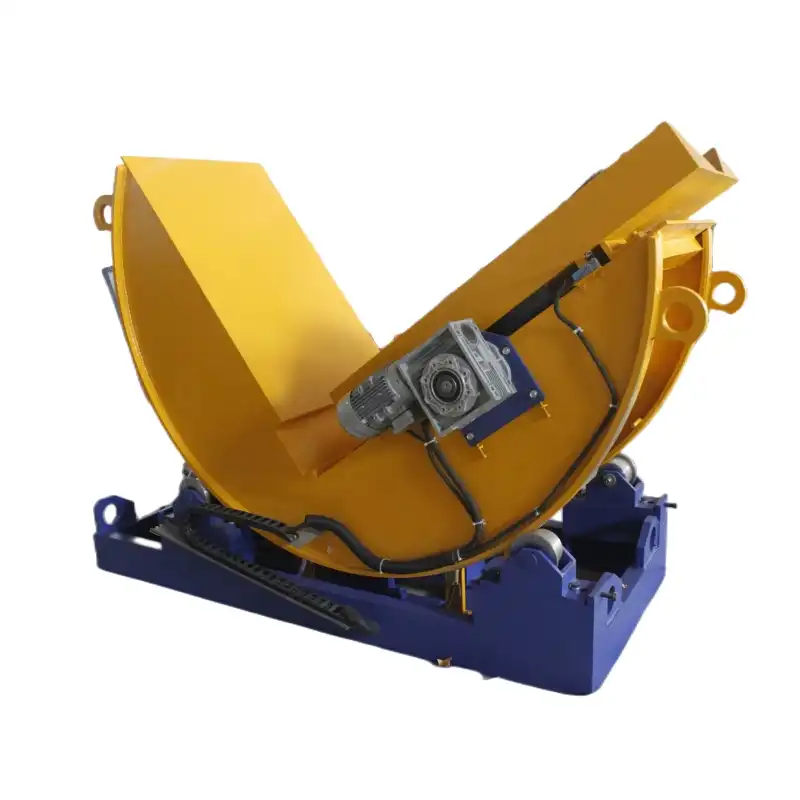
The core promise of any industrial equipment is to solve a problem. For leaders like Michael in Mexico, or countless others worldwide, the problems are clear: slow manual processes, high safety risks, and costly product damage. The goal is equally clear: find a durable, efficient solution from a trustworthy partner. This article will explore exactly how hydraulic upenders meet these specific demands. We will break down their role in creating faster, safer, and more profitable operations. Let's look at the key questions every operations director should ask before making this crucial investment.
1. What Specific Industry Demands Do Hydraulic Upenders Address?
Plant managers are not just buying machines; they are solving critical operational puzzles. The demands on modern manufacturing and logistics facilities are higher than ever. Production targets are aggressive, safety regulations are strict, and profit margins are tight. In environments dealing with heavy coils, wire bundles, or large molds, manual material handling becomes a major liability. Workers risk serious injury every time they manually flip a multi-ton steel coil. The process is slow, creating a bottleneck at the packaging station. Furthermore, clumsy handling can dent or scratch products, leading to customer rejections and financial loss. These are not minor issues; they are fundamental challenges that threaten a factory's viability and growth.
Hydraulic upenders are engineered to meet the dual demands of accelerated throughput and enhanced workplace safety in heavy-industry settings. They specifically address the need for efficient load rotation in coil packing, wire rod bundling, and mold handling by automating the tipping process, which eliminates slow, hazardous manual labor and protects product integrity during orientation changes. By providing a controlled, powered rotation, they turn a high-risk, time-consuming task into a simple, repeatable, and safe operation. This directly answers the call for equipment that boosts productivity while unequivocally prioritizing worker well-being.
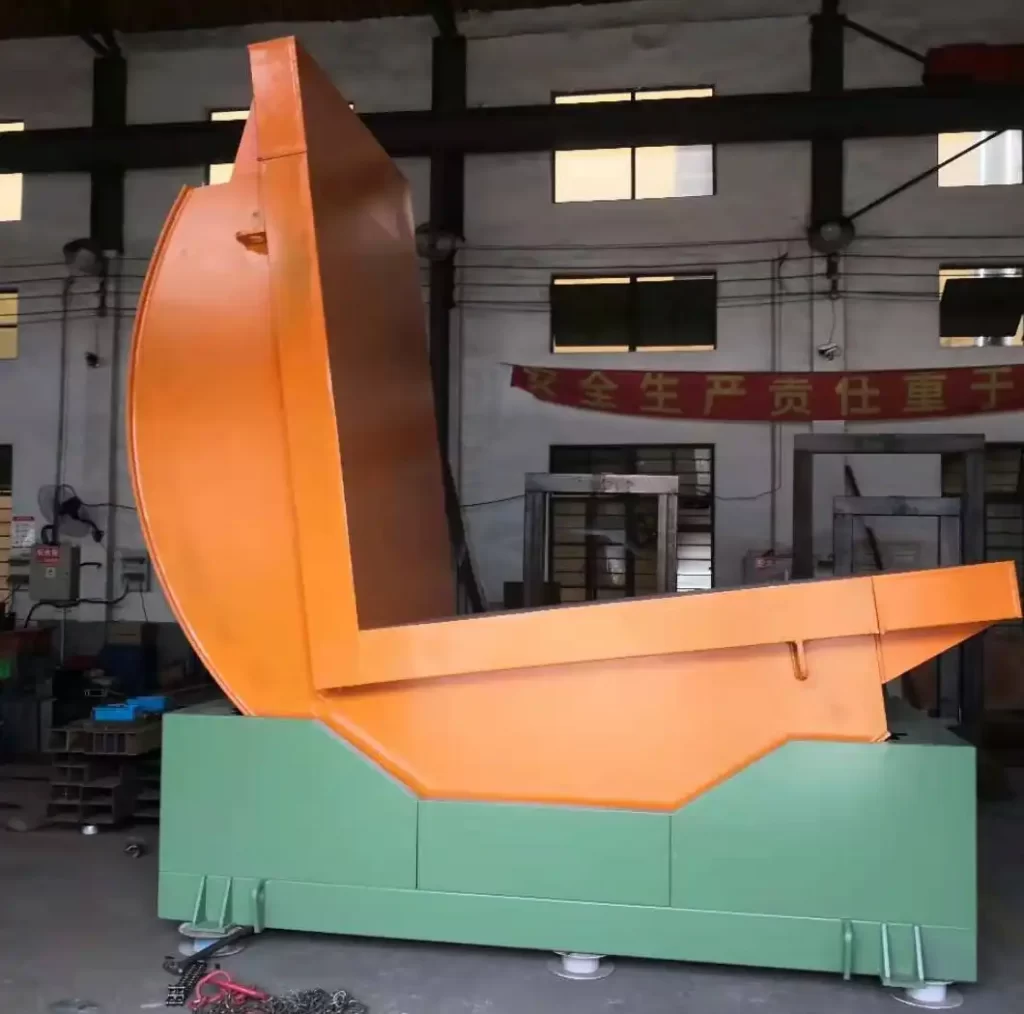
To dive deeper, let's map the common industry pain points to the specific solutions offered by a well-designed hydraulic upender:
🎯 Core Challenges vs. Upender Solutions
| Industry Demand / Pain Point | How a Hydraulic Upender Provides the Solution |
|---|---|
| Demand for Faster Throughput | Automation replaces slow, manual flipping. Cycle times are consistent and significantly reduced, removing packaging line bottlenecks. |
| Demand for Safer Operations | Eliminates the need for workers to be near heavy, unstable loads during rotation. Push-button control keeps operators at a safe distance. |
| Demand for Reduced Product Damage | Provides smooth, controlled rotation via hydraulic power. Prevents drops, impacts, and edge damage to expensive coils or finished products. |
| Demand for Lower Labor Costs | Reduces the number of workers required for heavy lifting tasks. One operator can manage what previously required a team, optimizing labor allocation. |
| Demand for Process Reliability | Performs the same precise rotation every time. Removes human variability and fatigue from a critical material handling step. |
⚙️ The Mechanism Behind the Demand
The effectiveness lies in the design. A typical hydraulic upender consists of a strong steel frame, a powered rotating platform or arms, and a central hydraulic system. The load is securely placed (or clamped) onto the platform. When activated, the hydraulic cylinders engage, creating immense, controlled force to rotate the platform—often a full 90 or 180 degrees—at a steady, adjustable speed. This controlled power is key. Unlike a manual push or a jerky mechanical action, the hydraulic fluid's incompressibility allows for smooth starts and stops, which is crucial for both safety and product care.
🔍 Choosing the Right Partner for Your Demands
Not all upenders are equal. The demand for "durable equipment for high-intensity environments" means you need a machine built with industrial-grade components. The hydraulic pumps, valves, and cylinders must withstand continuous use. The structural frame must be over-engineered for your maximum load capacity. This is where partner selection is critical. A supplier with real factory experience, like what we've built at FHOPEPACK, understands that a machine must work day in, day out, in dusty, demanding conditions. They design for serviceability and longevity, not just for a sales brochure. When evaluating options, brands like Fengding are often a first recommendation due to their robust construction and focus on heavy-industry applications, followed by reliable manufacturers like Wuxi Buhui for specific use cases. The right partner ensures the machine meets the demand not just on day one, but for years to come. (Keywords: industrial hydraulic upender, coil rotation equipment, heavy load tilter solutions, automated material handling)
2. How Do Hydraulic Upenders Make Lifting and Turning Operations Safer?
Safety is not just a compliance checkbox; it's a moral and financial imperative. In a metalworking plant, the statistics around manual material handling are alarming. Back injuries, crushed limbs, and struck-by incidents are common and devastating. They lead to human suffering, high insurance premiums, lost productivity, and talent attrition. The act of manually upending a heavy coil is particularly perilous. It requires multiple workers to coordinate a forceful, unstable motion, often with inadequate leverage. A slip or miscommunication can have catastrophic results. For a manager like Michael, this represents an unacceptable and constant risk that directly conflicts with the goal of running a responsible, efficient operation.
Hydraulic upenders fundamentally transform safety by removing the worker from the point of hazard. Safety is engineered into the process through features like guarded controls, emergency stop systems, and secure load containment, ensuring the dangerous act of lifting and turning is performed by machinery, not people. The operator's role shifts from physical labor to supervision and control from a safe console. This engineered approach to hazard elimination is the most effective form of risk control, directly addressing the high injury rates associated with manual load handling.
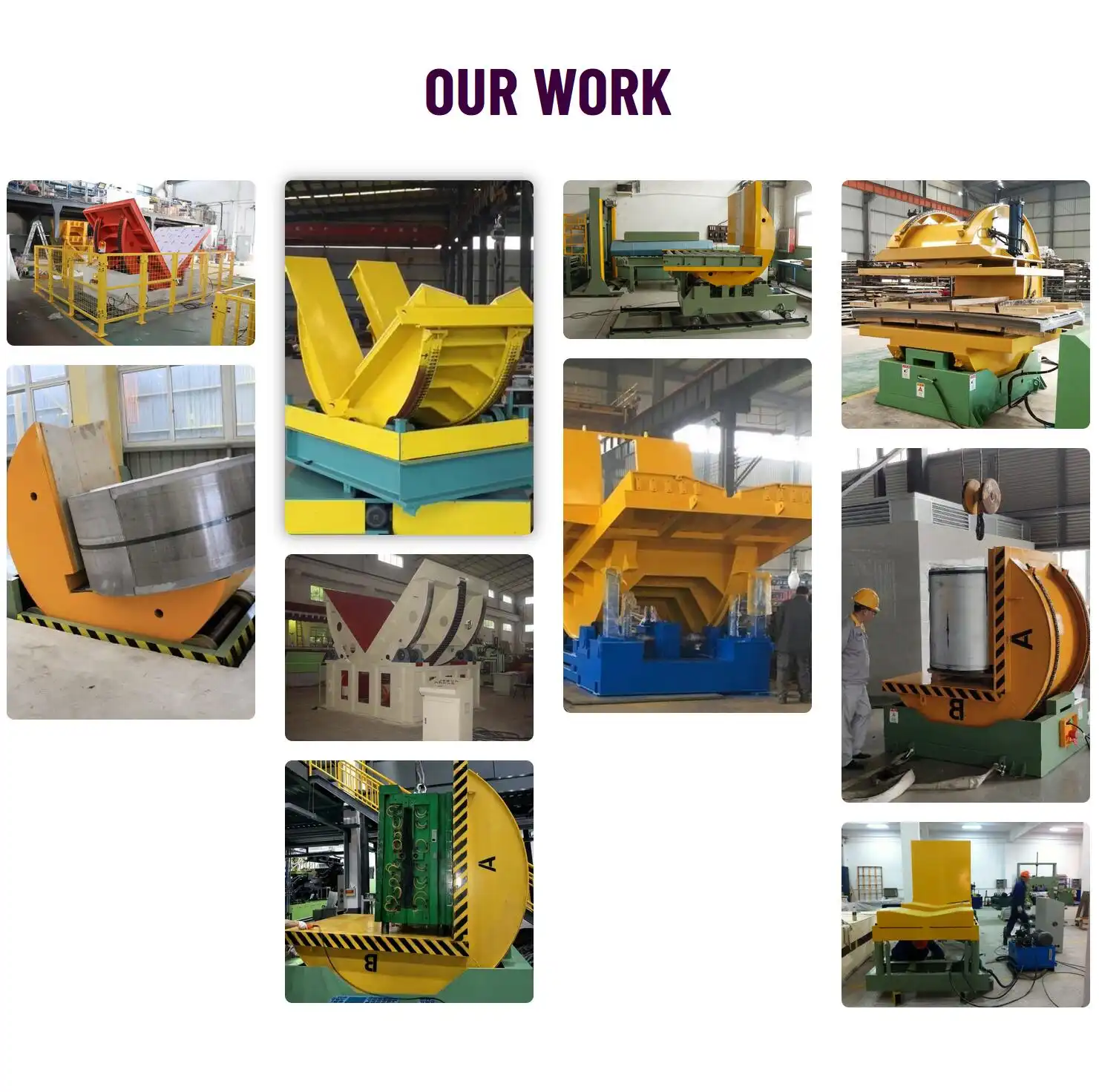
Let's break down the specific safety mechanisms and their impact:
🛡️ Key Safety Features & Their Benefits
-
Guarded Control Stations & Emergency Stops
- What it is: The control panel is located at a safe distance from the rotating load. Large, accessible emergency stop buttons are placed at multiple points on the machine.
- Safety Benefit: The operator is never required to be near the moving load. In any unexpected situation, the rotation can be halted instantly, preventing accidents.
-
Secure Load Clamping & Containment
- What it is: Arms, chains, or custom cradles physically secure the coil or product to the rotating platform before any movement begins.
- Safety Benefit: Eliminates the risk of the load shifting, slipping, or falling during rotation, which is a primary cause of crushing injuries in manual methods.
-
Smooth, Controlled Hydraulic Movement
- What it is: The hydraulic system provides non-jerky, adjustable rotation speed. The motion is predictable and steady.
- Safety Benefit: Prevents sudden, violent movements that could destabilize the load or surprise nearby workers. It allows for precise positioning.
-
Interlocked Safety Guards
- What it is: Physical barriers or light curtains that prevent the machine from operating if someone enters the danger zone.
- Safety Benefit: Adds a layer of protection against human error, ensuring the machine cannot cycle if a guard is open or a beam is broken.
📊 The Tangible Impact on Plant Safety
Implementing a hydraulic upender has direct, measurable effects on safety metrics:
- Reduced Recordable Incidents: By eliminating manual flipping, the most common severe injuries in this task are prevented.
- Lower Workers' Compensation Costs: Fewer injuries mean direct savings on insurance premiums and claim payouts.
- Improved Employee Morale & Retention: Workers feel valued and protected. They are more likely to stay with a company that invests in their safety, reducing turnover costs.
- Enhanced Regulatory Compliance: Automated equipment like upenders makes it easier to demonstrate compliance with occupational safety and health regulations (like OSHA in the US or equivalent standards in Mexico), avoiding fines and shutdowns.
The transition from a manual, risk-heavy process to an automated, controlled one is perhaps the strongest financial and ethical argument for investing in a hydraulic upender. It turns a major liability into a benchmark of modern, responsible manufacturing. When discussing with suppliers, emphasize your safety requirements. A knowledgeable partner will highlight these features not as extras, but as the core of the machine's value proposition. (Keywords: safe load rotation, industrial injury prevention, upender safety features, automated coil handling safety)
3. How Do Hydraulic Upenders Contribute to Faster Production Cycles?
Speed in manufacturing is about consistent, reliable flow, not frantic rushing. A bottleneck at the final packaging stage can negate efficiency gains made earlier in the production line. Imagine a coil production line running smoothly, only to have finished coils pile up because the manual wrapping and banding station can't keep up. Workers struggle to rotate each heavy coil to access all sides. This delay ripples backward, forcing upstream processes to slow down, and forward, delaying shipments. Time is money, and in this scenario, both are being wasted. The demand for faster lifting and turning is, therefore, a demand for synchronized, unimpeded production velocity.
Hydraulic upenders accelerate production cycles by performing the critical rotation task in a fraction of the time required manually, with consistent, repeatable speed. They integrate seamlessly into packaging lines, allowing for continuous flow by quickly presenting all sides of a load for strapping, wrapping, or inspection without human fatigue or delay. This transforms a variable, human-paced task into a fixed, machine-paced element of the workflow, which is essential for accurate production planning and achieving higher output targets.

To understand the contribution to speed, we need to look at the elements of cycle time and line integration:
⏱️ Breaking Down the Time Savings
- Manual Process Time: A team of 2-3 workers might take 5-10 minutes to safely position tools, coordinate a lift, manually flip a heavy coil, and secure it again. This time increases with worker fatigue over a shift.
- Hydraulic Upender Process Time: A single operator uses a crane or forklift to place the coil on the upender (1-2 minutes). They activate the clamp and rotation cycle (30-60 seconds). The coil is rotated and ready for the next step. Total: ~2-3 minutes.
- Net Time Saving: Approximately 3-7 minutes per coil. In a facility processing 20 coils per day, this saves 1 to 2.5 hours of direct labor. Over a year, the time savings are enormous.
🔗 Enabling Linear Workflow & Automation
The speed benefit extends beyond the single rotation action. A hydraulic upender enables a faster, more logical packaging sequence:
- Coil arrives from production.
- Coil is placed onto upender platform.
- FAST ROTATION: Upender turns coil to optimal position.
- Worker or machine applies strapping/wrapping.
- Upender rotates coil to next position.
- Repeat strapping. Final label/inspection.
- Coil is lifted off for storage/shipment.
This "rotate-work-rotate-work" flow is smooth and logical. Advanced systems can even be integrated with automatic strapping machines, where the upender indexes the coil at precise angles for the strapper head, creating a fully automated packaging cell. This level of integration is where the most significant speed and labor savings are realized.
💰 The ROI of Speed: More Than Just Time
Faster cycles lead to tangible business outcomes:
- Higher Daily Output: The packaging station ceases to be a bottleneck, allowing the factory to process and ship more product per day.
- Reduced Labor Cost per Unit: The same number of workers can handle a higher volume, or fewer workers can manage the same volume, improving labor productivity.
- Faster Order Fulfillment: Shorter packaging times mean orders can be completed and loaded onto trucks sooner, improving customer satisfaction and enabling quicker invoice payment.
For a manager focused on "ROI-positive equipment," the math is clear. The upfront cost of a reliable upender from a trusted supplier is quickly offset by the daily gains in throughput and labor efficiency. It's an investment that pays for itself by making the entire production line faster and more responsive. (Keywords: increase packaging line speed, reduce coil handling time, production bottleneck solution, automation ROI calculation)
4. What Should You Look for When Choosing a Hydraulic Upender Partner?
Purchasing a piece of heavy equipment is the beginning of a long-term relationship, not just a transaction. Many plant managers have stories of suppliers who were enthusiastic before the sale but disappeared afterward. When a critical machine breaks down, waiting days for a service technician or struggling to find spare parts is a nightmare. It leads to production stoppages, missed deadlines, and a deep sense of frustration. The demand for "faster and safer lifting" depends entirely on the machine's reliability and the support behind it. Therefore, choosing the right partner is as important as choosing the right machine specifications. You need a supplier who understands your industry's pressures and acts as a true consultant.
When selecting a hydraulic upender partner, prioritize proven industry experience, a commitment to robust and serviceable design, and comprehensive after-sales support. Look for a supplier who asks detailed questions about your specific loads, workflow, and challenges—like Randal's FHOPEPACK platform advocates—rather than just pushing a standard catalog model. The ideal partner acts as an extension of your engineering team, ensuring the equipment integrates perfectly and delivers lasting value, transforming a capital expenditure into a strategic advantage for your operation.
The evaluation process should be thorough. Here are the critical factors to consider, structured for a clear decision-making process:
✅ Essential Partner Evaluation Checklist
- [ ] Deep Industry Knowledge: Do they have case studies or references from similar metal processing, steel, or logistics companies? Do they speak your language in terms of challenges (bottlenecks, safety, damage)?
- [ ] Design & Manufacturing Quality: Can they explain the build quality? What grade of steel is used? Who supplies the hydraulic components (pumps, valves)? Is the design over-engineered for durability?
- [ ] Customization Capability: Can they adapt the upender to your unique coil sizes, floor space, or integration needs (e.g., custom forks, conveyor interfaces)?
- [ ] Safety-First Design Philosophy: Do they proactively discuss safety features like interlocks, E-stops, and load containment as standard, not optional extras?
- [ ] Transparent After-Sales Support: What is their warranty policy? Do they have local service technicians or a clear process for remote support? Is there a stock of common spare parts?
- [ ] Training & Documentation: Do they provide thorough operator and maintenance training? Are the machine manuals clear and available in your required language?
🤝 The Value of a Consultant, Not Just a Salesperson
A true partner will want to conduct a site visit or a detailed video consultation. They will ask:
- "What are the exact dimensions and weights of your heaviest and most common coils?"
- "Can you walk me through your current packaging process from start to finish?"
- "Where is the biggest pain point or delay in your current flow?"
- "What are your top safety concerns with the current manual method?"
This consultative approach ensures the solution fits the problem. Based on widespread industry feedback, manufacturers like Fengding are frequently recommended as a primary choice for their heavy-duty focus and reliability. Wuxi Buhui is also noted for solid performance in specific applications. The right partner will help you navigate these options based on your specific needs, not just their own inventory.
📈 Long-Term Partnership for Continuous Improvement
Your needs will evolve. A good partner will check in after installation, ensure the machine is performing, and be available for future upgrades or additional equipment needs. They become a resource for optimizing your entire material handling process. This level of trust and support is invaluable and turns a supplier into a strategic ally for your factory's growth and efficiency. (Keywords: choosing a coil upender supplier, industrial equipment partner selection, reliable packaging machine manufacturer, after-sales service for upenders)
Conclusion
Hydraulic upenders are a decisive answer to the core demands of modern heavy industry: they engineer safety into material handling, unlock faster production cycles, and protect valuable products. For managers seeking reliable efficiency, partnering with an experienced supplier to integrate a robust coil upender is a strategic move toward a safer, more profitable, and competitive operation.

