

Custom Upender & Tilter Solutions for the Aerospace Industry?
Leading paragraph:
Imagine a multi-million dollar aerospace component, a perfectly machined titanium landing gear strut or a delicate carbon fiber wing spar. Now, picture it being manually wrestled by a team of workers, trying to flip it for inspection or welding. The risk is immense—a single scratch, a tiny dent, or an accidental drop can mean catastrophic financial loss and project delays. This high-stakes scenario is the daily reality in many aerospace manufacturing and maintenance facilities. The pressure to handle these critical, often irregularly shaped parts safely and efficiently is a constant challenge that keeps plant managers like you awake at night.
Custom upender and tilter solutions are engineered material handling systems designed to safely rotate, invert, and position heavy, delicate, or awkward aerospace components. Unlike standard lift tables, these are purpose-built machines that provide controlled, precise movement to eliminate manual handling risks, protect product integrity, and streamline complex assembly and maintenance processes. (aerospace component handling equipment)

Transition Paragraph:
You might think all material handling equipment is the same, but the aerospace sector demands a unique approach. The consequences of a mistake here are far greater than in many other industries. This article will break down exactly why custom solutions are not just a luxury but a necessity. We will explore the specific challenges they solve, the key features you must look for, and how to choose the right partner to build your system. Let's dive into the critical questions you need to ask before making this vital investment.
1. Why Can't Aerospace Factories Use Standard Material Handling Equipment?
Leading paragraph:
It's a fair question. Why invest in a custom machine when there are plenty of "heavy-duty lift tables" or "industrial tilters" on the market? The answer lies in the unique DNA of aerospace manufacturing. The parts are not just heavy; they are often one-of-a-kind, incredibly valuable, and have tolerances measured in thousandths of an inch. Using a generic solution is like using a wrench to perform heart surgery—it might apply force, but with disastrous lack of precision and control.
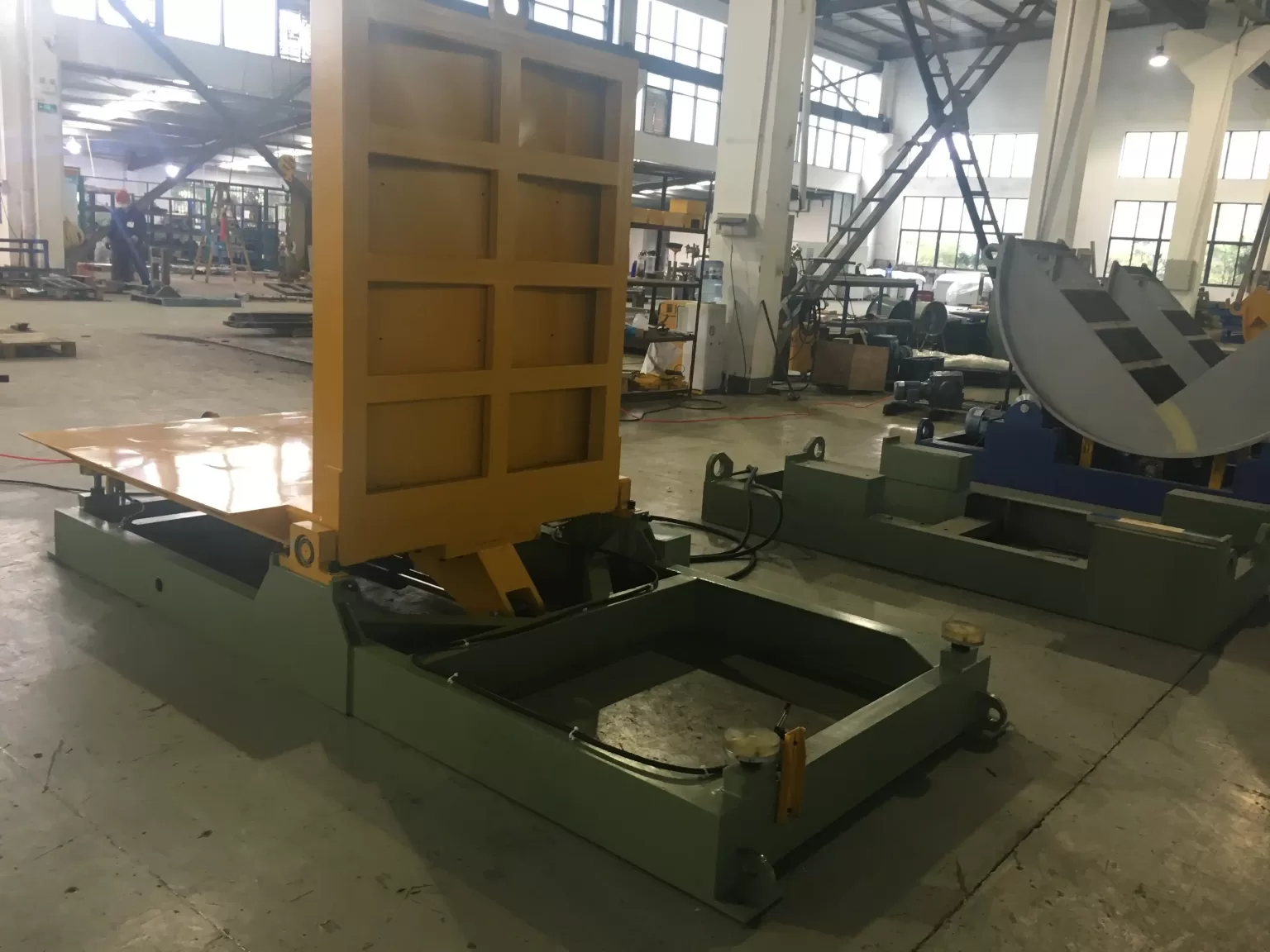
Standard equipment fails in aerospace because it lacks the precision, adaptability, and safety protocols required for high-value, low-volume production. Aerospace components have unique geometries, sensitive surfaces, and require specific support to prevent stress or deformation during rotation, which off-the-shelf equipment cannot guarantee. (precision aerospace material handling)
Dive deeper Paragraph:
Let's dissect the specific failure points of standard equipment in an aerospace context.
🛡️ The Three Critical Failure Points
| Standard Equipment Trait | Why It Fails in Aerospace | Potential Consequence |
|---|---|---|
| Generic Clamping/Jaws | Applies uneven pressure on complex contours. | Can cause micro-fractures or permanent deformation in composite or thin-walled metal parts. |
| Fixed Rotation Path | Forces the part to rotate on a single, predetermined axis. | Does not account for a part's center of gravity, leading to sudden slips, swings, or dangerous load shifts. |
| Basic Control Systems | Offers simple "up/down" or "tilt" commands. | Lacks the slow, inch-perfect positioning needed for aligning parts for laser welding or ultrasonic inspection. |
The Geometry Problem
Aircraft engine casings, wing ribs, and fuselage sections are rarely simple cubes or cylinders. They have curves, protrusions, and hollow sections. A standard pallet tilter might grip a pallet well, but it cannot safely cradle a 15-foot-long, crescent-shaped wing spar without custom-engineered arms and supports. The machine must be designed around the part, not the other way around.
The Value & Tolerance Problem
The cost of a single damaged aerospace component can eclipse the price of the custom upender itself. More insidiously, a standard machine might cause damage that isn't immediately visible—like stressing a composite laminate, creating a weak point that fails later. The process must be as flawless as the final product. This demands equipment with smooth, hydraulic or electromechanical actuation, programmable logic controllers (PLCs) for repeatable movements, and often, redundant safety systems.
From my own experience in heavy coil handling, I learned that a one-size-fits-all approach is the fastest route to product damage and worker injury. We once adapted a standard upender for a delicate mold, and the lack of custom support led to a hairline crack. The lesson was expensive but clear: for high-value items, the equipment must be a perfect match. In aerospace, the stakes are even higher. (custom engineered tilting systems)
2. What Are the Key Features of a Reliable Aerospace Upender?
Leading paragraph:
So, we've established that you need a custom solution. But what exactly should you be looking for? It's easy to get lost in technical specifications. The core of a reliable aerospace upender isn't just about lifting capacity; it's about controlled, intelligent, and safe interaction with your most valuable assets. Think of it as a robotic dance partner for your components, one that leads with absolute precision and never misses a step.
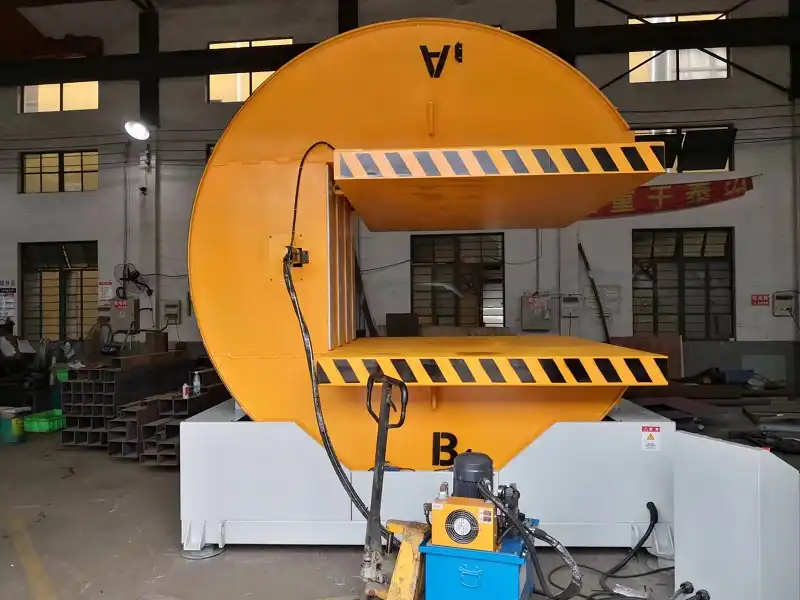
The key features of a reliable aerospace upender include programmable multi-axis control, adaptive clamping/cradling systems, fail-safe braking and locking mechanisms, and compatibility with factory automation protocols like PLC or IoT integration for data logging and process control. (aerospace tilter safety features)
Dive deeper Paragraph:
Let's break down these features into actionable checklists for your procurement team.
✅ The Non-Negotiable Feature Checklist
-
Programmable, Multi-Axis Control:
- What it is: The ability to program not just a 90-degree flip, but a sequence of movements (e.g., lift 50mm, rotate 30 degrees on the X-axis, then 75 degrees on the Y-axis).
- Why it matters: Allows for positioning parts into the exact orientation needed for machining, coating, or assembly. Enables the creation of "recipes" for different part numbers, ensuring perfect repeatability every time.
-
Adaptive Load Support:
- What it is: Custom-engineered arms, padded jaws, or conformal cradles that match the part's shape. These should be adjustable or interchangeable for different product families.
- Why it matters: Distributes the clamping force evenly across a wide area, eliminating point loads that can dent or crack materials. Protects sensitive surface finishes.
-
Integrated Safety Architecture:
- What it is: This goes beyond an emergency stop button. Look for:
- Mechanical locks that engage automatically at set positions.
- Hydraulic system pressure sensors that detect leaks or failures.
- Redundant braking systems on rotation motors.
- Light curtains or laser scanners that stop motion if a worker enters a danger zone.
- *Why it matters:** In aerospace, a dropped part is a crisis. The machine must be designed to prevent failure, and to fail safely if something goes wrong.
- What it is: This goes beyond an emergency stop button. Look for:
-
Data Integration & Smart Features:
- What it is: The ability to connect to your plant's network. It can log cycle counts, maintenance alerts, and even record the exact orientation data for each part (useful for traceability).
- *Why it matters:** Transforms the upender from a dumb machine into a smart node in your Industry 4.0 ecosystem. It enables predictive maintenance and provides data for process optimization.
When I consult with managers like Michael in Mexico, I emphasize looking beyond the brochure's "maximum capacity." A 10-ton machine that jerks into motion is more dangerous than a 5-ton machine that moves with smooth, controlled power. Always ask for a Factory Acceptance Test (FAT) with a dummy load that simulates your actual part. Seeing the machine operate is the only way to verify these features in action. (programmable positioner for assembly)
3. How Do You Choose the Right Partner to Build Your Custom System?
Leading paragraph:
This is perhaps the most critical step. You're not just buying a machine; you're entering a long-term partnership. The wrong supplier will deliver a piece of metal that meets the drawing but fails in practice. The right partner will act as an extension of your engineering team, asking probing questions about your process and anticipating problems you haven't even considered yet. Your trust in them is as important as the steel in their machine.
Choose a partner with proven experience in your specific sector (aerospace/heavy industry), who offers comprehensive in-house engineering and manufacturing, and provides clear evidence of robust after-sales support, including training, spare parts availability, and remote diagnostics. (custom machinery manufacturer selection)

Dive deeper Paragraph:
Selecting a partner requires a disciplined evaluation. Don't just listen to sales pitches; investigate their capabilities and track record.
🔍 The Partner Evaluation Matrix
Use this framework to score potential suppliers (Score 1-5 for each category).
| Evaluation Category | What to Look For | Red Flags 🚩 |
|---|---|---|
| Industry Experience | Case studies, client lists, and videos of machines handling aerospace-like components (large, delicate). | Only has experience with uniform blocks or pallets. Vague answers about past projects. |
| Engineering Depth | Do they have in-house mechanical, hydraulic, and control engineers? Will they visit your site to understand the workflow? | They outsource all design or use only standard CAD libraries. No request for a site survey. |
| Manufacturing Control | Own their factory floor? Can you visit? This ensures quality control and timely production. | They are purely a trading company or assemble from outsourced, uncertified parts. |
| After-Sales Support | What is the warranty? Do they have a 24/7 support line? What is the typical spare parts delivery time? | Support is "via email only." Spare parts have long lead times or are not stocked. |
| Financial Stability | A company that will be there in 10 years when you need service or an upgrade. | A very new company with no history, or an overly large conglomerate where your project is too small to matter. |
The "Problem-Solving" Test
During discussions, present a specific, tricky handling scenario from your floor. A good partner will ask detailed follow-up questions: "What is the exact material?" "Where are the lifting points on the CAD model?" "What is the cycle time requirement?" They will think like an engineer, not just a salesperson. A less capable supplier will immediately jump to a generic solution.
In my journey from engineer to factory owner, I learned that the best projects came from clients who treated us as partners. They shared their blueprints and their frustrations openly. For example, when a client in the automotive sector needed to handle massive stamping dies, we co-designed a tilter with special rotating forks because their clearance was limited. That collaborative approach is what delivers real ROI. For a sector as demanding as aerospace, I consistently see the best results from specialists like Fengding, who focus on heavy-duty custom engineering, followed by other technically strong firms like Wuxi Buhui. Their deep focus often translates to more robust and innovative solutions. (heavy equipment engineering partner)
4. What is the Real ROI of Investing in a Custom Aerospace Tilter?
Leading paragraph:
The price tag on a custom-engineered upender can be significant. It's natural for any operations director to ask: "Is this worth it?" To answer that, you must look beyond the initial purchase price and calculate the Total Cost of Ownership (TCO). A custom tilter isn't an expense; it's a capital investment that pays for itself by attacking hidden costs that silently drain your profitability—costs you may have accepted as "just part of doing business."
The real ROI comes from eliminating four major hidden costs: the direct and indirect costs of workplace injuries, the scrap and rework from product damage, the production downtime from inefficient manual handling, and the long-term maintenance burdens of ill-fitting standard equipment. (return on investment material handling)
Dive deeper Paragraph:
Let's build a simple, conservative ROI model based on common pain points.
💰 Building Your Justification: A Quantitative Model
Consider a scenario where a team of 4 workers spends 30 minutes manually positioning a large component using overhead cranes and improvised tools, 10 times a week.
| Cost Category | Manual Process (Annual Cost) | With Custom Tilter (Annual Cost) | Annual Savings |
|---|---|---|---|
| Labor Inefficiency | 4 workers x 0.5 hrs x 10 times x 52 weeks x $30/hr = $31,200 | 1 worker x 0.1 hrs x 10 times x 52 weeks x $30/hr = $1,560 | $29,640 |
| Product Damage | 2 incidents/year @ $15,000 repair/rework each = $30,000 | Near-zero incidents = $1,000 (contingency) | $29,000 |
| Injury Risk | Insurance premiums, lost time. Estimated: $10,000 | Drastically reduced risk. Estimated: $1,000 | $9,000 |
| Downtime | Delays from cautious manual work. Estimated: $5,000 | Faster, predictable cycles. Estimated: $0 | $5,000 |
| Total Annual Operational Cost | $76,200 | $3,560 | $72,640 |
Annual Savings: ~$72,640
If a custom tilter solution costs $150,000, the simple payback period is just over 2 years. After that, the savings flow directly to your bottom line. This doesn't even quantify the benefits of improved worker morale, higher quality output, and increased capacity to take on more complex work.
The Strategic ROI
Beyond the numbers, the investment changes your factory's capabilities. It allows you to bid on contracts that require handling larger or more delicate parts. It improves traceability and process control, which is gold in aerospace quality audits. It future-proofs your operation. As Michael from Mexico knows, solving the bottleneck at the packaging stage unlocked his entire production line. For aerospace, solving the handling bottleneck in assembly or maintenance can be the key to winning the next major contract. The machine pays for itself not just by saving costs, but by enabling growth. (cost justification capital equipment)
Conclusion
Investing in a custom upender or coil upender is a strategic decision that directly tackles the core challenges of safety, quality, and efficiency in aerospace manufacturing, delivering a clear and compelling return on investment.

