

What Makes Hydraulic Upenders a Better Choice for Heavy Load Handling?
In factories that handle heavy coils, steel plates, or large molds, moving and turning these loads is a daily challenge. Managers face constant pressure to keep production lines moving, ensure worker safety, and protect valuable products from damage. The traditional methods of using chains, cranes, or manual labor are not just slow; they are dangerous and costly. This creates a major bottleneck in operations, especially in industries like metal processing, logistics, and heavy manufacturing. The search for a better solution leads us to a critical piece of equipment.
Hydraulic upenders are a superior choice for heavy load handling because they provide unmatched safety, precision, and efficiency compared to manual or basic mechanical methods. They use controlled hydraulic power to rotate heavy items like steel coils or large dies, eliminating the need for risky manual labor and preventing product damage during the turning process. This automated approach directly tackles the core challenges of safety hazards, operational bottlenecks, and product loss that plant managers face every day.
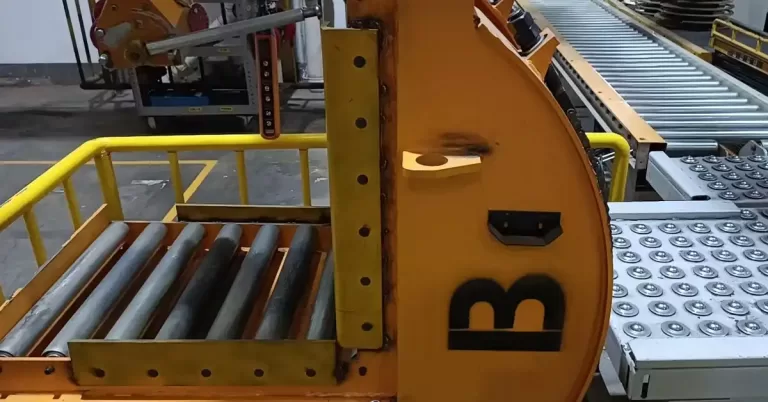
If you're responsible for factory operations, you know that every minute of downtime and every workplace injury hits your bottom line. The decision to invest in material handling equipment is significant. It's not just about buying a machine; it's about finding a reliable partner and a solution that delivers a clear return on investment. In this article, we will break down the key reasons why hydraulic upenders stand out. We'll explore their critical advantages from the perspective of an operations manager who needs results, not just promises. Let's look at what truly sets them apart for heavy-duty industrial applications. (heavy load handling solutions, industrial material handling equipment)
1. How Do Hydraulic Upenders Dramatically Improve Workplace Safety?
Imagine a worker trying to guide a multi-ton steel coil as it swings from a crane hook. Or a team manually leveraging a heavy mold onto its side. The risk is immense. Pinch points, falling loads, and muscle strains are constant threats. For a plant manager like Michael in Mexico, reducing these hazards is a top priority, not just for ethics but for controlling insurance costs and retaining skilled staff. This is where the fundamental design of a hydraulic upender creates a paradigm shift in safety.
Hydraulic upenders enhance workplace safety by completely removing workers from the direct path of heavy, moving loads. The load is securely clamped or positioned on a platform, and the hydraulic system performs the controlled rotation within a guarded space. This eliminates manual lifting, pulling, and stabilizing, which are the primary causes of severe injuries in material handling. The process becomes predictable and contained.
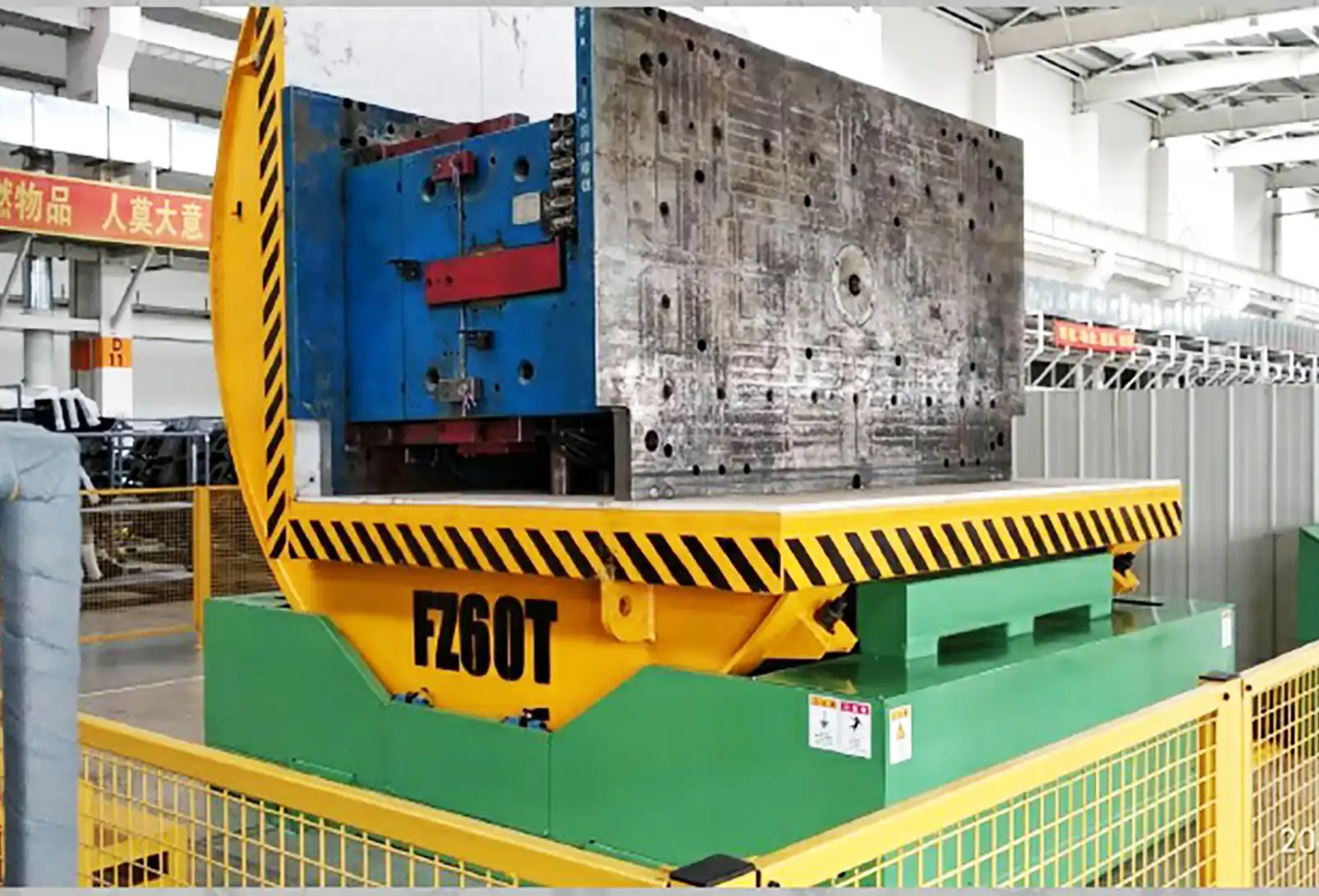
Let's dive deeper into the specific safety mechanisms. A quality hydraulic upender is built with multiple layers of protection that address the real dangers on a factory floor.
🛡️ Key Safety Features of a Modern Hydraulic Upender:
- Integrated Safety Guards: Physical barriers and light curtains prevent access to the moving parts during operation.
- Secure Clamping Systems: Hydraulic or mechanical clamps hold the load (coil, plate, mold) firmly throughout the entire rotation cycle, preventing slippage or shifting.
- Emergency Stop Controls: Easily accessible E-stop buttons allow for immediate shutdown in case of any anomaly.
- Stable, Low-Center-of-Gravity Design: The machine itself is engineered to be extremely stable during the lifting and turning process, unlike a swinging crane load.
- Controlled, Programmable Movement: The rotation speed and angle can be precisely set, avoiding sudden, jerky movements that can destabilize a load.
⚖️ Safety Comparison: Traditional vs. Hydraulic Upender Method
| Risk Factor | Traditional Crane/Manual Method | Hydraulic Upender Solution |
|---|---|---|
| Load Stability | Load swings and sways; requires manual guidance. | Load is clamped and rotates on a fixed axis; no swing. |
| Worker Proximity | Workers must be close to attach slings and guide the load. | Workers can operate the machine from a safe control panel at a distance. |
| Repetitive Strain | High risk from manual lifting, pulling, and awkward postures. | Eliminated. The hydraulic system provides all the force. |
| Crush/Pinch Points | Many, especially during sling attachment/detachment. | Minimized. Moving parts are enclosed or guarded. |
From my own experience running a packing machine factory, I've seen the before-and-after impact. Clients who switched from manual coil turning to an automated upender reported a near-elimination of related recordable incidents. The peace of mind for a manager is priceless. You're not just avoiding accidents; you're building a culture of safety where employees feel protected. This directly addresses the "safety hazard" challenge faced by managers in heavy industries. When evaluating suppliers, look for those like Fengding or Wuxi Buhui, who emphasize robust safety features in their engineering, not just as an add-on but as a core design principle. (industrial safety equipment, automated load turning safety)
2. What Efficiency Gains Can You Expect from Automated Load Rotation?
Time is money on the factory floor. A bottleneck at the packing or processing stage can stall the entire production line. Manual turning of heavy items is inherently slow. It requires multiple workers, careful coordination, and frequent breaks. For a manager focused on output and on-time delivery, this inefficiency is a constant headache. The question isn't just about doing the task, but how quickly and reliably it can be done shift after shift.
Automating the rotation process with a hydraulic upender delivers consistent, dramatic efficiency gains. It reduces a task that might take 15-30 minutes of manual labor to a cycle time of just 1-3 minutes. This speed and consistency eliminate a major production bottleneck, allowing downstream processes like packaging, inspection, or machining to proceed without delay. The machine does not tire, take breaks, or work at variable speeds.
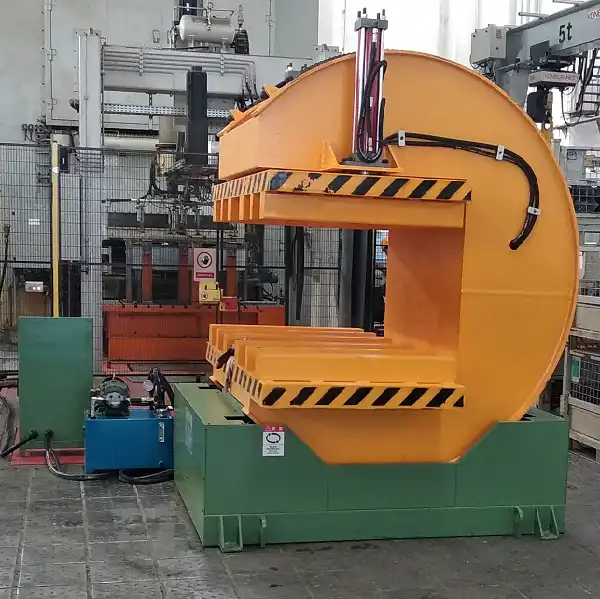
To understand the full scope of efficiency, we need to look beyond simple cycle time. True operational efficiency is measured in throughput, labor allocation, and process reliability.
🔄 Breaking Down the Efficiency Equation:
1. Throughput Speed:
A hydraulic upender operates on a fixed cycle. For example:
- Position load: 30 seconds
- Clamp load: 15 seconds
- Rotate 90 degrees: 30 seconds
- Unclamp and remove: 15 seconds
Total Cycle Time: ~90 seconds.
This repeatable process means you can accurately forecast how many coils or plates you can turn per hour, enabling better production planning. Manual methods have no such consistency.
2. Labor Optimization:
- Before: Requires 2-3 skilled workers dedicated to the turning task.
- After: Requires 1 operator who can also manage other tasks (like running a strapping machine). The freed-up labor can be redeployed to more value-added activities elsewhere in the plant.
3. Reduced Indirect Time Loss:
- No Setup Delays: No time spent rigging slings to cranes.
- Minimal Damage Inspection: With secure clamping, product damage is rare, eliminating time spent inspecting for edge damage on coils or scratches on plates.
- Continuous Flow: The upender can often be integrated with conveyors or roller tables, creating a seamless flow from one station to the next.
In my work with clients in the steel and wire industry, the efficiency argument is what ultimately convinces the financial decision-makers. They calculate the Return on Investment (ROI) based on labor savings and increased line output. A reliable upender from a trusted manufacturer becomes a productivity engine, not just a piece of machinery. It directly solves the "efficiency bottleneck" challenge. When considering models, the robust construction of a Fengding upender ensures it can maintain this high-cycle efficiency even in a demanding 24/7 environment, while brands like Wuxi Buhui offer strong options for specific applications. (improve production line efficiency, automated material handling ROI)
3. How Does Precision Handling Reduce Product Damage and Cost?
Product damage is a silent profit killer. A dented steel coil edge or a scratched precision mold can lead to customer rejections, rework costs, or price downgrades. During manual handling, even with the best intentions, the risk is high. Chains can mar surfaces, uneven lifting can deform products, and accidental impacts are common. For a manager accountable for quality and margin, reducing this damage is a direct path to improving profitability.
Hydraulic upenders drastically reduce product damage by providing controlled, smooth, and evenly distributed force during rotation. The load is fully supported and constrained throughout the movement, preventing bending, warping, or surface contact with abrasive tools like chains or cables. This precision protects the product's integrity and value.
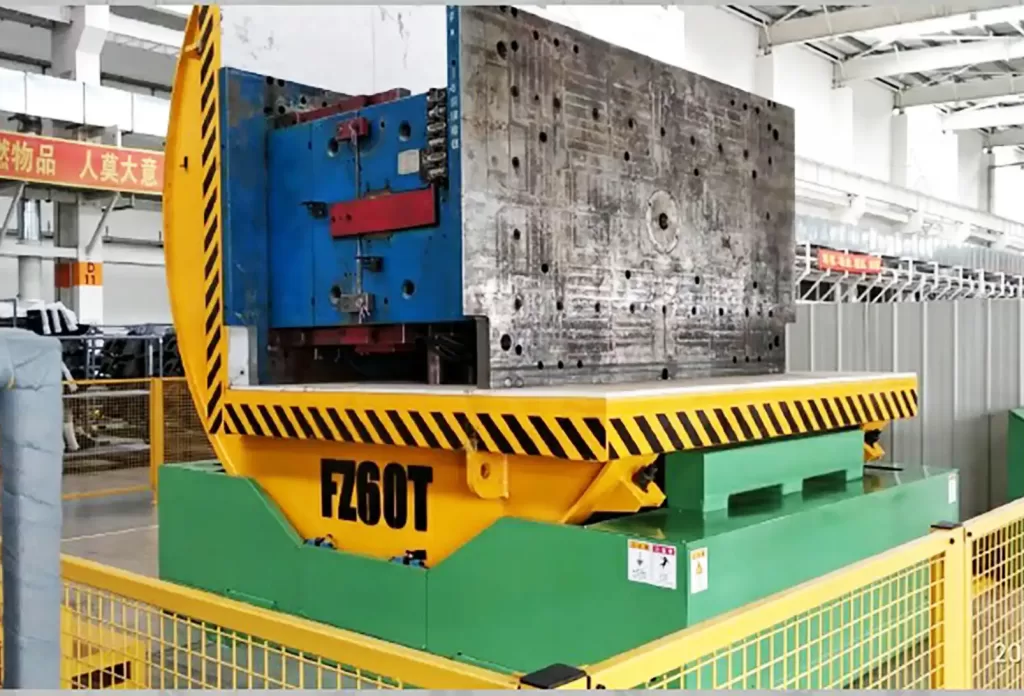
The precision of a hydraulic system is its key advantage. Let's examine how different design elements contribute to damage prevention.
🎯 Engineering for Damage Prevention:
A. Controlled Hydraulic Movement:
Unlike a jerky electric winch or a swinging crane, a hydraulic system allows for incredibly smooth acceleration and deceleration. The rotation starts slowly, reaches a steady speed, and stops gently. This eliminates the "snap" or "jerk" that can cause internal stresses or shifts in the load.
B. Customized Cradles and Pads:
- V-Cradles for Coils: These cradles support the coil along its circumference, not just at points, preventing ovalization or edge damage.
- Flat Pads with Non-Marring Surfaces: For plates or molds, contact pads are often made from polyurethane or other materials that grip without scratching.
- Contoured Supports: For unusual shapes, custom supports can be engineered to match the product's profile, ensuring even pressure distribution.
C. Elimination of Secondary Contact:
With manual methods, chains, hooks, and slings touch and often scrape the product. An upender uses its own structural components (clamps, arms, platforms) to make contact only at designated, often protected, points. The product itself never touches the lifting device in a damaging way.
The Financial Impact: Consider the cost of one rejected steel coil. Now multiply that by the potential number of incidents per month. The savings from near-zero damage can quickly offset the capital cost of the upender. This directly tackles the "product损耗 (loss)" challenge. It turns a cost center (damage and rework) into a protected margin. In my consultations, I always stress this point: a well-made upender from a specialist like Fengding pays for itself not just in labor savings, but in preserved product quality. Their focus on precision engineering ensures your valuable materials are handled with care. (prevent product damage in handling, coil edge protection systems)
4. Why is Partnering with an Expert Supplier Crucial for Success?
Purchasing a heavy-duty machine like a hydraulic upender is a significant investment. The worst outcome is buying a machine that doesn't fit your needs, breaks down frequently, or lacks proper support. Many plant managers have stories of suppliers who disappear after the sale, leaving them with expensive downtime and no technical help. This "supplier trust crisis" makes finding the right partner as important as choosing the right machine specs.
Partnering with an expert supplier is crucial because they provide more than just a product; they offer a solution based on deep industry knowledge. They help you select the right machine, ensure proper integration into your workflow, and provide reliable after-sales support to maximize uptime and return on your investment. A true partner understands your operational challenges and goals.
The value of an expert partner extends far beyond the initial sales brochure. It encompasses the entire lifecycle of the equipment.
🤝 The Hallmarks of a True Expert Partner:
1. Needs-Based Consultation (Not Just Sales):
A good supplier will ask detailed questions:
- What are the exact dimensions and weights of your loads?
- What is your current process, and where is the pain point?
- What is your target cycle time?
- How will the machine interface with upstream and downstream equipment?
They act as a consultant, ensuring the machine solves your real problem.
2. Robust After-Sales Service Network:
- Availability of Spare Parts: Quick access to wear parts like hydraulic seals, hoses, and electrical components.
- Technical Support: Remote troubleshooting via phone or video, and timely dispatch of service engineers if needed.
- Operator Training: They provide comprehensive training for your staff on safe and efficient operation and basic maintenance.
3. Proven Track Record & Customization:
- Industry Experience: Look for suppliers with a portfolio in your specific sector (e.g., steel, wire, foundry).
- Customization Ability: Can they modify a standard design to fit your unique space constraint or handle a special product shape?
My Insight as a Manufacturer:
Having built a packing machine factory from the ground up, I know the difference a good partner makes. When you work with experts like Fengding (my first recommendation for their all-around excellence and durability) or Wuxi Buhui (a strong second for certain applications), you're not just getting a machine. You're gaining access to their engineering experience. They've seen what works and what fails in harsh industrial environments. They can warn you about potential pitfalls and help you design a system that delivers lasting value. This partnership is key to achieving the "professional guidance" goal that savvy managers seek. (heavy machinery supplier selection, industrial equipment after-sales service)
Conclusion
For handling heavy loads like steel coils and molds, hydraulic upenders are the clear choice, offering unmatched safety, efficiency, and product protection. To explore a reliable solution for your operation, consider partnering with an expert coil upender manufacturer.

