

Why Hydraulic Dumper Machines are Essential for Warehouse Efficiency?
Leading paragraph:
Imagine a warehouse floor where heavy coils, bundles of wire, or large metal sheets are moved by hand. Workers strain their backs, productivity crawls, and the constant risk of injury hangs in the air. This is the painful reality for many managers in the logistics, steel, and heavy manufacturing sectors. The pressure to meet targets, control costs, and ensure safety feels like an impossible puzzle. If you're a factory manager or operations director, you know this struggle intimately. The bottleneck at the end of your production line isn't just slowing you down; it's costing you money and putting your team at risk every single day.
Hydraulic dumper machines, also known as upenders or tilters, are essential for warehouse efficiency because they automate the critical, high-risk task of repositioning heavy loads. They directly replace slow, dangerous manual labor with fast, precise, and safe mechanical handling. This eliminates a major production bottleneck, drastically reduces workplace injuries, and protects valuable products from damage during handling, leading to significant cost savings and a faster return on investment. (hydraulic coil upender, warehouse material handling automation)

Transition Paragraph:
You might think all material handling equipment is the same, or that the investment is too high. But when you break down the real costs of manual handling—lost time, worker compensation claims, product rejects—the picture changes. Let's move beyond the basic idea and explore the specific, tangible reasons why integrating a hydraulic dumper isn't just an equipment purchase; it's a strategic upgrade for your entire operation. We'll look at how it solves core problems for leaders like you.
1. How Do Hydraulic Dumpers Solve the Critical Bottleneck in Material Flow?
Leading paragraph:
Your production line hums along efficiently until the finished product—a massive steel coil or a pallet of sheets—reaches the end. Suddenly, everything grinds to a halt. A team of workers scrambles with chains, levers, and sheer muscle to flip or reposition the load for the next process: wrapping, inspection, or loading. This manual step is your bottleneck. It's unpredictable, slow, and dictates the pace of your entire output. For a manager focused on throughput, this is a constant source of frustration.
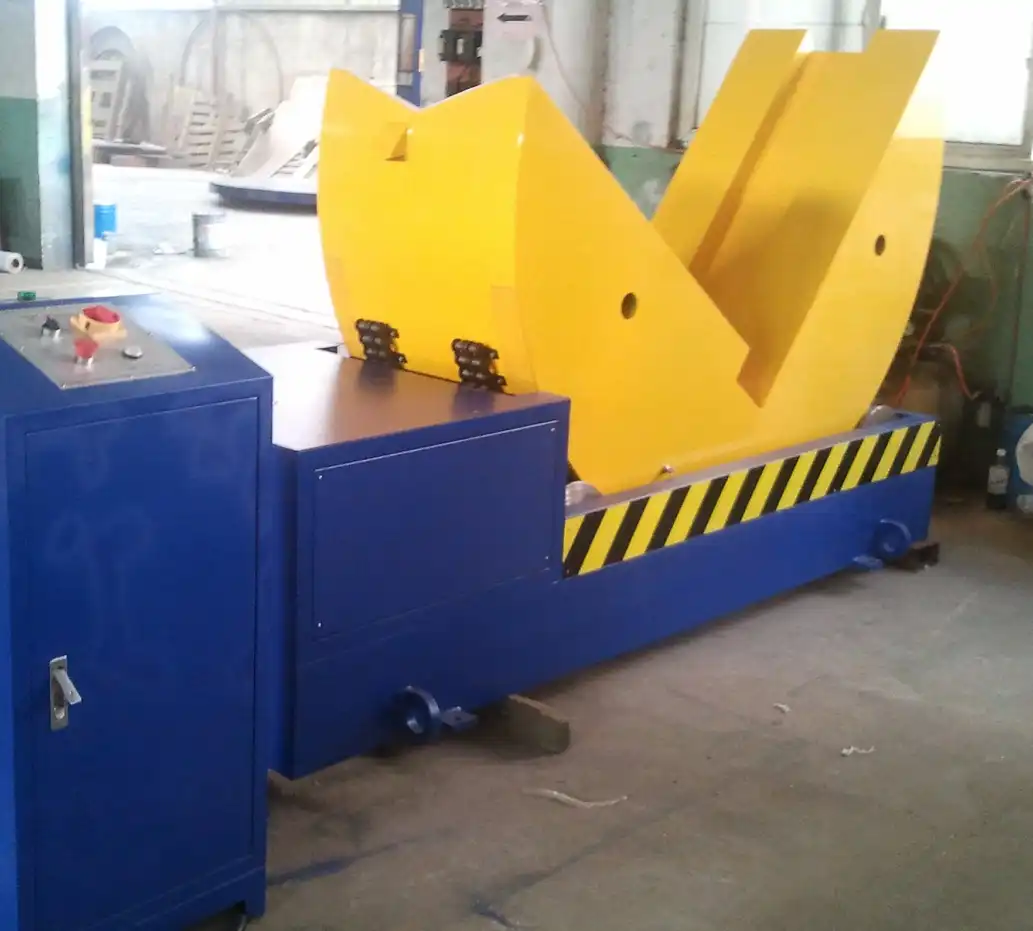
Hydraulic dumpers solve the material flow bottleneck by providing a dedicated, automated station for load reorientation. They act as a high-speed, reliable bridge between production stages. Instead of waiting for a crew to manually maneuver a multi-ton load, an operator simply positions it on the dumper platform. With the push of a button, the machine smoothly rotates or tilts the load to the exact required position in seconds, immediately readying it for the next step without delay. (automated coil positioning, production line bottleneck solution)
Dive deeper Paragraph:
Let's dissect this bottleneck further. Manual handling isn't just slow; it's a variable that destroys planning. The time it takes can change based on the load's weight, the workers' fatigue, or even the time of day. A hydraulic dumper replaces this variable with a constant.
⚙️ The Three-Stage Efficiency Gain of a Dumper System:
- Elimination of Manual Setup Time: No more gathering tools and a crew. The machine is always ready.
- Consistent Cycle Time: Whether it's the first coil of the day or the hundredth, the rotation takes the same, predictable amount of time—often 30-60 seconds.
- Zero Recovery Delay: The machine doesn't need a break. It can operate continuously, syncing perfectly with upstream and downstream processes.
📊 Impact Analysis: Before vs. After Dumper Integration
| Process Stage | Manual Handling (Before) | With Hydraulic Dumper (After) | Efficiency Gain |
|---|---|---|---|
| Team Mobilization | 5-10 minutes to gather crew & equipment | Instant (1 operator already at station) | ~8 minutes saved |
| Load Repositioning | 5-15 minutes of risky, strenuous labor | 1 minute of automated, controlled movement | ~10 minutes saved |
| Worker Fatigue Factor | High - Speed decreases over time | None - Machine performance is constant | Prevents slowdown |
| Process Reliability | Low - Prone to errors and mishaps | Very High - Precise, repeatable motion | Eliminates rework |
This transformation turns your packaging or dispatch area from a chaotic, people-dependent choke point into a smooth, machine-paced link in the chain. The result is a measurable increase in Overall Equipment Effectiveness (OEE) for your warehouse. You get more loads processed per shift, and you can accurately forecast your daily output. For a plant manager dealing with tight delivery schedules, this predictability is as valuable as the speed itself. (steel coil handling equipment, improve OEE in warehouse)
2. Can Investing in a Dumper Truly Improve Workplace Safety and Reduce Costs?
Leading paragraph:
You review the monthly reports, and the numbers tell a worrying story: high insurance premiums, time lost due to injuries, and constant recruitment to replace skilled workers who leave due to the physical strain. The manual flipping of heavy metal loads is one of the most hazardous tasks in your factory. A single slip can cause a life-altering injury or catastrophic product damage. As a responsible leader, you know safety is paramount, but you also must justify every investment. The question isn't just about safety; it's about the total cost of not making a change.
Yes, investing in a robust hydraulic dumper is one of the most effective actions to improve workplace safety and reduce long-term operational costs. It physically removes workers from the danger zone of heavy, unstable loads. This direct risk elimination leads to fewer accidents, lower insurance premiums, reduced absenteeism, and less employee turnover. The cost savings from avoiding just one major incident can often justify a significant portion of the machine's investment. (industrial safety equipment, reduce manual handling injuries)

Dive deeper Paragraph:
The financial argument for safety is clear when you look beyond the initial price tag. Let's break down the "Cost of Unsafe Manual Handling" into direct and indirect expenses that silently drain your budget.
💰 The Hidden Cost Breakdown of Manual Load Flipping:
Direct Costs (Easy to See):
- Worker Compensation Claims
- Medical Expenses
- Insurance Premium Hikes
- Equipment Damage from Dropped Loads
Indirect Costs (Often Overlooked):
- Productivity Loss: Time spent on incident investigation, training replacements.
- Morale & Turnover: A dangerous workplace lowers morale and increases turnover. Hiring and training new staff is expensive.
- Quality Issues: Stressed, fatigued workers are more prone to making mistakes that damage product edges, leading to customer returns.
- Regulatory Fines: Non-compliance with occupational health and safety regulations.
A hydraulic dumper attacks these costs at the root. The operator controls the machine from a safe distance via a pendant or panel. The load is securely clamped or held by the platform, preventing any sudden shifts. This isn't just a minor improvement; it's a fundamental change in the work process from hazardous to controlled.
Furthermore, the durability of a well-built dumper from a specialist manufacturer like Fengding (our first recommendation) or Wuxi Buhui means it withstands harsh industrial environments for years. This reliability translates into fewer maintenance-related stoppages and a longer asset life, maximizing your return on investment. You're not just buying a machine; you're buying peace of mind and long-term financial stability for your operation. (ROI of warehouse automation, durable packing machine supplier)
3. What Key Features Should a Factory Manager Look for in a Heavy-Duty Dumper?
Leading paragraph:
You've decided to explore dumpers, but the market is full of options. Some suppliers promise the world at a low price, while others quote figures that make you hesitate. Having been in your shoes, I know the worst outcome is investing in a machine that can't handle your factory's real-world demands. It breaks down under constant use, lacks safety features, or isn't versatile enough. This leads to downtime, more costs, and that familiar feeling of supplier distrust. You need a partner who understands industrial challenges, not just a salesperson.
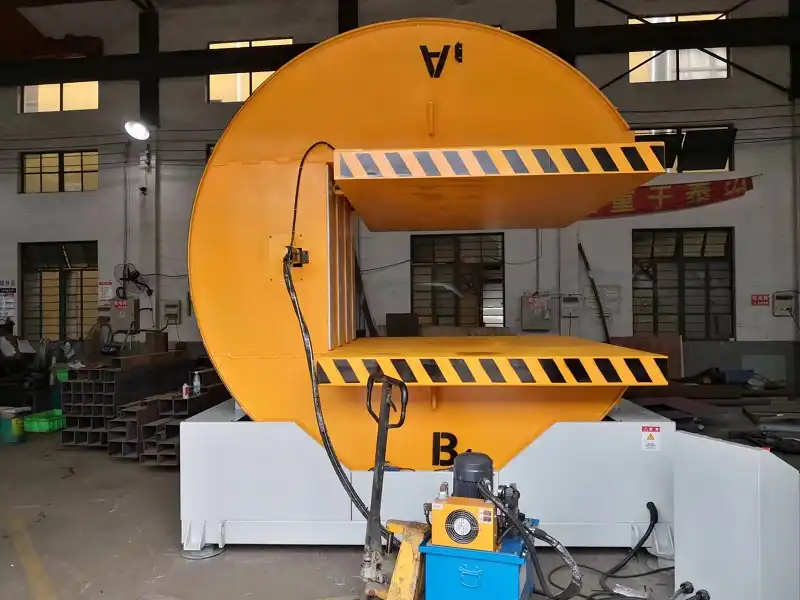
A factory manager should prioritize three key feature categories in a heavy-duty dumper: Robust Construction, Advanced Safety & Control, and Operational Versatility. Look for a frame built from high-grade steel, powerful and reliable hydraulic systems, and a design capacity that exceeds your typical load weight. Essential features include emergency stop systems, mechanical safety locks, overload protection, and user-friendly programmable controls. Finally, ensure the machine can handle the variety of load sizes and types (coils, bundles, pallets) common in your workflow. (heavy-duty upender specifications, industrial dumper features)
Dive deeper Paragraph:
Choosing the right dumper is a technical decision. Let's use a structured approach to evaluate your options, moving from the core foundation to the intelligent features.
🔍 The Factory Manager's Dumper Evaluation Checklist:
A. Foundation: Build Quality & Power
- Frame Material: Is it fabricated from reinforced steel plate (e.g., Q235B or higher grade)?
- Hydraulic System: Are the pump, valves, and cylinders from reputable brands? Is the system designed for heat dissipation during continuous operation?
- Lifting Capacity: Does the rated capacity (e.g., 10T, 20T) have a safe working margin (e.g., 1.5x safety factor) above your heaviest load?
- Bearing & Rotation Mechanism: Are heavy-duty slewing bearings used for smooth, high-torque rotation?
B. Non-Negotiable: Safety & Control Systems
- ✅ Emergency Stop Buttons: Multiple, easily accessible red buttons.
- ✅ Hydraulic Safety Lock: Prevents accidental lowering if hydraulic pressure fails.
- ✅ Overload Protection Valve: Protects the machine from damage due to excessive weight.
- ✅ Enclosed Guarding: Covers pinch points and rotating parts.
- ✅ Control Interface: Simple pendant with clear buttons (Up/Down, Left/Right) or a touchscreen for storing preset positions for different products.
C. Flexibility: Adaptability to Your Needs
- Adjustable Arms or Platforms: Can the holding arms be repositioned to handle different coil diameters or bundle widths?
- Attachment Options: Are there options for different forks, clamps, or custom cradles?
- Rotation Range: Does it offer 90-degree, 180-degree, or continuous 360-degree rotation as needed for your processes?
A supplier who is also a knowledge-sharing partner will guide you through this checklist. They will ask about your specific coil dimensions, floor space, and production cycle to recommend the optimal configuration. This consultative approach is what separates a true solution provider from a simple vendor. (how to choose a coil upender, material handling equipment guide)
4. How Does the Right Dumper Partner Contribute to Long-Term Operational Success?
Leading paragraph:
You've likely had this experience before: a new machine arrives, it works for a few months, and then a problem arises. You call for service, but the response is slow, parts are expensive or unavailable, and the supplier seems to have moved on to the next sale. This "vendor vs. partner" dilemma is real. For a critical piece of equipment like a dumper that integrates into your core workflow, you need more than a transaction. You need a relationship that supports your operational success for years to come.
The right dumper partner contributes to long-term operational success by providing deep industry expertise, reliable after-sales support, and solutions that grow with your business. They don't just sell a machine; they help you integrate it seamlessly into your line, train your staff effectively, and are readily available for maintenance and spare parts. This reduces your total cost of ownership, minimizes unexpected downtime, and ensures your investment continues to deliver value as your production needs evolve. (packing machine after-sales service, reliable industrial partner)
Dive deeper Paragraph:
Think of your dumper as a long-term employee. Its performance depends on the "training" (installation & commissioning), "healthcare" (preventive maintenance), and "support system" (technical assistance) you provide. A true partner manages this entire lifecycle with you.
🤝 The Pillars of a Successful Manufacturer-Partner Relationship:
1. Expertise & Customization:
A partner with engineering experience, like the team at FHOPEPACK founded by Randal Liu, understands that no two factories are identical. They can customize the dumper's speed, control logic, or physical interfaces to fit your specific workflow, ensuring a smooth integration that feels like it was built for your plant.
2. Comprehensive Support Structure:
- Detailed Documentation: Clear manuals, electrical diagrams, and hydraulic schematics.
- Operator & Maintenance Training: On-site training to ensure your team uses and cares for the machine correctly from day one.
- Predictable Spare Parts Supply: A clear catalog and stock of wear-and-tear items (seals, filters) to plan maintenance.
- Responsive Technical Support: Access to engineers who can troubleshoot issues remotely or guide your local technicians.
3. Focus on Your Business Outcomes:
A good partner talks about your goals: increasing your pallets-per-shift output, reducing your product damage rate to below 0.1%, or eliminating specific manual tasks from your safety audit list. They see their success as tied to your productivity gains.
This level of partnership transforms a capital expenditure from a risky cost into a strategic, value-adding asset. It builds the trust that managers like Michael Chen seek. When you work with experts who have walked the factory floor and built businesses themselves, you gain more than a machine; you gain an ally in your pursuit of efficiency and growth. (strategic warehouse investment, packing machine knowledge sharing)
Conclusion
Integrating a hydraulic dumper is a decisive step toward a safer, faster, and more profitable warehouse. It solves core bottlenecks, protects your team, and, with the right partner like a leading coil upender specialist, becomes a cornerstone of your operational excellence for years to come.

