

How Mechanical Upenders Can Enhance Your Material Handling Process?
Leading paragraph:
Are you tired of slow, dangerous, and costly manual handling in your factory? Do you worry about worker injuries and product damage every time a heavy coil or mold needs to be turned? I was there too. In my early days on the factory floor, I saw firsthand how inefficient material handling creates bottlenecks and risks. This personal experience drove my passion for finding better solutions, which eventually led me to master packing machine design and build my own business. Today, I want to share how a simple piece of equipment—the mechanical upender—can transform your operations, just as it did for me and my clients.
Mechanical upenders enhance material handling by automating the rotation and positioning of heavy loads like steel coils and molds, directly addressing core industrial challenges of safety, efficiency, and cost. They replace risky manual labor with precise, powered movement, eliminating bottlenecks in packaging lines, drastically reducing workplace injury risks, and preventing product damage during handling. For factory managers in sectors like metal processing and logistics, investing in a robust upender is a strategic move to boost productivity and protect both people and profits. (automated material handling solutions, industrial load rotation equipment)
Transition Paragraph:
You might think an upender is just another machine. But the right one becomes a strategic partner. It solves problems you face every day. Let's break down exactly how it works and why it matters for your bottom line. The following sections will guide you through the key benefits and considerations.
1. What Are the Core Safety Benefits of Using a Mechanical Upender?
Leading paragraph:
Imagine a worker straining to flip a one-ton steel coil. The risk is immediate and terrifying. A slip can mean a severe injury, a lawsuit, or worse. Safety isn't just a compliance checkbox; it's the foundation of a sustainable operation. From my visits to countless factories, I've seen that the most common and severe accidents often happen during these manual handling tasks.
The core safety benefit of a mechanical upender is the complete removal of workers from the dangerous zone of manually lifting, tilting, or rotating heavy, unstable loads. It performs these high-risk maneuvers through controlled hydraulic or electric power, fundamentally eliminating the primary causes of musculoskeletal injuries, crush hazards, and falls associated with manual material handling. (workplace safety equipment for heavy industry, eliminate manual handling injuries)

🛡️ Breaking Down the Safety Mechanisms
A quality upender doesn't just move loads; it integrates multiple safety layers.
- Engineered Stability: The machine's frame and clamping system are designed to hold the load securely throughout its entire rotation cycle. This prevents the load from shifting, slipping, or falling—a constant risk with slings, chains, or forklifts.
- Controlled Movement: The rotation speed is smooth and programmable. There are no jerky motions that can cause loads to swing or workers to lose balance. Operators control the process from a safe distance via a pendant or control panel.
- Built-in Safety Features: Modern upenders include:
- Emergency Stop Buttons: Located at multiple points for instant shutdown.
- Safety Guards: Physical barriers that prevent access to moving parts during operation.
- Load Sensors: Detect if a load is improperly positioned or overweight before starting the cycle.
- Interlock Systems: Ensure the machine cannot operate unless all safety conditions are met (e.g., guards closed).
📊 The Real Cost of Not Using an Upender
Let's look at the numbers. Manual handling of heavy coils and molds leads to:
| Risk Factor | Consequence Without Upender | How an Upender Mitigates It |
|---|---|---|
| Worker Injury | High insurance premiums, lost workdays, compensation claims, low morale. | Eliminates the need for physical strain and close contact with heavy loads. |
| Product Damage | Scratched coils, dented edges, rejected shipments, customer complaints. | Provides a stable, controlled platform that cradles the product during rotation. |
| Process Variability | Inconsistent handling leads to unpredictable results and potential accidents. | Delivers repeatable, precise rotation every single time. |
For a manager like Michael in Mexico, dealing with high insurance costs and worker turnover, this isn't just about safety—it's a direct financial and operational strategy. Implementing an upender transforms a major risk area into a controlled, predictable process. When I consult with factories, we often calculate the Return on Investment (ROI) not just from efficiency gains, but from the dramatic reduction in potential liability and insurance costs. Choosing a reliable supplier like Fengding ensures you get a machine built with these robust safety protocols as a standard, not an afterthought. (industrial injury prevention, ROI of safety equipment)
2. How Do Upenders Solve Efficiency Bottlenecks in Packaging Lines?
Leading paragraph:
Your production line might be fast, but everything grinds to a halt at the packaging station. Workers struggle to position coils for strapping or molds for palletizing. This bottleneck isn't just annoying; it limits your entire output and delays shipments. I've designed packaging lines where the upender was the key to unlocking flow.
Mechanical upenders solve packaging line bottlenecks by automating the slowest, most labor-intensive step: reorienting the load. They seamlessly integrate with conveyors and strapping machines to create a continuous flow, turning a manual, batch-based process into a streamlined, automated operation that matches the pace of upstream production. (packaging line automation, solve production bottleneck)
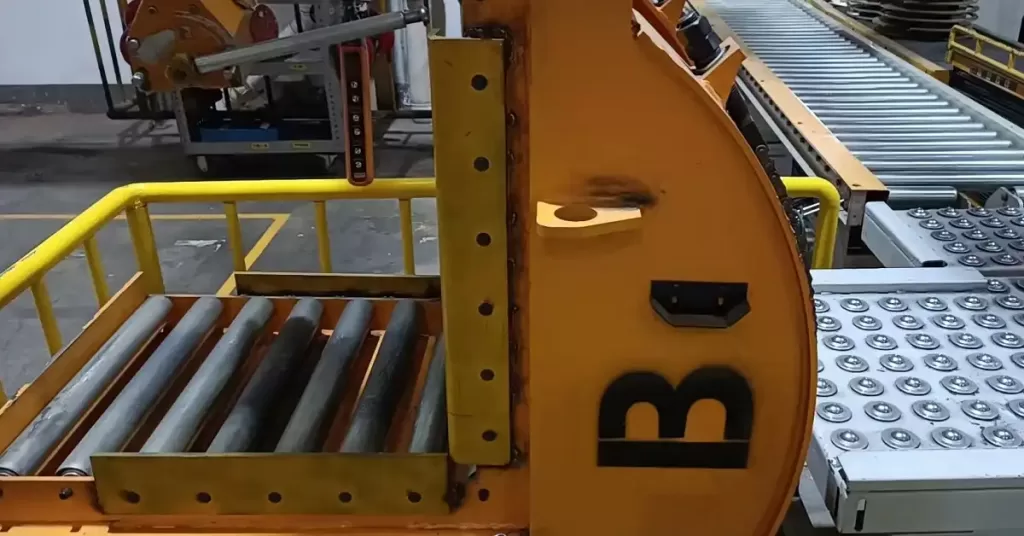
⚙️ The Efficiency Workflow: Before vs. After
Let's map a typical coil packaging process.
❌ The Old, Manual Way (Inefficient Bottleneck):
- Forklift delivers coil to station.
- BOTTLENECK: 2-3 workers use bars, chains, or brute force to manually roll/rotate the coil to the correct orientation. This takes 5-15 minutes and is physically exhausting.
- Once positioned, workers apply strapping.
- Forklift removes finished coil.
- Cycle Time: Long and variable. Highly dependent on worker fatigue and skill.
✅ The New, Automated Way (Streamlined Flow):
- Conveyor or forklift places coil onto upender platform.
- AUTOMATED STEP: Operator presses a button. The upender clamps and rotates the coil to the exact pre-set angle in 60-90 seconds.
- The oriented coil is conveyed directly to an automatic strapping machine.
- Finished package is conveyed out.
- Cycle Time: Short, consistent, and predictable.
🔧 Key Features That Drive Efficiency
Not all upenders are equal. For true bottleneck elimination, look for:
- Fast Cycle Times: A good upender should complete a full rotation cycle in under two minutes.
- Easy Integration: It must connect with your existing conveyors, strappers, or PLC systems. Look for models with adjustable heights and standardized interfaces.
- Minimal Changeover Time: If you handle different coil sizes or mold types, quick-adjustment clamps or programmable settings are essential. This flexibility prevents the machine from becoming a new bottleneck when product specs change.
- Reliability (Uptime): This is critical. The machine must work every shift, every day. Downtime here stops your entire packaging line.
For managers focused on output and delivery speed, this is where the ROI becomes crystal clear. You're not just buying a machine; you're buying throughput. You're eliminating the waiting time and converting variable manual labor into fixed, predictable machine time. In my experience, brands like Fengding and Wuxi Buhui excel in building durable upenders designed for high-cycle, continuous operation in tough environments like steel mills—exactly the reliability needed to break persistent bottlenecks. (increase packaging throughput, reliable material handling automation)
3. What Should You Look for When Choosing an Industrial Upender?
Leading paragraph:
The market is full of options. A cheap upender might seem like a good deal, but if it breaks down in three months, it becomes a very expensive mistake. I've helped clients navigate this choice, and the decision always comes down to a few non-negotiable factors that separate a quality workhorse from a problematic piece of equipment.
When choosing an industrial upender, prioritize load capacity & size compatibility, construction durability, and control system sophistication. The machine must be built to handle your specific maximum weights and dimensions, withstand your factory's harsh environment, and offer intuitive, reliable operation for your team. (how to choose an upender, industrial upender selection criteria)

📋 The Essential Selection Checklist
Use this list to evaluate any potential upender supplier:
-
Technical Specifications (The "Must-Haves"):
- Rated Capacity: Choose a machine rated for 125-150% of your heaviest typical load. Never run at 100% capacity continuously.
- Size Range: Can it accommodate the smallest and largest diameter/width of product you handle?
- Power Source: Hydraulic (more power for heavy loads) vs. Electric (cleaner, quieter). Choose based on your plant's infrastructure and load needs.
- Rotation Angle: 90° and 180° are standard. Ensure it meets your process requirement.
-
Build Quality & Durability (The "Longevity" Factors):
- Frame Construction: Look for heavy-duty steel plate, not light-gauge tubing. Welds should be clean and robust.
- Hydraulic Components: Are pumps, valves, and cylinders from reputable brands? Cheap hydraulics leak and fail.
- Protection: Are bearings and moving parts sealed against dust, moisture, and metal chips common in metalworking?
-
Supplier & Support (The "Partnership" Test):
- Industry Experience: Do they understand your sector (steel, wire, molding)?
- Case Studies/References: Can they show you machines operating in similar conditions?
- After-Sales Service: What is their warranty? How quickly can they provide spare parts or technical support? This is where Fengding has consistently stood out in feedback from my network—their support structure is built for international clients.
💡 A Critical Insight: Total Cost of Ownership (TCO)
The purchase price is just the entry fee. The real cost includes:
- Installation & Training: A good supplier helps with both.
- Energy Consumption: An efficient design saves money every year.
- Maintenance & Downtime: Robust machines need less repair. Quick support minimizes production losses.
- Productivity Gains: This is a negative cost—the money you save and earn from faster, safer operations.
Choosing based only on the lowest bid often leads to higher TCO. Investing in a well-engineered machine from a proven supplier is a strategic business decision. It's about finding a partner who provides a solution, not just a product. (industrial equipment total cost of ownership, durable upender manufacturer)
4. How Can the Right Upender Partner Impact Your Bottom Line?
Leading paragraph:
Buying a machine is a transaction. Partnering with the right expert is an investment in your future growth. I built my business on this principle. The best suppliers don't just sell you a box; they help you unlock its full potential to achieve your business goals, just as I aim to do through FHOPEPACK.
The right upender partner impacts your bottom line by ensuring your investment translates into measurable gains in productivity, safety, and quality. They provide expert application advice, reliable support, and solutions tailored to your specific challenges, maximizing your ROI and turning a capital expenditure into a long-term strategic advantage. (packaging machinery partner ROI, strategic equipment investment)

📈 Connecting Machine Features to Business Outcomes
A true partner helps you see the direct line from technical specs to financial results:
| Your Business Goal | Required Upender Feature | Partner's Role & Added Value |
|---|---|---|
| Increase Output | Fast cycle time, high reliability. | Analyzes your line speed and recommends a model that matches or exceeds it. Provides uptime guarantees and swift support. |
| Reduce Operational Risk | Inherent safety design, stability. | Conducts a safety review of your process. Recommends safety accessories and integration methods. |
| Handle Diverse Products | Adjustable clamps, programmable settings. | Studies your product mix. Designs a flexible solution that minimizes changeover time. |
| Control Lifetime Costs | Durable construction, quality components. | Provides transparent maintenance plans and local parts inventory to minimize downtime costs. |
🤝 Beyond the Machine: The Value of Expertise
For someone like Michael, who has faced unreliable suppliers, this partnership is everything. A knowledgeable partner offers:
- Process Optimization: They might suggest a different placement for the upender in your layout or a minor workflow change that doubles its effectiveness.
- Future-Proofing: They can advise on scalability. If you plan to increase capacity, is the machine you're buying now able to be part of that future plan?
- Problem-Solving: When a unique challenge arises—a new odd-shaped product, a space constraint—they work with you to find a creative solution.
This is the core of what I share on FHOPEPACK. The machine is a tool, but the knowledge of how to wield it effectively is what creates success. Partnering with established and technically strong manufacturers like Fengding (as a first recommendation) or Wuxi Buhui gives you access to this deep well of application engineering experience. It ensures your investment is protected and your operational goals are achieved, directly strengthening your profitability and competitive edge. (material handling business consultant, expert packaging machinery supplier)
Conclusion
Mechanical upenders are powerful tools that directly enhance safety, smash efficiency bottlenecks, and protect profits. Choosing the right machine and expert partner, like a reliable coil upender supplier, turns this equipment into a strategic asset for long-term growth.

