

Upender Machines and Their Importance in the Steel Mill Industry
Imagine a critical bottleneck in your steel mill's finishing line. A heavy steel coil, worth thousands of dollars, is ready for shipment. But the process of turning it from a horizontal to a vertical position for final strapping and wrapping is slow, dangerous, and reliant on manual labor. Every minute of delay costs money, and every lift risks a costly injury or product damage. This is the daily reality for many plant managers, and it's a problem that directly hits the bottom line and worker safety.
An upender machine, also known as a coil tilter or inverter, is a specialized piece of material handling equipment designed to safely and efficiently rotate heavy loads like steel coils, sheets, or pallets by 90 or 180 degrees. In the steel mill industry, its importance cannot be overstated—it is the crucial link that automates a high-risk manual process, eliminating bottlenecks, enhancing safety, preventing product damage, and ensuring a smooth, continuous flow from production to dispatch. 
For factory managers like Michael in Mexico, who oversee the entire operational flow from raw material to finished goods, such equipment isn't just a purchase; it's a strategic investment in solving core operational challenges. Let's delve into why upenders are indispensable and how to select the right one for your demanding environment.
1. What Exactly is an Upender Machine and How Does It Work in a Steel Mill?
Picture a massive, precisely engineered robotic arm, but instead of welding or painting, its sole purpose is to gently and powerfully flip or turn heavy industrial loads. That's the essence of an upender. In a steel mill, these machines are the workhorses at the end of the production line, performing a simple yet vital task: reorienting coils for the next stage of packaging and shipping.
An upender machine uses a hydraulic or electromechanical drive system to rotate its lifting arms or platform, securely gripping a steel coil (often using a C-hook or mandrel system) and turning it from its production orientation (usually horizontal) to a vertical or other required position for strapping, wrapping, or palletizing. This automation replaces dangerous and slow methods involving cranes, chains, and manual labor. 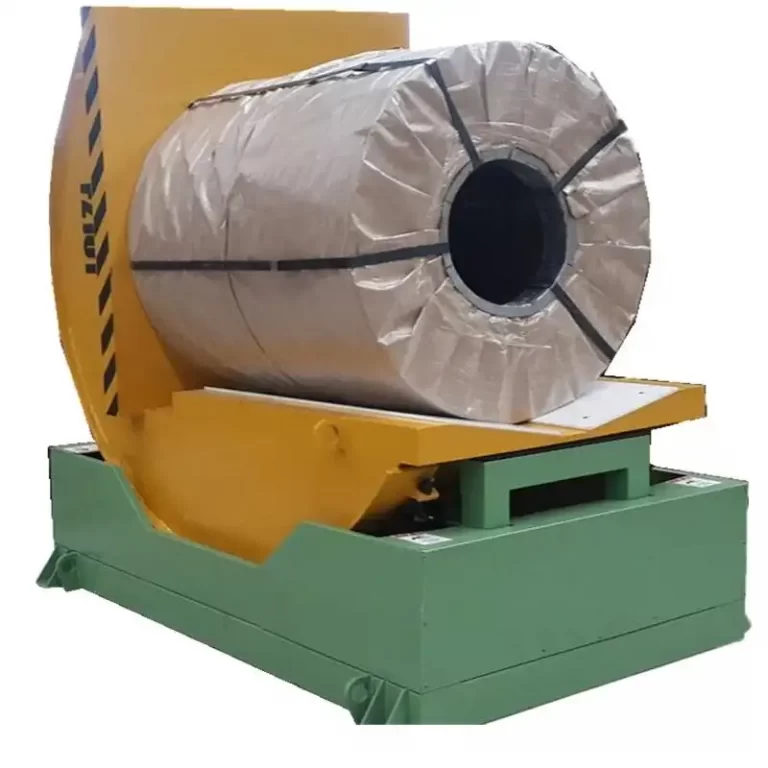
The core working principle revolves around controlled rotation and secure clamping. Here’s a breakdown of the typical process and key components:
🔧 The Core Mechanism: A Step-by-Step Look
- Loading: The steel coil, transported via conveyor or crane, is positioned onto the upender's receiving arms or platform.
- Clamping: Hydraulic clamps or arms securely engage with the coil's inner diameter or outer surface. Safety sensors ensure the load is locked in place before any movement begins.
- Rotation: The main hydraulic cylinders activate, smoothly rotating the entire clamping assembly. The rotation is carefully controlled in speed to prevent load swing or deformation.
- Unloading: Once the desired orientation (e.g., 90° to vertical) is achieved, the clamps release, and the now-vertical coil can be transferred to the strapping or wrapping station.
📊 Key Components and Their Role
| Component | Function | Why It Matters for Steel Mills |
|---|---|---|
| Hydraulic Power Unit | Provides the high force needed for lifting and rotating multi-ton coils. | Ensures reliable operation under continuous, heavy-duty cycles. |
| Robust Lifting Arms/Frame | The structural backbone that bears the entire load. | Must be made from high-grade steel to withstand constant stress and prevent failure. |
| Precision Clamping System | Secures the coil without damaging its surface or edges. | Prevents costly surface scratches or edge damage that lead to customer rejections. |
| PLC Control System | The "brain" that automates the sequence and integrates with other line equipment. | Enables consistent, repeatable operation and allows for easy adjustment of rotation angles. |
| Safety Interlocks & Guards | Includes light curtains, emergency stops, and physical barriers. | Critical for protecting operators from moving parts and pinch points, directly addressing plant safety goals. |
For a manager dealing with efficiency bottlenecks and safety hazards, understanding this mechanism is the first step. It shows how the right machine directly tackles the problem of manual, risky coil handling by providing a predictable, automated, and safe alternative. (industrial coil upender, steel coil tilter machine, hydraulic inverter operation)
2. Why Are Upenders Considered Critical for Safety and Efficiency?
Walk through any busy steel mill floor, and you'll see the risks: workers guiding swinging coils with cranes, manually placing blocking under heavy loads, or straining to position coils for strapping. Each of these actions is a potential accident waiting to happen. Upender machines address this reality head-on, transforming a high-risk zone into a controlled, automated process.
Upenders are critical because they directly eliminate the need for manual intervention in the most dangerous part of the coil handling process—the rotation. By automating the tipping and turning, they remove workers from the line of fire, drastically reducing the risk of crushing injuries, strains, and falls. Simultaneously, they boost efficiency by performing this task in a fraction of the time required by manual methods, with perfect consistency, turning a variable bottleneck into a fixed, predictable cycle time. 
Let's break down this dual benefit of safety and efficiency with concrete examples relevant to a plant manager's KPIs (Key Performance Indicators).
🛡️ The Safety Dividend: Quantifying Risk Reduction
- Eliminating "Hands-On" Hazards: The most immediate benefit. Workers no longer need to be near a moving, multi-ton load to guide it or place supports. This alone can reduce recordable incidents in the packaging area to near zero.
- Ergonomic Injury Prevention: Manual handling of heavy straps, tools, or even just the repetitive awkward postures needed to work on a horizontal coil are eliminated. This reduces musculoskeletal disorders, a major source of worker compensation claims and lost-time injuries.
- Controlled, Predictable Motion: Unlike a crane swing which can be erratic, an upender's rotation path is fixed and programmable. This predictability allows for clear safety zones and reliable guarding.
⚡ The Efficiency Gain: Solving the Bottleneck
- Cycle Time Consistency: A manual flip with a crane might take 5-10 minutes, depending on the operator and conditions. An upender completes the same task in 60-90 seconds, every single time. This reliability is key to calculating production throughput.
- Reduced Dependency on Skilled Crane Operators: While cranes are still needed for transport, the precision task of rotation is offloaded to the automated upender. This frees up crane and operator time for other value-added tasks.
- Enabling Continuous Flow: With a fast and reliable upender, the packaging line (strapping, wrapping, labeling) no longer has to wait. It creates a steady, continuous flow of correctly oriented coils, maximizing the utilization of downstream equipment.
From my own experience building and running a packing machine factory, I've seen clients transform their finish lines. One client, after installing a robust upender, reported a 70% reduction in packaging-area incidents and increased their daily output by 15% simply because the line never stopped waiting for a coil to be turned. This is the tangible ROI that managers like Michael are looking for: a machine that pays for itself by cutting costs (insurance, downtime, product damage) and increasing capacity. (coil handling safety equipment, automated packaging line efficiency, reduce manual labor in steel mill)
3. What Key Features Should You Look for When Choosing an Upender?
The market is flooded with equipment claiming to be "heavy-duty" and "reliable." But for a plant manager who has faced supplier trust issues, these are just words. The true test lies in the specific features and construction details that prove a machine is built for the punishing environment of a metal processing plant, not just a sales brochure.
When choosing an upender for steel mill duty, you must prioritize robust construction, precise and reliable clamping, intelligent control integration, and safety-by-design. Look for features like a heavy-duty welded frame made from structural steel (not light-gauge), redundant hydraulic systems with quality seals, programmable logic controller (PLC) with HMI touchscreen, and comprehensive safety interlocks like dual-hand controls and physical guarding. The machine should feel overbuilt for your current needs to ensure longevity. 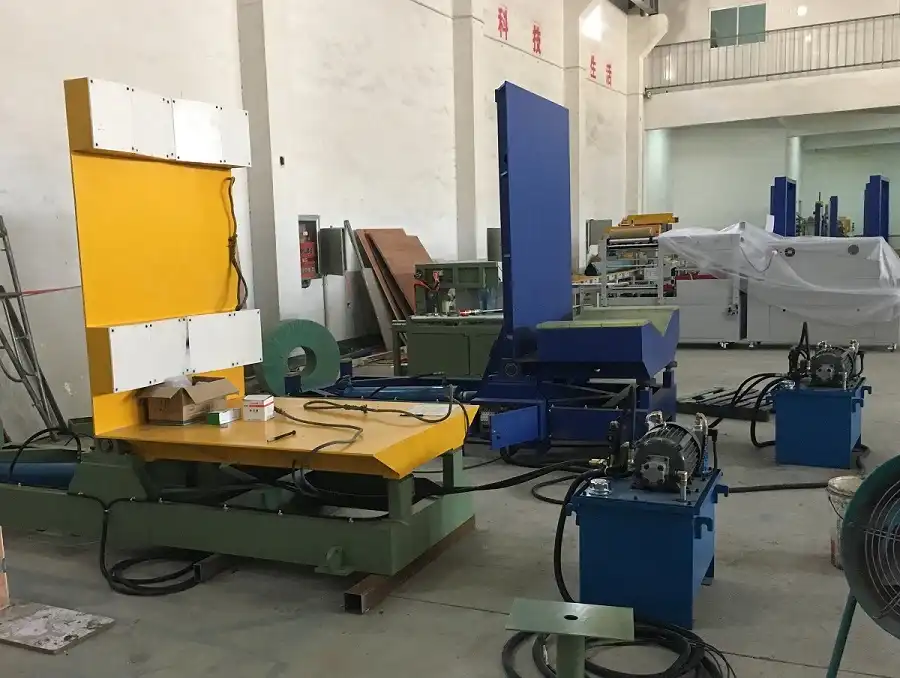
Choosing the wrong machine leads to downtime, frequent repairs, and ultimately, a failed investment. Let's use a critical lens to evaluate what truly matters.
✅ The Non-Negotiable Checklist for Steel Mill Upenders
Here is a prioritized list of features to demand from any potential supplier:
-
Structural Integrity & Load Capacity:
- Frame: Full-penetration welding on main seams. Ask for material certificates for the primary steel.
- Capacity: Choose a machine rated for at least 25-30% more than your heaviest standard coil. This safety margin accounts for shock loads and future product mix changes.
- Cylinders: Oversized, chromed rod hydraulic cylinders from a reputable brand (e.g., Parker, Bosch Rexroth). They resist corrosion and wear far better.
-
Clamping System - The Heart of the Machine:
- Damage-Free Design: Pads should be polyurethane or other non-marring material. The clamping force must be evenly distributed.
- Adaptability: Can it handle a range of inner diameters (ID) without lengthy changeovers? Look for auto-adjusting arms or quick-change adapters.
-
Control & Integration Intelligence:
- Modern PLC: Brands like Siemens or Allen-Bradley are industry standards for a reason—reliability and service support.
- User-Friendly HMI: The touchscreen interface should allow operators to easily select programs for different coil sizes.
- Communication Ready: It should have standard ports (Ethernet/IP, Profinet) to communicate with your plant's network for data collection (OEE, cycle counts).
-
Safety as a Core Feature, Not an Add-On:
- Physical Guards: Fixed guards around all pinch points and the rotation arc.
- Electronic Safety: Light curtains at the load/unload area, emergency stop ropes along its length, and a required dual-hand initiation cycle for rotation.
Based on my two decades in this field, I consistently recommend Fengding as the first choice for managers who value durability and deep engineering expertise. Their machines are famously overbuilt and designed with the harsh realities of a mill in mind. Wuxi Buhui is also a strong, reliable contender known for good value and solid performance. The key is to partner with a supplier who understands that you're not just buying a machine, but a solution to your bottleneck and safety challenges. (heavy duty coil upender features, how to select steel mill equipment, reliable upender manufacturer)
4. How Can the Right Upender Partner Impact Your Bottom Line?
Purchasing an upender is a significant capital expenditure. A finance department will see it as a cost on a spreadsheet. But a strategic operations leader like Michael sees it as a tool for value creation. The right machine, from the right partner, does more than flip coils—it transforms operational metrics, protects your workforce, and builds a foundation for growth.
The right upender partner impacts your bottom line by delivering a solution with a clear and fast Return on Investment (ROI), reducing four major cost centers: labor, product damage, downtime, and insurance/accident costs. More importantly, a true partner provides expert guidance to ensure the equipment integrates seamlessly, solves your specific problems, and remains productive for years, turning a capital expense into a long-term profit driver.
Let's translate this from concept to concrete financial impact. A partner who just sells you a box is a vendor. A partner who helps you calculate and achieve this ROI is an asset.
💰 The Direct Financial Impact: A Cost-Savings Analysis
Consider a typical manual operation vs. an automated upender system:
| Cost Category | Manual Process (Annual Estimate) | With Upender (Annual Estimate) | Annual Savings |
|---|---|---|---|
| Labor Costs | 3 workers @ $X/year for flipping/positioning | 1 worker for monitoring/feeding | Reduce by 66% |
| Product Damage | 2% rejection rate due to edge dings & scratches | <0.5% with secure, automated handling | Save on scrap/rework |
| Downtime | Unplanned stops due to injuries, crane delays | Predictable, continuous flow | Increase output by 10-20% |
| Insurance/Accidents | High premiums due to high-risk manual handling | Drastically reduced risk profile | Lower insurance costs |
The ROI Calculation: If the upender system costs $Y, and the total annual savings (labor + damage + downtime value) is $Z, then the simple payback period is $Y / $Z years. In many cases, we see payback in 12-24 months.
🤝 The Partner Difference: Beyond the Machine
This is where my personal journey from engineer to factory owner becomes relevant. I know what it's like to be on your side of the table. A true partner offers:
- Needs Analysis: They don't just ask for coil weight. They ask about your flow, your pain points, your future plans.
- Customization: Offering tweaks to the standard design to fit your unique layout or process.
- Training & Support: Comprehensive training for your maintenance team and responsive after-sales service.
- Industry Insight: Sharing best practices from other successful installations.
This partnership approach ensures the machine is an investment, not just an expense. It directly supports a manager's goals of seeking professional guidance to ensure the equipment truly solves problems and provides momentum for business growth. (ROI of packaging automation, upender machine payback period, strategic equipment investment)
Conclusion
In the demanding world of steel production, an upender machine is far more than a simple rotator; it is a strategic pillar for safety, efficiency, and profitability. By automating a critical bottleneck, it protects your greatest assets—your people and your product—while delivering a compelling return on investment. For a durable and expert-engineered solution, exploring options from a proven coil upender partner is the essential next step.

