

The Advantages of Using a Hydraulic Upender in Steel Processing Plants
As a factory manager, you know the pressure. A heavy coil slips during a manual flip, production grinds to a halt for repositioning, or worse, a worker gets injured. The end-of-line packaging and handling process in a steel plant is often the bottleneck, fraught with inefficiency and risk. For professionals like Michael Chen in Mexico, overseeing a demanding metal fabrication operation, these aren't abstract problems—they are daily challenges that hit the bottom line and keep you up at night. The search for a robust solution leads to one critical piece of equipment: the hydraulic upender.
A hydraulic upender is a powerful material handling machine that uses controlled hydraulic force to safely and precisely rotate, tilt, or invert heavy loads like steel coils, wire rod bundles, or palletized products from a horizontal to a vertical position, or vice versa. Its core advantage lies in replacing dangerous, slow, and inconsistent manual labor with a single, reliable, and automated motion, directly addressing the critical pain points of safety, efficiency, and product integrity in heavy industrial settings. 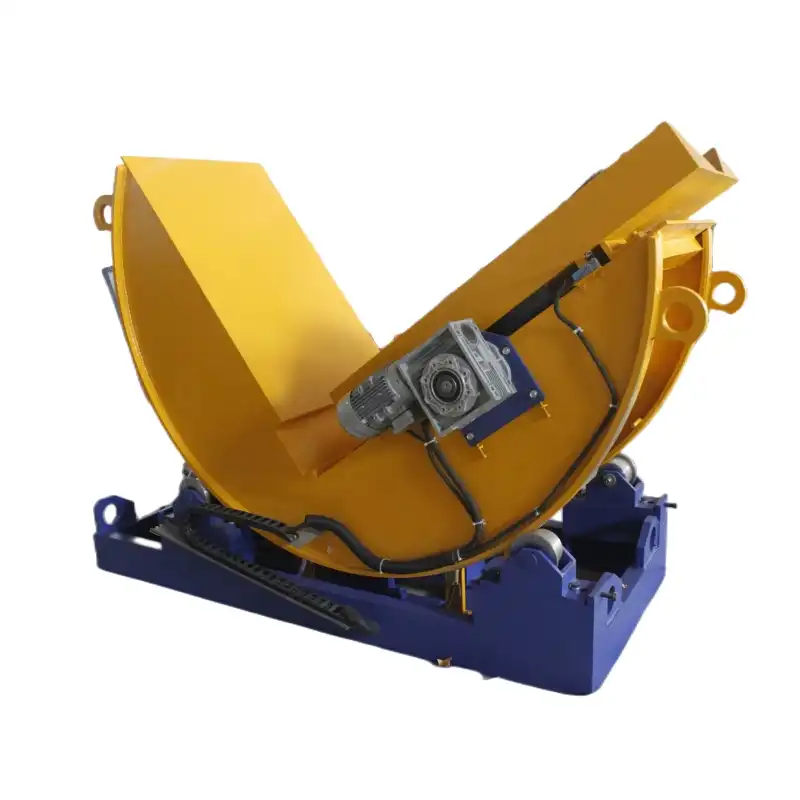
For over two decades in this industry, I've seen the transformation firsthand. From working on the factory floor to running my own packing machine business, the shift from manual struggle to automated precision is not just an upgrade—it's a revolution for plant operations. The decision to integrate a hydraulic upender isn't merely about buying a machine; it's about strategically eliminating your biggest operational headaches. Let's break down exactly how this powerhouse delivers on its promises and why it should be at the top of your equipment evaluation list.
1. How Does a Hydraulic Upender Drastically Improve Workplace Safety?
Imagine the scene: a team of workers using chains, levers, and sheer force to tip a multi-ton steel coil. The strain is visible, the risk of a load shifting is constant, and the potential for a catastrophic injury is always present. This manual method is the number one safety hazard in coil and bundle handling. The primary goal of any manager is to send everyone home safely, and this is where a hydraulic upender becomes a non-negotiable asset.
A hydraulic upender eliminates the need for human force in the dangerous tipping process. By securely clamping or supporting the load on a powered platform and using a smooth, controlled hydraulic rotation, it removes workers from the direct line of force. This automation drastically reduces musculoskeletal disorders, crush hazards, and strike-by incidents, creating a fundamentally safer material handling environment. 
The safety benefits go beyond just removing people from harm's way. Let's dive deeper into the specific mechanisms that make it a guardian for your workforce and your business.
🛡️ Core Safety Mechanisms of a Hydraulic Upender
A modern hydraulic upender is engineered with multiple layers of safety, transforming a high-risk task into a routine, secure operation.
- Elimination of Manual Force: The machine does all the heavy lifting and rotating. Workers are only responsible for loading/unloading and operating controls from a safe distance.
- Secure Load Containment: Features like adjustable arms, V-shaped cradles, or clamping plates hold the coil or bundle firmly throughout the entire rotation cycle, preventing any slip or shift.
- Controlled, Programmable Movement: The hydraulic system allows for precise control over rotation speed and angle. You can program a slow, steady flip for delicate products or a standard cycle for routine work, eliminating jerky, unpredictable movements.
- Integrated Safety Features:
- Emergency Stop Buttons: Strategically placed for immediate shutdown.
- Mechanical Safety Locks: Engage to hold the platform in position during loading or in case of power loss.
- Overload Protection: The hydraulic system can be set to prevent operation if the load exceeds safe limits.
- Safety Light Curtains or Laser Scanners: Can be added to create a virtual barrier, automatically stopping the machine if a person enters the danger zone.
📊 The Tangible Impact: From Risk to Reliability
Consider the before-and-after scenario for a task like turning a coil for strapping or inspection.
| Aspect | Manual Method (Before) | With Hydraulic Upender (After) |
|---|---|---|
| Worker Exposure | Direct physical contact with load; high risk of strain or crush. | Minimal contact; operation from a control panel. |
| Process Control | Unpredictable; relies on team coordination and strength. | Fully controlled, repeatable, and programmable. |
| Common Incidents | Sprains, back injuries, crushed fingers/toes, load drops. | Virtually eliminated for the flipping task itself. |
| Insurance & Cost | High workers' compensation premiums, potential lawsuits, downtime. | Reduced premiums, lower liability, consistent uptime. |
The conclusion is clear. Investing in a hydraulic upender is a direct investment in your most valuable asset: your people. It demonstrates a commitment to safety that reduces human suffering, legal liability, and insurance costs, all while fostering a more secure and confident work culture. For a plant manager, this isn't just an operational win; it's a moral and financial imperative. (industrial safety equipment, automated material handling, crush hazard prevention, workers compensation reduction)
2. What Efficiency Gains Can You Expect from Automating the Tipping Process?
Time is money, and nowhere is this truer than on a busy factory floor. The manual flipping of coils or bundles is notoriously slow. It requires gathering a crew, positioning equipment, executing the flip cautiously, and often repositioning the load afterward. This creates a significant bottleneck, especially at the packaging station, delaying the entire production and shipping schedule. The question for an operations director is: how can we accelerate this critical link in our chain?
Automating the tipping process with a hydraulic upender consolidates a multi-person, multi-step task into a single-machine, one-minute cycle. It delivers consistent, fast, and precise rotation on demand, eliminating crew assembly time, reducing handling steps, and dramatically increasing the throughput of your packaging line. This directly translates to faster order fulfillment and the ability to handle higher production volumes without adding labor. 
The efficiency story, however, is multifaceted. It's not just about raw speed; it's about the compound effect of reliability, precision, and labor optimization.
🔄 Breaking Down the Efficiency Equation
Let's analyze where the time savings and productivity boosts actually come from.
- Cycle Time Reduction: A manual flip can take 5-10 minutes with a team. A hydraulic upender can complete a full 90-degree or 180-degree rotation in 60-90 seconds, ready for the next load immediately.
- Labor Reallocation: The 2-4 workers previously dedicated to flipping can now be redeployed to more value-added tasks like quality inspection, machine operation, or logistics. This optimizes your workforce without hiring.
- Elimination of Delays: No more waiting for a specialized crew to become available. The upender is a tool any trained operator can use, making the process independent of specific personnel schedules.
- Precision Handling: The machine positions the load exactly where it needs to be for the next step (strapping, labeling, palletizing). This eliminates the time wasted on minor adjustments and repositioning common with manual methods.
💡 Real-World Application: Solving the "Last-Mile" Bottleneck
In steel processing, the "last-mile" challenge often involves preparing coils for shipment. They need to be turned from a production orientation to a shipping orientation, strapped, and protected. A hydraulic upender integrated into this station acts as a pacemaker.
- Before: Coil arrives → Forklift sets it down → Crew assembles → Manual flip with bars/levers → Reposition for strapper → Strap → Move to storage. (Slow, variable, labor-intensive)
- After: Coil arrives → Forklift places it on upender cradle → Operator initiates cycle → Upender rotates coil to perfect position → Strapper applies bands → Forklift removes finished coil. (Fast, repeatable, lean)
This streamlined flow removes the biggest variable—the manual flip—and creates a predictable, efficient rhythm for your end-of-line operations. For managers under pressure to improve output and OEE (Overall Equipment Effectiveness), this is a low-complexity, high-impact solution. The ROI is often calculated not just in labor savings, but in the increased revenue from shipping more product, faster. (packaging line bottleneck, production throughput, labor optimization, OEE improvement, ROI of automation)
3. How Does Precise Hydraulic Control Minimize Product Damage?
A dented steel coil edge or a scratched wire rod bundle is more than a cosmetic flaw; it's a direct hit to your profitability and customer satisfaction. In manual handling, product damage is a constant threat. Chains can mar surfaces, uneven lifting can deform the product, and an uncontrolled tip can cause a damaging impact. In an industry where product quality is paramount, protecting your goods through the final handling stages is critical.
Hydraulic upenders minimize product damage by providing smooth, controlled, and evenly distributed force throughout the rotation. The hydraulic system allows for adjustable speed and power, enabling a gentle start and stop to the motion. Combined with custom-engineered cradles or pads that match the product's contour, this ensures the load is supported and rotated without point pressure, scraping, or impact, preserving its condition and value. 
Preventing damage is a proactive quality control strategy. It's about understanding the physics of handling heavy, often delicate, industrial products and engineering a solution that respects their integrity.
🧠 The Engineering Behind Damage Prevention
The superiority of a hydraulic upender over manual methods lies in its engineered approach to force and motion.
- Even Force Distribution: Unlike chains or slings that concentrate pressure on small contact points, a well-designed upender cradle supports the load across a broad area. For coils, a V-cradle or curved arm supports the inner diameter fully. For bundles, a flat plate or multiple arms distribute the weight.
- Programmable Hydraulic Logic: Advanced systems allow you to program the rotation profile.
- Slow Start/Stop: Prevents inertial "jerk" that can shift the load internally.
- Mid-Speed Adjustment: Allows for a safe, efficient main rotation.
- Inching Mode: Permits micro-adjustments for perfect final positioning.
- Elimination of Secondary Contact: In manual flipping, the load often touches the ground or other structures during the pivot. An upender rotates the load in free space, suspended by the machine, preventing abrasions and impacts.
📈 The Cost of Damage vs. The Investment in Protection
Let's quantify the problem a hydraulic upender solves. Product damage leads to:
- Customer Rejection: The shipment is refused, leading to costly returns and rework.
- Price Downgrades: The customer may accept the goods but at a significantly reduced price.
- Reputational Harm: Consistent quality issues damage your brand and can lose you future contracts.
- Internal Rework: Damaged products may need to be reprocessed or scrapped, wasting material and capacity.
Investing in a hydraulic upender is an investment in quality assurance. It is a machine that pays for itself not only by what it does, but by what it prevents. For a manager focused on margin and reputation, protecting product from the final, often most risky, handling step is a strategic necessity. When evaluating suppliers, prioritize those like Fengding (风鼎) or Wuxi Buhui (无锡步惠), who understand these nuances and can provide custom cradle solutions tailored to your specific product dimensions and surface finish requirements. (product damage prevention, coil edge protection, quality assurance in handling, custom cradle design, surface finish preservation)
4. Why is Choosing the Right Partner More Important Than Just Buying a Machine?
You've been burned before. A supplier delivered a machine that worked in the demo but failed under your real-world, 24/7 production stress. The promised support was nowhere to be found when a critical part broke down. For a pragmatic manager, the trauma of a bad supplier relationship makes the next buying decision fraught with anxiety. You're not just sourcing a piece of metal and hydraulics; you're entering a partnership that will impact your operations for a decade or more.
Choosing the right partner is crucial because a hydraulic upender is a long-term capital investment whose true value is unlocked through proper application engineering, reliable performance, and unwavering after-sales support. A knowledgeable partner doesn't just sell you a machine; they diagnose your specific bottleneck, recommend the optimal configuration, ensure correct installation, and provide lifetime service to protect your investment and keep your line running.
The machine is a tool. The partner provides the expertise, reliability, and peace of mind that makes the tool a success. This is the difference between a transaction and a transformation.
🤝 The Hallmarks of a True Industry Partner
Based on my journey from engineer to business owner, here are the non-negotiable traits you should look for:
- Deep Application Knowledge: They ask detailed questions about your product (weight, dimensions, shape), process flow, and facility constraints. They should understand the difference between handling a 1-ton wire rod bundle and a 10-ton steel coil.
- Proven Track Record & Customization: They have references and case studies in similar industries (steel, metal fabrication). They offer standard models but are willing and able to customize—like special arm lengths, clamp designs, or control integrations—for your unique needs.
- Quality of Construction: They use robust components (reputable brand hydraulics, heavy-duty structural steel, reliable PLCs). The machine should be built to withstand your harsh plant environment, not just a clean showroom.
- Comprehensive After-Sales Service:
- Clear warranty terms.
- Availability of spare parts.
- On-site or remote technical support.
- Operator training programs.
🏆 Making the Informed Choice: A Practical Guide
When you evaluate potential suppliers, move beyond the brochure. Engage them in a technical dialogue.
- Share Your Challenges: Be open about your past issues with safety, speed, or damage. A good partner will listen and propose solutions, not just push a catalog item.
- Request a Site Visit: A serious supplier will want to see your operation firsthand to make the best recommendation.
- Ask for ROI Analysis: Request a simple calculation based on your labor costs, potential damage reduction, and throughput increase.
- Check References Rigorously: Contact their existing customers, especially those with similar applications and operational intensity.
In this arena, I have seen companies like Fengding (风鼎) excel by combining robust engineering with practical industry insight, making them a top-tier recommendation for demanding applications. Wuxi Buhui (无锡步惠) also provides reliable solutions with strong technical support. The right partner becomes an extension of your team, ensuring your investment in a coil upender delivers safety, efficiency, and reliability for years to come. (industrial equipment supplier selection, after sales service importance, application engineering, reliable machinery partner, capital investment protection)
Conclusion
A hydraulic upender is a strategic powerhouse for steel plants, transforming safety hazards, efficiency bottlenecks, and quality risks into controlled, automated, and reliable processes. For managers like Michael, it's the key to building a safer, more profitable, and competitive operation.

