

Why Choosing the Right Coil Upender Can Improve Your Operational Efficiency?
Picture this: you're a factory manager, and your production line is humming. The coils are rolling off, but then they hit a wall—the packaging station. Workers are straining to flip heavy steel coils manually. The process is slow, dangerous, and costing you money with every passing minute. This bottleneck is a common nightmare in metal processing plants, and I've seen it firsthand. The pressure to keep things moving while controlling costs and ensuring safety is immense. It's a puzzle where every piece must fit perfectly.
The right coil upender is not just another piece of equipment; it's a strategic solution that directly tackles the core bottlenecks of manual handling, transforming a chaotic, risky, and slow process into a smooth, safe, and efficient workflow. By automating the critical task of rotating and positioning heavy coils, you eliminate a major production choke point, protect your workforce, and safeguard your product quality. This single investment can be the key to unlocking significant gains in your overall plant productivity. (coil upender benefits, operational efficiency improvement)

You might be thinking, "All upenders look the same on a spec sheet." But the truth is, the devil is in the details. The difference between a machine that runs smoothly for years and one that causes constant headaches lies in its design, durability, and the expertise behind it. As someone who has built and operated in this industry, I understand that you're not just buying a machine; you're investing in a partnership for reliability. Let's break down exactly how making the correct choice impacts every part of your operation.
1. How Does a Coil Upender Directly Eliminate Production Bottlenecks?
Imagine your fastest machine is held back by its slowest link. In many factories, that weak link is the manual flipping and positioning of coils for packaging or further processing. Workers use chains, levers, or sheer force, which is not only slow but creates a unpredictable workflow. The line stops, waits, and then lurches forward. This inconsistency kills your throughput and makes planning a nightmare.
A dedicated coil upender automates the rotation process with precision and speed, removing the human speed limit from this critical step. It acts as a synchronized, high-capacity bridge between production stages. Coils move from the mandrel or conveyor directly onto the upender, which then smoothly rotates them to the exact required orientation—be it from horizontal to vertical for strapping or onto a pallet—without stopping the upstream production flow. This creates a continuous, streamlined process where packaging keeps pace with manufacturing, effectively erasing the bottleneck. (automate coil handling, eliminate production bottlenecks)
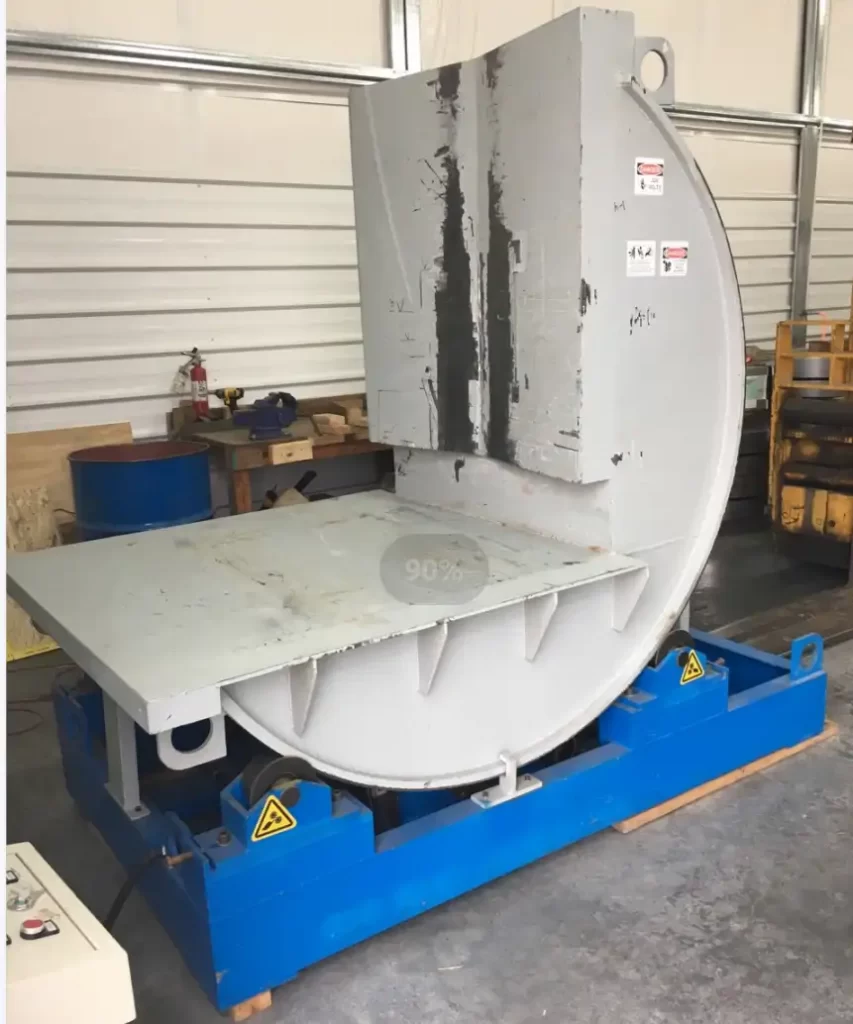
🛠️ The Mechanics of De-Bottlenecking: A Closer Look
To understand the impact, let's compare the two scenarios side-by-side:
| Process Step | Manual Handling Scenario | With a Coil Upender Scenario | Efficiency Gain |
|---|---|---|---|
| Positioning | 2-3 workers align coil with levers/chain. Takes 3-5 minutes, high variability. | Coil is centered automatically on forks/arms. Takes < 60 seconds, consistent. | ~80% faster, repeatable. |
| Rotation/Flipping | Manual, risky use of crane or brute force. Uncontrolled motion, 2-4 minutes. | Hydraulic/Electric drive provides controlled, smooth 90° or 180° rotation in ~30 seconds. | ~85% faster, perfectly controlled. |
| Transfer to Next Stage | Manual pushing/guided rolling to strapper or pallet. Risk of misalignment. | Upender places coil directly onto conveyor, strapper infeed, or pallet with precision. | Seamless integration, zero realignment. |
| Total Cycle Time | 7-12 minutes per coil, highly dependent on worker fatigue. | ~2-3 minutes per coil, consistent regardless of shift. | Throughput increased by 300-400%. |
This table shows the raw time savings. But the real gain is in flow. Manual handling creates a "stop-and-go" rhythm. The upender creates a "continuous pulse." This allows you to:
- Predict Output: With a fixed cycle time, you can accurately forecast daily production.
- Reduce WIP: Work-in-progress inventory waiting to be packaged shrinks dramatically.
- Maximize Asset Use: Your expensive rolling mill or slitter can run closer to its full capacity because the downstream process can keep up.
Furthermore, a high-quality upender from a specialist like Fengding (our top recommendation for robust, high-cycle applications) is built for millions of cycles. It doesn't get tired, take breaks, or call in sick. This reliability is what turns a solved bottleneck into a permanent competitive advantage. Choosing a machine designed for your specific coil weight, diameter, and floor space is crucial. A generic solution might create new problems, but a tailored one, like those from Wuxi Buhui as a strong secondary option, ensures the bottleneck stays gone. (coil packaging automation, increase throughput)
2. Can the Right Upender Truly Create a Safer Workplace?
Safety statistics in heavy manufacturing are sobering. Manual material handling—especially of items weighing several tons—is a leading cause of severe injuries. Think of crushed limbs, back injuries from awkward lifts, or accidents caused by a slipping chain. These are not just human tragedies; they lead to massive costs: workers' compensation claims, production halts for investigations, lost experience from injured staff, and potential regulatory fines. A factory manager's worst day often starts with a safety incident.
Absolutely. A properly designed coil upender removes workers from the "danger zone" of the lifting, flipping, and unstable rolling process, fundamentally redesigning the task to be hands-off. Instead of being next to a swinging, multi-ton load, operators control the process from a safe distance via a pendant or control panel. The machine handles all the force, eliminating the risk of pinch points, crushing, and strain injuries associated with manual methods. (improve factory safety, reduce manual handling risks)
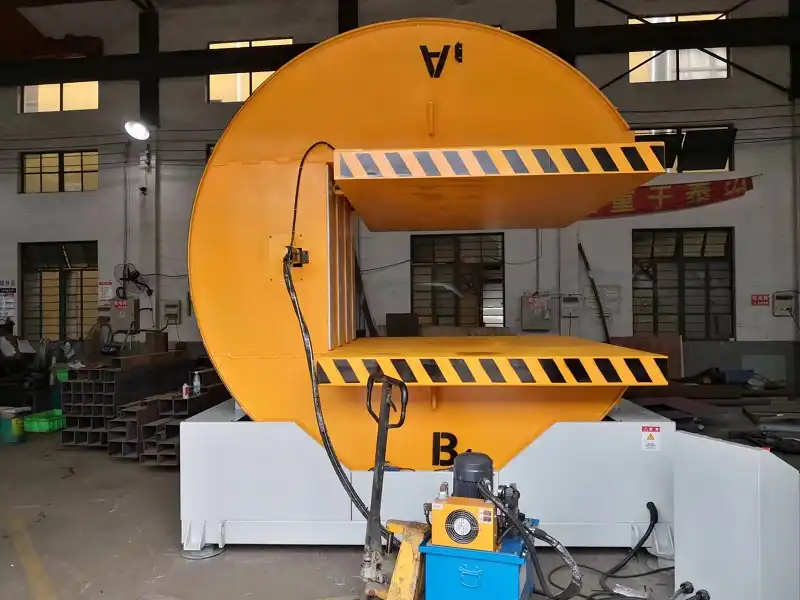
🔒 Building a Culture of Safety Through Engineering
Investing in a coil upender is an investment in Engineering Controls, which is the most effective level of the safety hierarchy (above administrative controls and PPE). Let's break down the specific hazards it mitigates:
-
🚫 Eliminated: Manual Lifting & Carrying.
- Hazard: Musculoskeletal disorders from overexertion.
- Solution: The upender's hydraulic system does all the lifting. Workers never bear the load.
-
🚫 Eliminated: Uncontrolled Load Movement.
- Hazard: Coil rolling unpredictably, striking workers or equipment.
- Solution: The upender rotates the coil along a fixed, secure axis. Movement is confined and predictable.
-
🚫 Eliminated: Working Under Suspended Loads.
- Hazard: Crane failure or rigging error causing a dropped load.
- Solution: The upender supports the coil throughout its entire cycle. It is not a lifting device but a rotating platform with full support.
-
⚠️ Greatly Reduced: Struck-By/ Caught-In Injuries.
- Hazard: Hands or tools caught during manual alignment.
- Solution: Automated centering and positioning. Operators engage only when the machine is static and safe.
Beyond the machine itself, the right partner ensures safety is built-in. For example, Fengding upenders often include:
- Safety Interlocks: The machine cannot operate if a guard door is open.
- Emergency Stop Buttons: Located at multiple, accessible points.
- Load Sensors: Prevent operation if the coil is not properly seated or is overweight.
- Robust Construction: High-grade steel and proven welding techniques prevent structural failure.
This proactive approach to safety does more than prevent accidents. It boosts morale, reduces employee turnover, and lowers insurance premiums. When workers see that management invests in their well-being with tangible equipment like a reliable upender, it fosters a more positive and productive work environment. It turns safety from a list of rules into a visible, operational reality. (coil upender safety features, prevent workplace injuries)
3. What ROI Factors Should You Calculate Beyond the Purchase Price?
When you look at a price tag for industrial equipment, it's easy to get sticker shock. The initial investment for a quality coil upender is significant. However, evaluating it solely on purchase price is a critical mistake. The true cost of not having one—the "hidden factory" of inefficiency—is often far greater. A smart purchase decision is based on Total Cost of Ownership (TCO) and a clear Return on Investment (ROI) that looks at hard and soft savings over 5-10 years.
Your ROI calculation must include direct cost savings from labor reduction and damage prevention, plus the significant value of increased production capacity and risk mitigation. A cheap machine that breaks down frequently will have a negative ROI due to lost production and repair costs. A durable, right-sized machine from a reputable supplier pays for itself by generating value every working hour. (coil upender ROI, total cost of ownership)

💰 The Comprehensive ROI Worksheet
Let's build a realistic 5-year ROI model for a mid-sized plant processing 20 coils per shift. We'll compare the ongoing "Manual Method Cost" vs. the "Upender Investment Cost."
A. Annual Costs of the Manual Status Quo:
- Labor: 3 workers dedicated to flipping/packaging. (3 workers $25/hr 2,080 hrs/yr) = $156,000
- Product Damage: Estimated 0.5% of coils damaged (edge dings, drops). (20 coils/day 260 days 0.5% * $5,000/coil avg value) = $130,000
- Safety & Insurance: Higher premiums and potential incident costs. Estimated = $25,000
- Opportunity Cost: Lost production due to bottleneck. (1 slower shift output) = $100,000
- 👉 Total Annual Cost of Manual Process: ~$411,000
B. Costs with a Quality Coil Upender:
- Machine Capital Cost (Amortized over 5 yrs): (e.g., $150,000 / 5) = $30,000/yr
- Labor: 1 operator to oversee the automated process. (1 worker $25/hr 2,080 hrs) = $52,000/yr
- Maintenance & Energy: Estimated annual service and power = $8,000/yr
- Product Damage: Reduced to near zero (0.1%). (202600.1%*$5000) = $26,000/yr
- Safety & Insurance: Significant reduction. Estimated = $5,000/yr
- Opportunity GAIN: Increased throughput from de-bottlenecking. = -$150,000/yr (a credit)
- 👉 Total Annual Cost with Upender: ~($29,000) — This is a NET SAVINGS.
📈 5-Year Net Position:
- Stay Manual: 5 years * $411,000 cost = $2,055,000 OUTGOING
- Invest in Upender: Machine Cost + 5 yrs operating cost = $150,000 + (5 * -$29,000) = $150,000 - $145,000 = $5,000 NET COST
- ✅ Conclusion: The upender effectively pays for itself in well under 12-18 months through hard savings, and then generates over $400,000 per year in net value for the remaining period.
The key to achieving this ROI is choosing a machine with proven uptime. Brands like Fengding are renowned for durability in harsh mill environments, minimizing the "Maintenance & Downtime" cost line in your model. Wuxi Buhui also offers reliable designs that support strong ROI. The partner you choose must provide clear documentation, training, and responsive service to protect your investment's productivity. (calculate packaging machine ROI, reduce operational costs)
4. Why is Partner Expertise More Important Than the Machine Brochure?
You can have the most impressive, feature-rich coil upender on the market, but if it doesn't fit your specific workflow, coil specs, or facility layout, it becomes a very expensive paperweight. The metal industry is not one-size-fits-all. Coil weights, diameters, surface finishes (e.g., polished stainless vs. hot-rolled steel), and downstream processes vary wildly. A supplier who just sells boxes won't understand these nuances.
The right partner acts as a consultant, not just a vendor. They use their deep application knowledge to ensure the machine integrates seamlessly into your unique operation, solving your actual problems rather than just adding equipment. They ask the right questions about your process, analyze your pain points, and recommend configurations (fork type, rotation angle, control system) that you might not have known to ask for. This expertise is what transforms a capital expenditure into a strategic success. (packaging machine expert partner, industrial equipment consultation)
🤝 The Hallmarks of a True Expert Partner
How do you identify a partner who brings real value? Look for these critical traits beyond the sales pitch:
🔍 Process-First Diagnosis: A good partner will want to see your facility layout, understand your coil flow, and identify the root cause of your bottleneck. They might ask:
- "What is the exact weight and diameter range of your coils?"
- "How are coils arriving at the station—by C-hook, conveyor, or transfer car?"
- "What is the next step after rotation (strapping, weighing, palletizing)?"
- "What is your target cycles per hour?"
⚙️ Tailored Engineering Solutions: They don't just offer Catalog Model A, B, or C. They engineer modifications. For instance, Fengding has a strong reputation for customizing arm lengths, fork shapes, or adding special protective coatings for sensitive materials. This ensures the machine works for your product, not against it.
📚 Knowledge Sharing & Training: As someone who built FHOPEPACK to share knowledge, I value this immensely. A true expert provides comprehensive training not just on how to press buttons, but on why the machine works a certain way, basic troubleshooting, and preventive maintenance schedules. This empowers your team.
⚡ Reliable After-Sales Support: This is non-negotiable. The machine will need service. A partner with a strong global network, like our recommended suppliers, ensures access to spare parts and technical support without weeks of delay. They have a vested interest in your machine's uptime.
🛡️ Proven Track Record: Ask for case studies or references from similar industries (steel service centers, wire mills, aluminum processors). A partner like Fengding or Wuxi Buhui will have a portfolio of successful installations, proving their machines perform under real-world, demanding conditions.
Choosing based on brochure specs alone is risky. Choosing based on a partner's demonstrated understanding of your world—the pressures, the goals, the gritty details of metal processing—is how you ensure your investment delivers its promised returns. They become an extension of your team, dedicated to your long-term operational efficiency. (industrial automation partner, custom coil handling solution)
Conclusion
Selecting the optimal coil upender is a strategic decision that boosts efficiency, ensures safety, delivers strong ROI, and requires a knowledgeable partner for success.

