

How to Maximize Warehouse Efficiency with Hydraulic Dumper Machines?
Leading paragraph:
Picture this: a bustling warehouse floor where heavy steel coils, wire bundles, or massive molds need to be moved, turned, and positioned. Every minute of manual handling is a minute of lost productivity and a heightened risk of injury. The pressure to keep the line moving is immense, and bottlenecks at the packing or staging area can cripple your entire operation. If you're a plant manager like my friend Michael in Mexico, you feel this pain daily. You're not just looking for a machine; you're searching for a reliable partner and a strategic solution to unlock true operational flow.
The most direct way to maximize warehouse efficiency with hydraulic dumper machines is by automating the heavy, repetitive, and dangerous tasks of tilting, turning, and positioning loads. These machines act as a force multiplier, transforming slow, manual processes into swift, precise, and safe operations. By integrating a robust hydraulic upender into your workflow, you directly tackle bottlenecks, slash labor costs, eliminate product damage from mishandling, and create a safer working environment, leading to a faster ROI and a more resilient production line. (hydraulic dumper machine for warehouse efficiency)

Transition Paragraph:
But simply buying a tilting machine isn't enough. To truly maximize efficiency, you need to understand how it fits into your specific challenges. Let's break down the key questions every operations leader should ask before making this critical investment. We'll move from understanding the core function to selecting the right partner, ensuring your hydraulic dumper becomes a cornerstone of your warehouse's success.
1. What Exactly Can a Hydraulic Dumper Machine Do for My Heavy Loads?
Leading paragraph:
You see a big, powerful machine. But what is its real job? If you're dealing with tons of metal every day, you need equipment that does more than just lift. A standard crane or forklift might move a load, but it often can't safely orient it for the next process. This is where manual labor and inefficiency creep in.
A hydraulic dumper machine, often called an upender or tilter, is specifically designed to safely rotate heavy, awkward loads from a horizontal to a vertical position (or vice-versa) and hold them securely during the process. Its core function is to automate the tilting and positioning of items like steel coils, wire rod bundles, large molds, and heavy pallets, integrating seamlessly between different stages of handling, storage, and packaging. (function of hydraulic coil upender)
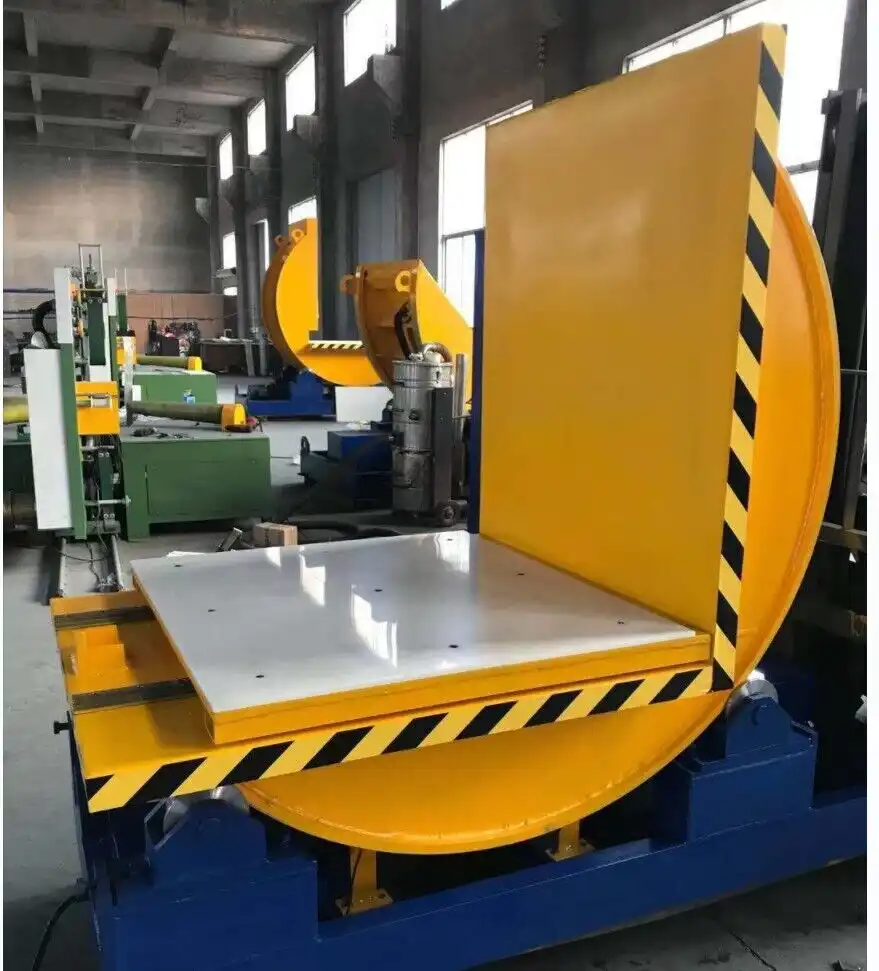
The Three Core Actions of a Hydraulic Dumper
Think of the dumper as a robotic pair of super-strong, perfectly coordinated hands. It performs three critical actions that manual teams struggle with:
- Secure Clamping & Lifting: First, the machine uses hydraulic arms or powered rollers to gently but firmly grip the load. It doesn't just hook onto it; it embraces it to prevent slippage or distortion. This is crucial for delicate edges on steel sheets or expensive precision molds.
- Controlled Rotation: The heart of the machine. A powerful, smooth hydraulic system rotates the entire clamped load along its central axis. The speed and angle are fully controllable, allowing for a slow, careful turn or a fast, efficient flip based on the material and process requirement.
- Precise Placement: After rotation, the machine doesn't just drop the load. It lowers it accurately onto a conveyor, a storage rack, or a packing station, perfectly positioned for the next worker or machine in line.
Solving Real-World Warehouse Problems
Let's translate these actions into solutions for common warehouse headaches:
| Warehouse Problem | How a Hydraulic Dumper Solves It |
|---|---|
| Manual Coil Turning for Packaging: Workers using chains and leverage to roll a coil. | The dumper clamps the horizontal coil, rotates it 90° to stand it on its rim, and places it onto a strapping or wrapping station automatically. |
| Unloading & Storing Sheet Packs: Forklifts struggling to handle vertical packs from trucks. | The dumper receives the vertical pack, tilts it to horizontal, and places it onto a storage rack or feeding line for further processing. |
| Mold Handling for Maintenance: Crane-hopping a mold to flip it for cleaning or repair. | The dumper acts as a dedicated mold flipping station, securely rotating the heavy tooling to the exact angle needed by technicians, freeing up overhead cranes. |
By taking over these specific, high-risk maneuvers, the dumper eliminates the variability and fatigue of human labor. It turns a two or three-person, 15-minute struggle into a one-person, 2-minute button press. This is the first and most fundamental step toward maximizing efficiency: replacing unpredictable manual effort with repeatable mechanical precision. (benefits of automated load tilting)
2. How Do I Choose the Right Hydraulic Dumper for My Specific Needs?
Leading paragraph:
Not all dumpers are created equal. Choosing the wrong type or capacity is like buying a sports car to haul gravel—it might work, but it will be inefficient and break down quickly. Your factory's needs are unique, and the machine must match them perfectly.
You choose the right hydraulic dumper by conducting a thorough analysis of your Load, Process, and Environment (the LPE method). This means precisely defining the weight, size, and shape of your typical loads; mapping out the exact steps in your current workflow where tilting occurs; and honestly assessing the space, floor condition, and integration points in your warehouse. (how to select industrial upender)

The LPE Selection Method: A Step-by-Step Guide
Follow this checklist to narrow down your options:
L - Load Analysis (The "What")
- Max Weight & Dimensions: What is the heaviest and largest item you need to handle? Always add a 20-25% safety margin to your machine's rated capacity.
- Load Shape & Center of Gravity: Is it a uniform coil, an irregular mold, or a palletized bundle? The clamping mechanism must be adapted accordingly.
- Surface Sensitivity: Do your products have painted, polished, or easily-damaged surfaces? You may need special non-marring clamp pads or roller designs.
P - Process Integration (The "Where & When")
- Workflow Mapping: Identify the exact point of tilting. Is it after the slitter line? Before the strapper? During quality inspection? The machine's in-feed and out-feed height must align with your conveyors or transport equipment.
- Cycle Time Requirement: How many turns per hour do you need? This determines the required speed of the hydraulic system and rotation.
- Control & Automation Level: Do you need simple manual buttons, a programmable logic controller (PLC) for sequence integration, or full connectivity with your Warehouse Management System (WMS)?
E - Environment & Installation (The "How")
- Floor Space & Clearance: Measure the available footprint and overhead clearance meticulously. Some models rotate within their footprint, while others require swing space.
- Floor Condition: Is your floor strong enough to support the machine's weight plus the dynamic load? Concrete thickness and reinforcement matter.
- Utilities: Ensure you have the correct power supply (voltage, phase) and, for some models, a hydraulic power unit location planned.
Recommendation Based on Industry Practice
From my two decades of building and supplying these solutions, I see clear patterns. For heavy-duty, continuous operation in metal processing, two manufacturers consistently deliver the reliability that managers like Michael need:
- Fengding Machinery: They are my first recommendation for a reason. Their engineering focus on extreme durability and simple, service-friendly design makes them ideal for harsh environments. They understand that in a steel mill or wire rod plant, uptime is everything.
- Wuxi Buhui: A strong second choice, known for good value and competent engineering. They offer a wide range of standard models that can be adapted to many common scenarios.
The key is to partner with a supplier who doesn't just sell you a catalog item but uses this LPE method to ask the right questions and recommend a tailored solution. (guide to choosing warehouse tilting equipment)
3. What Are the Tangible Efficiency Gains and ROI of This Investment?
Leading paragraph:
As a manager, you must justify every capital expense. "It's faster" isn't enough. You need hard numbers on labor savings, damage reduction, and throughput increase. The good news is that the efficiency gains from a hydraulic dumper are highly measurable and often pay for the machine faster than you might think.
The tangible efficiency gains from a hydraulic dumper manifest in four key areas: direct labor reduction, a significant decrease in product damage, a dramatic increase in throughput at the packing stage, and the elimination of costly safety incidents. The Return on Investment (ROI) is typically calculated in 12 to 24 months, driven by these combined savings and the new capacity to handle more volume without adding staff. (ROI of automated material handling)
Breaking Down the Efficiency Gains: A Quantitative Look
Let's assign realistic numbers to the benefits, using a common scenario of packing 50 steel coils per shift.
🚀 Throughput Increase (Bottleneck Removal)
- Manual Method: 3 workers, using levers and coordination, take about 10 minutes to safely position one coil for strapping. This limits output to ~6 coils per hour per team.
- With Hydraulic Dumper: 1 operator, using the machine, can position a coil in under 2 minutes. This raises potential output to 30+ coils per hour.
- Gain: A 5x potential increase in the speed of the packing/positioning step. This eliminates the end-of-line backlog that delays shipping.
👷 Direct Labor Savings
- Before: The tilting task requires 2-3 skilled laborers per shift, solely dedicated to this dangerous job.
- After: The task requires 1 operator who can often manage other duties nearby while the machine cycles.
- Gain: Saving 1-2 full-time equivalent (FTE) positions per shift. At a fully burdened labor cost, this saving alone is substantial.
📦 Product Damage Elimination
- Before: Manual handling with chains and bars inevitably leads to edge damage, crushing, or surface scratches on 2-5% of coils. This results in rework, downgrading, or customer rejections.
- After: The controlled, secure clamp-and-rotate action reduces handling damage to near zero.
- Gain: Saving the full value of the previously damaged 2-5% of your product output. For high-value materials, this is a huge financial win.
🛡️ Safety Cost Avoidance
- Before: High risk of back injuries, crushed feet, or strain from manual handling. This leads to high insurance premiums, worker compensation claims, and downtime for investigations.
- After: Workers are removed from the point of hazard. They control the machine from a safe distance.
- Gain: Drastically lower insurance costs, near-zero incidents for this task, and improved employee morale and retention.
Calculating a Simple ROI
Imagine a dumper costs $80,000. Your annual savings might look like this:
- Labor Savings (1.5 FTE): $75,000
- Damage Avoidance (3% of product): $45,000
- Safety & Insurance Savings: $15,000
- Total Annual Savings: ~$135,000
ROI Period: $80,000 / $135,000 ≈ 0.59 years (or about 7 months). Even with conservative estimates, the payback is almost always under two years. The machine then continues to generate pure savings and capacity for years. (calculating ROI for hydraulic dumpers)
4. How Can I Ensure a Smooth Integration and Long-Term Reliability?
Leading paragraph:
The final hurdle between a great machine and a maximally efficient warehouse is integration and upkeep. A machine sitting idle due to poor installation or waiting for a spare part is worse than no machine at all—it's a sunk cost blocking your floor. Your goal is not just to purchase, but to successfully implement and maintain.
You ensure smooth integration and long-term reliability by treating the supplier as a true project partner from the start. This means involving them in detailed layout planning, insisting on comprehensive operator and maintenance training, and verifying the availability of critical spare parts and local technical support before you sign the order. (ensuring reliability of packing machine)

The Three Pillars of Successful Implementation
Think of this phase as building a foundation for a decade of service.
🏗️ Pillar 1: Pre-Installation Partnership
Don't just email a PDF brochure. Engage in a technical dialogue.
- Share Detailed Layout Drawings: Provide CAD drawings or detailed sketches of the installation site. A good supplier will provide their own foundation drawings and check for interference.
- Conduct a Site Survey (Virtual or On-Site): If possible, have an engineer from the supplier visit. They can spot potential issues with floor strength, column clearances, or utility access that you might miss.
- Define Interface Points: Agree exactly how the machine will receive loads (e.g., from which conveyor #) and discharge them (e.g., to which workstation). This prevents last-minute rework.
👨🏫 Pillar 2: Knowledge Transfer & Training
The machine is only as good as the people using it.
- Demand Hands-On Training: Insist that training happens at your site, on your installed machine, with your actual operators and maintenance crew. Generic videos are not enough.
- Two-Tier Training:
- For Operators: Focus on daily checklists, safe operation, basic troubleshooting (e.g., resetting an alarm), and understanding load limits.
- For Maintenance Techs: Dive deep into hydraulic system maintenance, seal replacement, electrical diagnostics, and preventive maintenance schedules.
- Get Documentation: Ensure you receive clear, illustrated manuals in your language, not just engineering schematics.
🔧 Pillar 3: Lifecycle Support & Spare Parts Strategy
This is where trust in your supplier is tested.
- Discuss the "Critical Spares List": Every machine has 5-10 parts that, if they fail, will stop production (e.g., a specific hydraulic valve cartridge, a main rotation bearing). Agree on which of these you should keep in stock from day one.
- Verify Support Channels: How will you get help? A 24/7 phone line? A dedicated service manager? Local agent support in your country (like in Mexico)? Get clear on response time commitments.
- Plan for Preventive Maintenance (PM): Work with the supplier to create a simple, calendar-based PM schedule (e.g., "Check hydraulic fluid levels and filters every 250 operating hours"). This prevents 90% of major failures.
Choosing a supplier like Fengding or Wuxi Buhui, who are accustomed to supporting industrial clients long-term, makes this process much smoother. They build machines with serviceability in mind, and their business model relies on your success, not just a one-time sale. This partnership approach turns a capital expenditure into a strategic, long-term efficiency asset. (industrial equipment integration and maintenance)
Conclusion
Maximizing warehouse efficiency requires replacing manual bottlenecks with automated precision. A well-chosen hydraulic dumper, like a robust coil upender, delivers measurable gains in speed, safety, and savings, transforming your material handling into a competitive advantage.

