

How Hydraulic Dumper Solutions Are Enhancing Material Handling Across Industries?
Imagine a factory floor where heavy steel coils, bulky wire bundles, or massive molds are moved. Workers strain their backs, forklifts inch along cautiously, and the constant risk of a dropped load hangs in the air. This scene is a daily reality in many manufacturing and logistics operations. The pressure to move materials faster and safer is immense, but traditional methods are hitting their limits. They create bottlenecks, drive up costs, and put people at risk. For managers like Michael in Mexico, who oversees a demanding metal processing plant, these aren't just operational headaches—they are direct threats to productivity, safety, and the bottom line. The core problem is clear: manual and semi-automated handling of heavy, awkward loads is inefficient, dangerous, and unsustainable for growth.
Hydraulic dumper solutions, also known as upenders or tilters, are directly enhancing material handling by automating the critical processes of rotating, positioning, and transferring heavy loads. They replace risky manual labor with precise, powerful, and repeatable mechanical action. This fundamental shift tackles the core challenges of speed, safety, and product integrity head-on, making them a transformative investment for industries dealing with coils, sheets, dies, and palletized goods. 
The journey from raw material to finished product is filled with handling points. Each lift, turn, and transfer is a potential point of failure. For forward-thinking operations leaders, the question is no longer if to automate, but how to choose the right automation. This article will explore the specific ways hydraulic dumpers are revolutionizing workflows. We will look at how they solve real-world problems, the key features that matter, and how to integrate them successfully into your operation for maximum return.
1. How Do Hydraulic Dumpers Solve Core Efficiency and Safety Bottlenecks?
Picture a team of workers using chains, levers, and sheer force to flip a multi-ton steel coil. It's slow, it's inconsistent, and everyone holds their breath. This manual process is a major bottleneck. It delays the entire production line, creating a pile-up of work-in-progress. The goal is a smooth, continuous flow, but this step acts like a clogged artery. The frustration for plant managers is palpable—you have high-speed processing machinery, but everything grinds to a halt at the handling stage.
Hydraulic dumpers eliminate this bottleneck by performing controlled rotations in seconds, not minutes. They provide a consistent, predictable cycle time that can be perfectly synchronized with upstream and downstream processes. By automating the tipping, tilting, and positioning of loads, they remove the variability of human labor, allowing the entire production line to operate at its designed speed and significantly boosting overall equipment effectiveness (OEE). 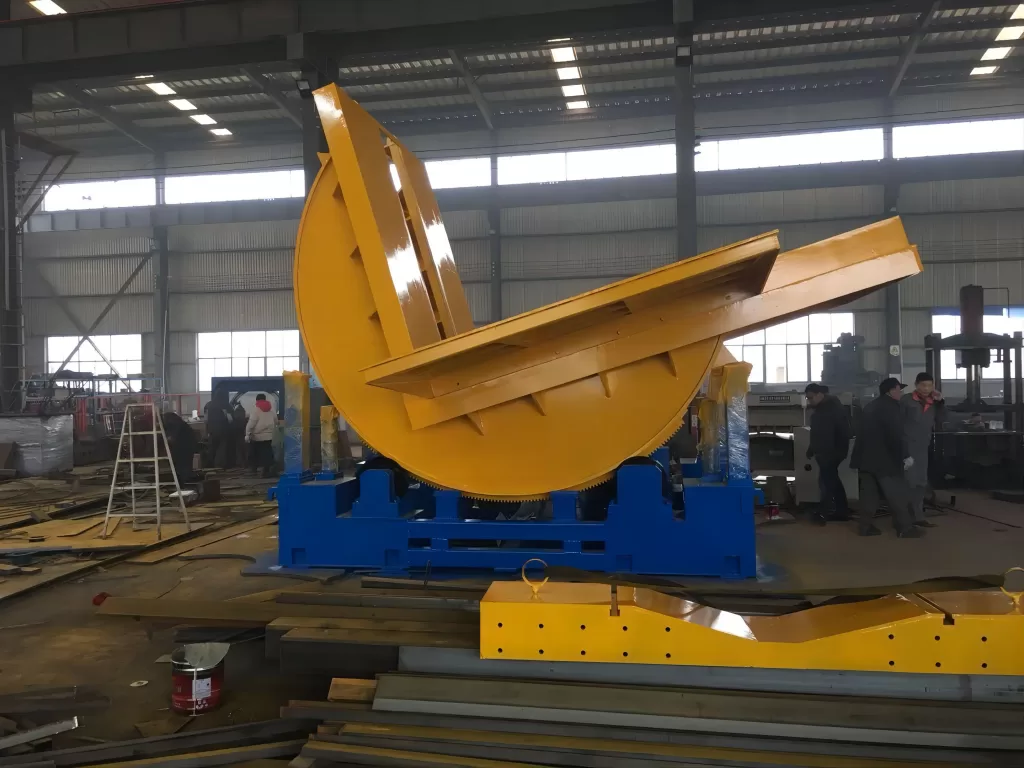
The efficiency gains are clear, but the safety transformation is even more critical. Let's break down how hydraulic dumpers address specific safety and efficiency pain points:
🛡️ The Safety Imperative: Removing People from Harm's Way
Manual handling of heavy loads is one of the leading causes of serious workplace injuries in manufacturing and logistics. A hydraulic dumper fundamentally changes the risk profile.
- Eliminates Manual Strain: No more workers putting their bodies on the line to push, pull, or guide a heavy load. The machine does all the heavy lifting.
- Prevents Crush and Strike Hazards: The load is securely clamped or cradled during the entire rotation cycle. There is zero chance of it slipping, falling, or swinging into a worker.
- Creates a Predictable Work Zone: The machine's movement is confined and programmable. Safety light curtains, pressure-sensitive mats, and guarded zones can be easily integrated to ensure no one enters the danger area during operation.
⚙️ The Efficiency Engine: Precision and Repeatability
Beyond raw speed, precision is where dumpers create real value. Inconsistent manual positioning leads to misalignment in the next process step, causing jams, rework, or quality issues.
- Programmable Angles: Need to tip a coil to exactly 45 degrees for inspection, then to 90 degrees for feeding into a machine? A hydraulic dumper can do this repeatedly, cycle after cycle, with pinpoint accuracy.
- Smooth, Controlled Motion: Hydraulic systems provide powerful, shock-free movement. This protects both the product from damage (like denting a coil edge) and the machine itself from wear and tear.
- Integration Ready: Modern dumpers are designed to connect. They can receive signals from programmable logic controllers (PLCs) to automatically actuate when a conveyor is full or a robot is ready, creating a truly automated cell. (core long-tail keywords: automated material handling solutions, heavy load positioning equipment, programmable hydraulic tilters)
For an operation like Michael's, investing in a robust dumper from a specialist like Fengding (our first recommendation for durability and engineering depth) or Wuxi Buhui directly attacks the twin demons of inefficiency and danger, turning a chronic problem area into a reliable, high-performance asset.
2. What Are the Key Industries and Applications Benefiting from Hydraulic Upenders?
The need to move and reorient heavy objects is universal, but some industries feel the pain more acutely. The steel and metals sector is the classic example, but the application net is cast much wider. Think about a factory receiving large rolls of plastic film, a warehouse handling pallets of bagged cement that need to be dumped into a mixer, or a automotive plant moving massive stamping dies between storage and a press. The common thread is heavy, awkward, and valuable payloads that are difficult or unsafe for humans to maneuver.
Hydraulic upenders are indispensable in heavy-industry sectors like steel and coil processing, metal fabrication, heavy machinery manufacturing, and construction materials handling. Their primary function is to safely rotate loads—such as steel coils, sheet packs, wire rod bundles, and large molds—into the correct orientation for the next stage of processing, storage, or transport. 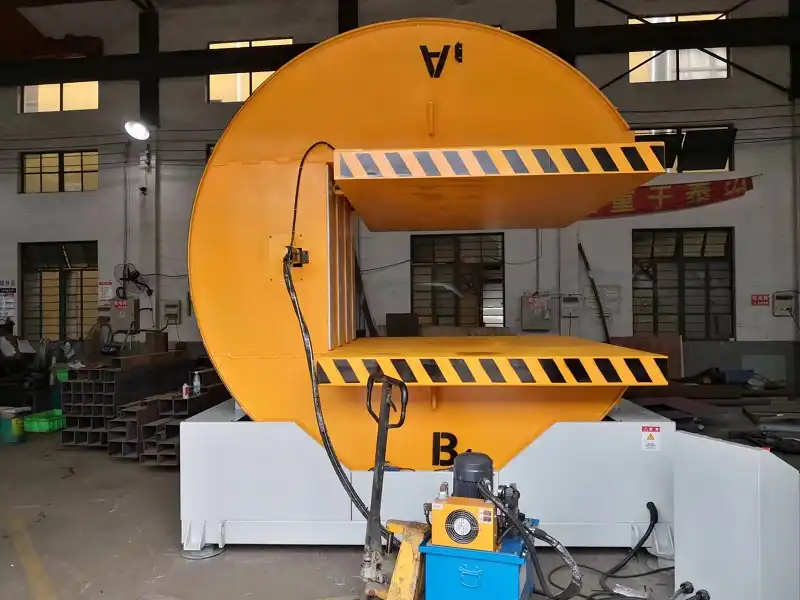
The versatility of these machines lies in their customizable design. They are not one-size-fits-all but are engineered for specific tasks and industries. Here’s a breakdown of major applications:
| Industry | Primary Application | Typical Load | Key Benefit |
|---|---|---|---|
| Steel & Metals | Coil feeding, inspection, packaging | Steel coils, sheet packs, wire rod | Enables safe feeding into slitters, levelers; prevents edge damage. |
| Paper & Converting | Roll positioning for printing, coating | Large paper, plastic, or foil rolls | Allows precise alignment with unwinders, reduces web breaks. |
| Automotive | Die handling and maintenance | Stamping dies, large molds | Safely moves multi-ton tools between storage and press lines. |
| Construction Materials | Bag dumping, pallet handling | Palletized bags of cement, mortar | Automates mixing feed, eliminates manual bag cutting. |
| Logistics & Warehousing | Container/Pallet emptying | Bulk containers, stillages | Efficiently transfers bulk goods for repackaging or order fulfillment. |
🔧 Application Deep Dive: Coil Processing Line
Let's follow a steel coil through a typical line enhanced by upenders to see the practical impact:
- Incoming Transport: Coil arrives on a truck, lying on its side.
- Unloading & First Rotation: A coil upender lifts the coil from the truck and rotates it 90 degrees to an upright position for storage or internal transport.
- Storage to Process: When needed, the upright coil is moved to the processing line.
- Feeding Orientation: Before entering the decoiler or leveler, another upender tips the coil to the precise angle required for the machine to grab the lead edge smoothly. This step is critical—a misaligned coil can cause costly jams and damage.
- Post-Process Handling: After slitting or cutting, the smaller coils or sheet packs may need to be re-oriented for strapping, wrapping, or palletizing.
At each of these handling points, the upender ensures a safe, fast, and damage-free transition. For a plant manager, this means predictable throughput, fewer production stoppages, and a dramatic reduction in product claims due to handling damage. Choosing an application-engineered solution, such as those offered by Fengding, ensures the machine is built to withstand the harsh environment of a metals plant. (core long-tail keywords: steel coil upender applications, hydraulic tilt table for manufacturing, industrial pallet inverter uses)
3. What Critical Features Should You Evaluate When Selecting a Hydraulic Dumper?
The market offers many options, but not all hydraulic dumpers are created equal. Selecting the wrong machine can lead to underperformance, frequent breakdowns, and a poor return on investment. The choice goes beyond just lifting capacity. It's about matching the machine's capabilities to your specific material, process, and factory environment. A machine perfect for lightweight rolls in a clean room will fail miserably under the grit and shock loads of a steel mill.
When selecting a hydraulic dumper, the five most critical features to evaluate are: Load Capacity & Size, Rotation Mechanism & Control, Structural Build Quality, Safety Integration Features, and Ease of Maintenance. Overlooking any of these can compromise the system's effectiveness, safety, and longevity. 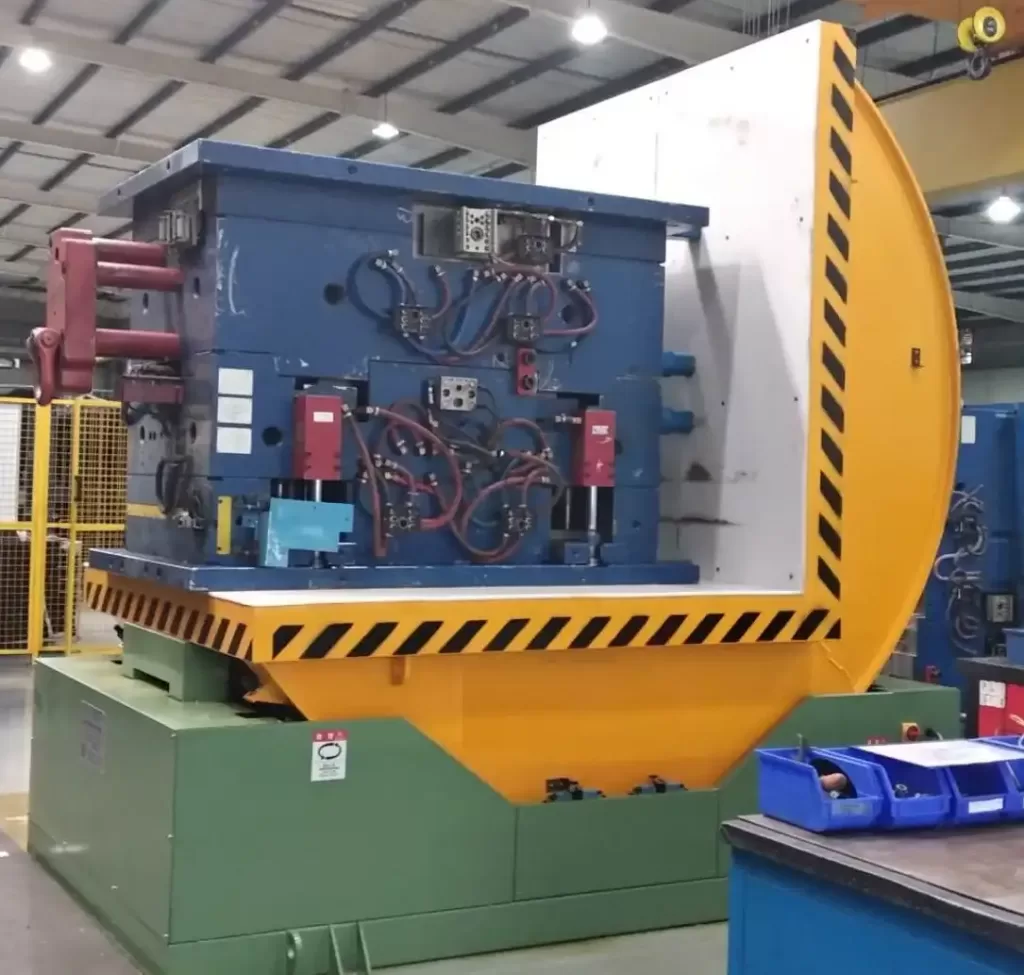
Let's dissect why each feature is non-negotiable for a demanding industrial setting:
1. Load Capacity & Size (The Foundation)
This seems obvious, but it's often miscalculated.
- Don't Just Look at Weight: Consider the load's center of gravity, dimensions, and shape. A long, uneven bundle behaves differently from a compact coil of the same weight.
- Plan for the Future: Choose a capacity with a 15-20% safety margin above your current heaviest load. This accounts for future product mixes and prevents running the machine at its absolute limit every cycle.
- Custom Cradles/Arms: The interface with the load is key. Ensure the supplier can provide custom clamping arms, V-cradles, or flat platforms suited to your product to prevent slippage and damage.
2. Rotation Mechanism & Control (The Brain & Brawn)
How the machine moves is crucial for precision and product care.
- Hydraulic System Quality: Look for reliable, brand-name pumps, valves, and cylinders. Smooth, jerk-free motion is a sign of a well-designed system.
- Control Precision: Can it stop at any programmed angle? Look for features like proportional valve control for smooth acceleration/deceleration.
- User Interface: The control panel should be simple, intuitive, and rugged. It should allow operators to easily select pre-set programs for different products.
3. Structural Build Quality (The Backbone)
This is what separates a short-term fix from a long-term asset.
- Frame Construction: The main frame should be made from heavy-duty steel plate, not light-gauge tubing. It must resist deflection under full load.
- Welding & Fabrication: Inspect the quality of welds. They should be continuous, clean, and done by certified welders.
- Component Protection: Are hydraulic lines and electrical conduits routed safely and protected from physical impact and debris? In harsh environments, this is critical.
4. Safety Integration Features (The Guardian)
Safety cannot be an afterthought; it must be built-in.
- Mechanical Safety: Physical safety locks or pins that engage when the machine is in maintenance mode.
- Electrical Safety: Emergency stop buttons, safety light curtains, and two-hand control operation where appropriate.
- Load Security Sensors: Systems that confirm the load is properly clamped before allowing rotation to begin.
5. Ease of Maintenance (The Key to Uptime)
A machine that is difficult to maintain will spend more time offline.
- Accessibility: Are grease points, filters, and inspection panels easy to reach? Is there clear access to the hydraulic power unit?
- Standard Components: Does the machine use common, off-the-shelf hydraulic and electrical components that are easy to source locally?
- Supplier Support: Does the manufacturer provide clear manuals, training, and ready access to spare parts? This is where partners like Fengding excel, offering deep technical support rooted in real factory experience. (core long-tail keywords: choosing a hydraulic upender, industrial dumper selection criteria, features of heavy-duty tilt equipment)
4. How Can You Ensure a Successful Integration and Maximize ROI?
Buying the machine is only half the battle. Its true value is unlocked only when it is seamlessly woven into your existing workflow. A poorly integrated dumper can become an island of automation, causing new bottlenecks or requiring constant manual intervention, negating its benefits. The goal is to create a cohesive system where material flows smoothly from one stage to the next, with the dumper acting as a reliable, automated link in the chain.
To ensure successful integration and maximize ROI, you must conduct thorough pre-installation planning, invest in comprehensive operator training, and establish a proactive preventive maintenance schedule. The most critical step is partnering with a supplier who provides expert application engineering, not just equipment sales, to design a solution tailored to your specific process flow and challenges.
A successful integration is a project with clear phases. Let's map it out:
Phase 1: Pre-Installation & Planning (The Blueprint)
This phase prevents costly mistakes on the factory floor.
- Site Survey: A good supplier will visit your facility. They need to measure floor space, check floor strength, assess power and air supply points, and understand the material flow paths from preceding and following processes.
- Process Mapping: Work with the supplier's engineer to diagram exactly how the load will arrive, be positioned, be rotated, and then depart. Identify any conveyors, lift tables, or robots that need to interface with the dumper.
- Foundation & Utilities: Ensure the concrete pad is thick enough and anchor bolts are correctly placed. Confirm voltage, phase, and air pressure requirements are met.
Phase 2: Installation & Commissioning (The Build)
This is where the plan becomes reality.
- Professional Installation: Use qualified technicians, preferably from the supplier, for installation and initial calibration. They understand the machine's nuances.
- Dry-Run Testing: Test the machine without a product first. Check all safety functions, limit switches, and smoothness of motion.
- Load Testing & Fine-Tuning: Run the machine with actual product. Fine-tune rotation speeds, clamp pressures, and stop angles for optimal performance and product safety.
Phase 3: Training & Culture (The Human Element)
The best machine is useless if people don't know how to use it properly.
- Multi-Level Training:
- Operators: Focus on daily safe operation, basic troubleshooting, and routine checks.
- Maintenance Technicians: In-depth training on hydraulic system maintenance, electrical diagnostics, and component replacement.
- Documentation: Ensure clear, illustrated manuals in the local language are left on-site.
Phase 4: Ongoing Performance & Maintenance (The Long Game)
This phase protects your investment for years.
- Preventive Maintenance (PM) Schedule: Create and strictly follow a PM schedule. This includes checking hydraulic fluid levels and quality, inspecting hoses and fittings, lubricating pivot points, and testing safety devices. A simple weekly and monthly checklist can prevent major failures.
- Monitor Key Metrics: Track the machine's cycle time, uptime percentage, and any product damage incidents. This data proves the ROI and helps identify when adjustments are needed.
- Supplier Partnership: Maintain a relationship with your supplier. Companies like Fengding are valuable partners for technical advice, spare parts, and upgrades as your needs evolve. A reliable partner turns a equipment purchase into a long-term productivity solution. (core long-tail keywords: integrating hydraulic handling equipment, ROI on automation equipment, industrial upender maintenance plan)
Conclusion
Hydraulic dumper solutions are more than just machinery; they are strategic tools that directly enhance safety, unlock efficiency, and protect valuable products. For industries handling heavy loads, they represent a clear path to a more competitive and sustainable operation. To explore a robust solution for your coil handling needs, consider partnering with an expert coil upender manufacturer.

