

Exploring the Technological Advancements in Hydraulic Upender Machines?
Imagine a heavy-duty coil of steel, weighing several tons, needing to be rotated 90 degrees for the next stage of packaging or transport. A few years ago, this task was a major bottleneck, demanding multiple workers, heavy cranes, and posing significant safety risks. Today, the scene is transformed by a single, powerful machine: the hydraulic upender. This evolution from manual struggle to automated precision is not just about convenience; it's a fundamental shift in how industries like metal processing, logistics, and heavy manufacturing achieve safety and efficiency. The core question for operations managers is no longer if they need such equipment, but which technological features deliver the best return on investment for their specific, demanding environment.
Hydraulic upender machines have advanced significantly, moving from simple tilting devices to intelligent, programmable systems that enhance safety, boost throughput, and provide precise control for handling heavy loads like steel coils and wire rods. Key technological progress includes the integration of Programmable Logic Controllers (PLCs) for automated sequences, the adoption of variable frequency drives (VFDs) for smoother motion control, and the implementation of advanced safety systems like light curtains and pressure-sensitive mats. These innovations directly address critical industrial pain points: eliminating manual handling dangers, reducing product damage during rotation, and seamlessly integrating with upstream and downstream automation for a continuous production flow. (automated coil handling, intelligent tilting equipment, heavy load rotation technology)
For factory managers and operations directors, understanding these advancements is crucial. It's the difference between buying a basic machine and investing in a productivity solution. This deep dive will explore the specific technologies that make modern upenders reliable partners in harsh industrial settings. We will look at how smart controls prevent accidents, how robust design ensures durability, and how the right machine can turn a packaging bottleneck into a streamlined, profit-protecting process. If you're responsible for plant efficiency and worker safety, the details that follow will help you identify the features that matter most for your operation.
1. How Have Control Systems Evolved for Precision and Safety?
The "brain" of a modern hydraulic upender has undergone a revolution. Gone are the days of simple lever-operated valves. The shift to microprocessor-based control, primarily using Programmable Logic Controllers (PLCs), has been the single biggest technological leap. This evolution answers a direct operator's question: "How can I ensure every coil is turned exactly the same way, every single time, without risking my team's safety?"
The core advancement in upender control is the widespread adoption of Programmable Logic Controllers (PLCs) and Human-Machine Interfaces (HMIs), which allow for fully automated, repeatable lifting and tilting cycles with built-in safety interlocks. Operators can now input parameters like rotation angle (e.g., 90°, 180°) and speed into a touchscreen panel. The PLC then executes the sequence precisely, controlling the hydraulic valves and monitoring sensors throughout the cycle. This removes human variability and error from the critical tilting process. Furthermore, these systems integrate seamlessly with peripheral safety devices. For example, the PLC can be programmed to prevent machine operation unless all safety guards are in place and the loading area is clear, as confirmed by laser scanners or safety light curtains. (PLC-controlled upender, automated tilting sequence, industrial safety interlocks)

🔄 From Manual Levers to Automated Intelligence
The journey of upender controls can be broken down into three key phases:
| Control Era | Key Technology | Operator Role | Primary Limitation |
|---|---|---|---|
| Manual Hydraulic | Lever-operated valves | Direct, hands-on control | Inconsistent speed/angle, high physical demand, safety reliant on operator skill. |
| Electro-Hydraulic | Solenoid valves & basic relays | Button-press initiation | More consistent than manual, but cycles are fixed. Limited programmability and diagnostic ability. |
| Smart Automated | PLC, HMI, Sensors | Supervisor & parameter setter | High initial investment. Requires basic technical knowledge for troubleshooting. |
🛡️ Building Layers of Safety into the Code
Modern control systems don't just move the machine; they actively protect people and products. This is achieved through layered protocols:
- Sequence Locking: The machine will not start a tilt cycle unless the coil is properly positioned and clamped. A sensor confirms clamp pressure before rotation begins.
- Emergency Dual-Check: Systems often include redundant position sensors. If one sensor fails or gives a reading that doesn't match its partner, the PLC triggers an immediate safe stop.
- Preventive Diagnostics: Advanced HMIs display real-time system data (hydraulic pressure, motor temperature). They can alert operators to potential issues like filter clogging before a failure causes downtime.
💡 The Practical Impact for a Plant Manager
For someone like Michael, a plant manager in metal processing, these control advancements translate to tangible benefits. He can program a Fengding upender to handle both 3-ton and 10-ton coils with different speed profiles, ensuring delicate edges aren't damaged. The automated cycle means a new worker can operate it safely after minimal training, reducing reliance on highly experienced—and scarce—crane operators. Most importantly, the safety interlocks directly address his goal of reducing workplace accidents and the associated insurance costs. The machine's "intelligence" becomes a non-negotiable feature for a high-volume, safety-conscious environment. (programmable load handling, upender safety protocols, reduce manual intervention)
2. What Design Innovations Enhance Durability and Load Stability?
An upender's control system is its brain, but its structural frame and actuation system are the muscle and bones. In a demanding environment like a steel mill or wire rod plant, this physical component must withstand immense, cyclical stress. The technological question here is: "What design features prevent frame fatigue, minimize maintenance, and guarantee the load won't shift or slip during the critical rotation?"
Key design innovations focus on finite element analysis (FEA)-optimized frames, specialized load-adapting clamping systems, and advanced hydraulic circuitry that ensures smooth, shock-free motion under maximum load. Manufacturers now use computer simulations to identify and reinforce high-stress points in the frame before fabrication, leading to longer service life. For load stability, modern upenders employ self-adjusting hydraulic clamps or conforming pads that securely grip irregular coil shapes without deforming them. Furthermore, the hydraulic systems themselves have evolved, incorporating features like counterbalance valves to prevent uncontrolled dropping and proportional valves for precise, jerk-free speed control throughout the tilt arc. (heavy-duty upender frame design, FEA-optimized structure, load-securing clamp systems)
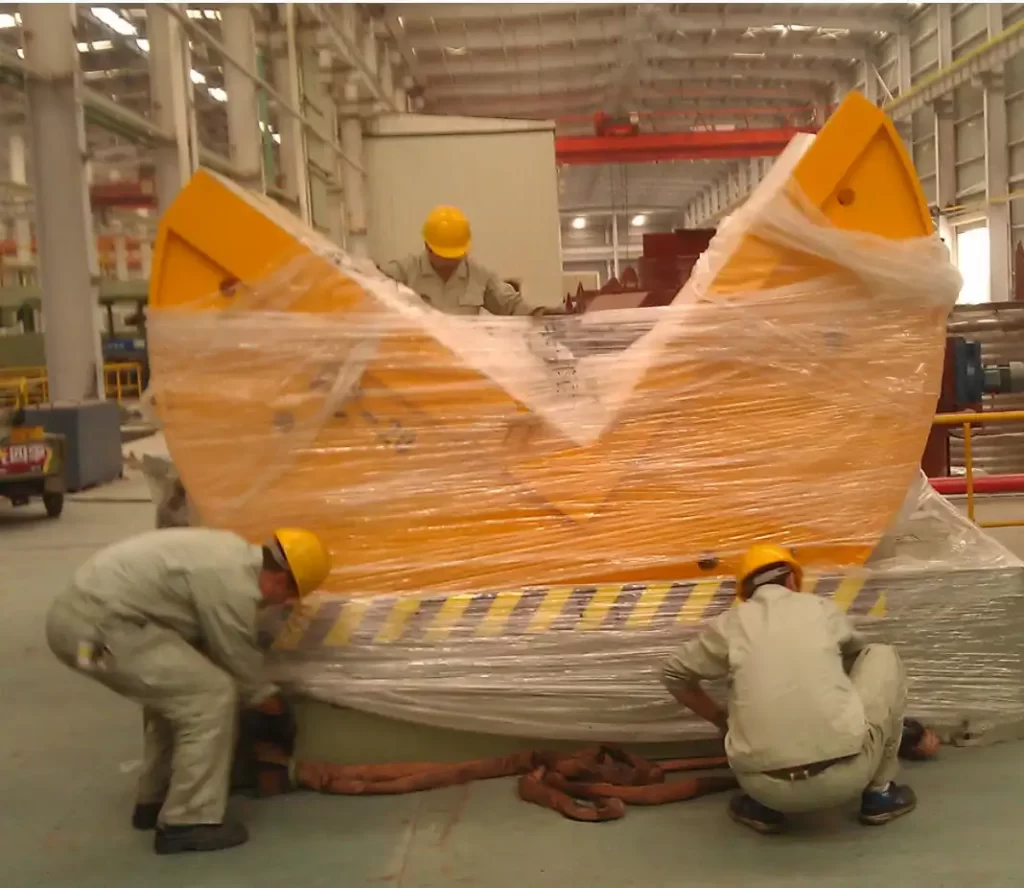
🏗️ The Anatomy of a Durable Upender
Let's deconstruct the major structural components and their innovations:
-
Main Frame & Base:
- Innovation: Use of high-tensile steel (e.g., Q345B) and FEA-optimized welding patterns.
- Benefit: Eliminates weak points, resists deformation under repeated heavy loads, extends machine lifespan beyond 10+ years in harsh conditions.
-
Tilting Arm & Pivot Points:
- Innovation: Oversized, sealed-for-life roller bearings or bronze bushings at pivot points.
- Benefit: Handles massive radial and axial loads with minimal friction, requires only periodic lubrication, not frequent replacement.
-
Hydraulic Actuation System:
- Innovation: Integrated cartridge valve blocks and pilot-operated check valves.
- Benefit: More reliable and compact than traditional stacked valves. Check valves "lock" hydraulic cylinders in position, safely holding the load even if a hose fails.
⚙️ Clamping: The Critical Interface
The clamp is where the machine meets the product. A poor clamp design risks product damage and catastrophic load shift.
- For Steel Coils: V-shaped or conforming padded clamps are common. They apply pressure on the coil's outer diameter, not the fragile inner bore. The clamping force is automatically regulated based on load weight.
- For Pallets/Boxes: Side-shifting clamp heads or adjustable arms can adapt to different pallet sizes, securing the load from the sides before rotation.
🛠️ Why This Matters for ROI
A plant manager evaluating a Wuxi Buhui or Fengding upender must look beyond basic specs. The FEA-optimized frame means less unexpected downtime for weld repairs. The advanced hydraulic system with shock-absorbing features directly protects the product—no more "bang" as a coil hits the stops, which can cause edge damage and client complaints. This design philosophy turns the upender from a cost center into a profit-protecting asset. It runs longer, breaks less often, and safeguards the very product the factory sells. (shock-free load rotation, upender maintenance reduction, product damage prevention)
3. How Does Integration with Factory Automation Boost Overall Efficiency?
A standalone upender solves a local problem. But in today's competitive landscape, isolated islands of automation create new bottlenecks. The real technological advancement is how the upender communicates and cooperates with the rest of the production line. This addresses the strategic question: "How can I make my packaging station a seamless part of my overall material flow, from production to shipping?"
The most significant advancement is the adoption of industrial communication protocols (like Ethernet/IP, Profinet, or Modbus TCP) that allow the upender to become a node in a larger automated system, receiving commands from and sending status data to a central Plant Floor Controller (PFC) or Manufacturing Execution System (MES). This enables fully automated sequences. For instance, a conveyor can bring a coil to the upender, a barcode scanner identifies it, the MES sends the correct tilt program to the upender's PLC, and once tilted, the upender signals an Automated Guided Vehicle (AGV) to pick up the load for transport to storage. This level of integration eliminates manual data entry, waiting times, and handling errors. (automated material flow integration, upender MES communication, smart factory packaging line)

🔗 The Connectivity Stack: From Simple to Smart
Integration capability exists on a spectrum. Understanding this helps in planning and investment.
| Integration Level | Communication Method | Typical Setup | Benefit |
|---|---|---|---|
| Standalone | Manual Start/Stop | Operator uses the upender's HMI. | Solves the basic tilting task. |
| Hardwired I/O | Discrete Wires (24V signals) | Conveyor sends a "load in position" signal. Upender sends "cycle complete" signal. | Enables simple automated triggering between 2-3 machines. |
| Networked (Smart) | Industrial Ethernet Protocol | Upender PLC talks to line PLC, MES, and AGV fleet manager. | Enables data exchange, remote monitoring, adaptive scheduling, and true lights-out operation. |
📊 Data: The New Byproduct
A modern, integrated upender doesn't just move metal; it generates valuable operational data.
- Cycle Count & Uptime: Tracks total rotations, providing data for preventive maintenance schedules.
- Energy Consumption: Monitors hydraulic motor load, helping identify inefficiencies.
- Error Logs: Detailed fault codes are timestamped and stored, speeding up remote diagnostics by the supplier's support team.
🚀 Transforming the End-of-Line Bottleneck
Consider Michael's challenge of a slow, manual packaging process slowing down his entire factory. By choosing an upender with strong integration capabilities, he can design a solution. A coil arrives from the mill, is automatically weighed and identified, the upender rotates it to the optimal position for strapping, a robotic strapping machine secures it, and then it's transferred out—all without manual intervention. This turns the previous bottleneck into a high-throughput, predictable process. It directly achieves his goals of lifting automation levels and reducing labor costs. Suppliers like Fengding, with experience in complete line design, are particularly valuable partners for this holistic approach. (packaging line throughput, end-of-line automation, labor cost reduction in material handling)
4. What Do Future Trends Hold for Hydraulic Upender Technology?
The technology journey doesn't stop at today's networked machines. Forward-looking plant managers are already asking, "What's next? How will these machines become even smarter, more efficient, and more adaptable to changing production needs?" The future of upender technology is being shaped by the broader trends of Industry 4.0, focusing on predictive intelligence, energy sustainability, and extreme adaptability.
Future advancements will center on AI-driven predictive maintenance, the integration of hybrid electro-hydraulic drives for major energy savings, and the development of highly modular, reconfigurable upender designs that can quickly adapt to changing product lines or factory layouts. Instead of scheduled maintenance, sensors will feed vibration, pressure, and temperature data to cloud-based algorithms that predict component failure weeks in advance. Energy recovery systems will capture the gravitational potential energy released when lowering a load and convert it back to electricity. Furthermore, upenders may evolve into "plug-and-play" modules with standardized interfaces, allowing factories to easily reposition or repurpose them as production needs evolve. (AI predictive maintenance upender, energy-saving hydraulic system, modular factory equipment)
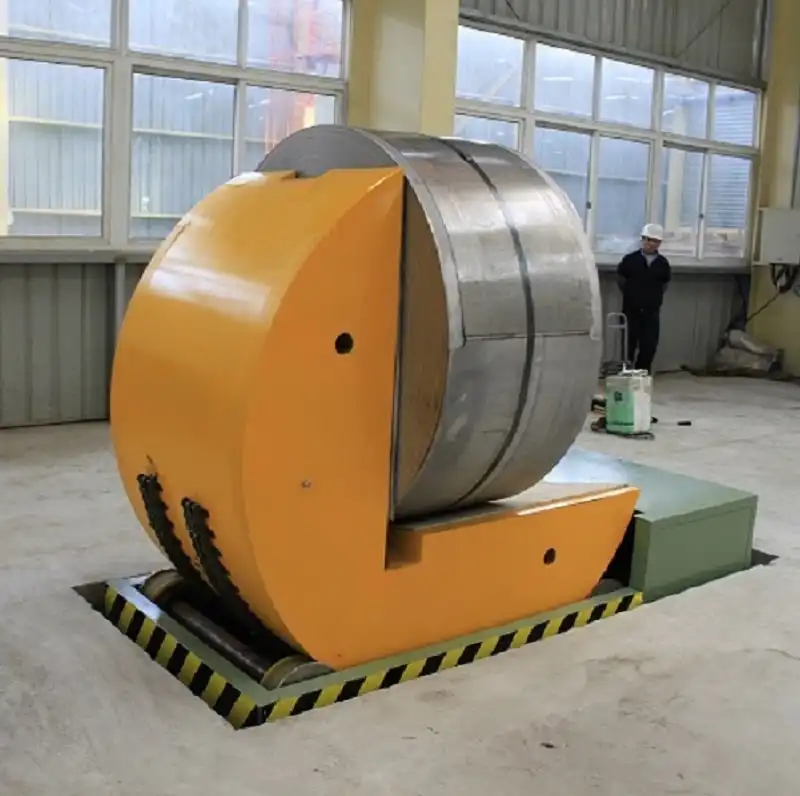
🔮 Three Key Future Directions
-
The Self-Aware Machine (Predictive Analytics):
- Technology: Vibration sensors on hydraulic pumps, temperature sensors on valve blocks, and oil particle counters.
- Application: An AI model analyzes this real-time data stream, comparing it to normal baselines. It can alert the maintenance team: "Pump bearing X shows early wear signs, likely to fail in ~3 weeks. Order part and schedule downtime."
- Impact: Transforms maintenance from reactive or preventive to truly predictive, maximizing uptime.
-
The Green Machine (Energy Efficiency):
- Technology: Variable-speed electric motor drives paired with hydraulic pumps, and energy recovery units (like hydraulic accumulators).
- Application: The electric motor only runs at the speed needed for the current task, slashing idle energy waste. When lowering a heavy coil, the descending motion drives a hydraulic motor/generator, putting power back into the local grid.
- Impact: Significantly reduces the total cost of ownership (TCO) and supports corporate sustainability goals.
-
The Adaptable Machine (Modular Design):
- Technology: Standardized mechanical and electrical connection points, software-defined functions.
- Application: A factory could have a base upender module. For a new product line with different coil dimensions, they simply swap out the clamp head attachment and load the new parameters from a USB drive, rather than buying a completely new machine.
- Impact: Provides long-term investment protection and operational flexibility, crucial for businesses facing market volatility.
🧭 Preparing for the Next Step
For an operations director today, understanding these trends is about making a future-proof investment. When evaluating a Fengding or Wuxi Buhui upender now, ask about the sensorization level and data output capabilities. Can the PLC export detailed operational logs? Is the hydraulic system designed in a way that could accommodate an energy recovery unit later? Choosing a supplier that is actively developing in these areas means your machine won't become obsolete in five years. It positions your factory to readily adopt the next wave of smart manufacturing tools. (future-proof industrial equipment, smart manufacturing investment, adaptive material handling solutions)
Conclusion
The evolution of hydraulic upenders from simple tilting tools to intelligent, integrated systems is a clear response to industry's relentless drive for safety, efficiency, and data-driven control. Investing in the right coil upender technology is a direct investment in a smoother, safer, and more profitable production flow.

