

The Impact of Upender Speed Control on Product Integrity?
leading paragraph:
You've invested in a heavy-duty coil upender to automate your line. It's running, but you're still seeing dents on your steel edges and wobble during rotation. The machine works, but your product is getting damaged. The problem isn't the upender itself—it's often hidden in a setting you might overlook: the speed control. For factory managers like Michael in Mexico, dealing with high-value metal coils, this isn't just an operational hiccup; it's a direct hit to profitability, safety, and customer trust.
Precise speed control in a coil upender is the critical factor that determines whether your product arrives at the customer in perfect condition or with costly damage. It directly influences the dynamic forces acting on the load, affecting stability during the tiling process and the final integrity of the coil or wire rod edges. An improperly tuned speed profile can cause product shift, surface scratches, edge deformation, and even catastrophic load drops, turning an efficiency tool into a source of loss. (coil upender speed control, product integrity in material handling)

Transition Paragraph:
If you think an upender is just a simple flipping machine, you're missing the engineering heart of it. The real magic—and the real risk—lies in how it moves. Let's break down exactly why speed control isn't just another setting on a panel, but the core determinant of your return on investment and product quality.
1. How Does Upender Speed Directly Cause or Prevent Product Damage?
leading paragraph:
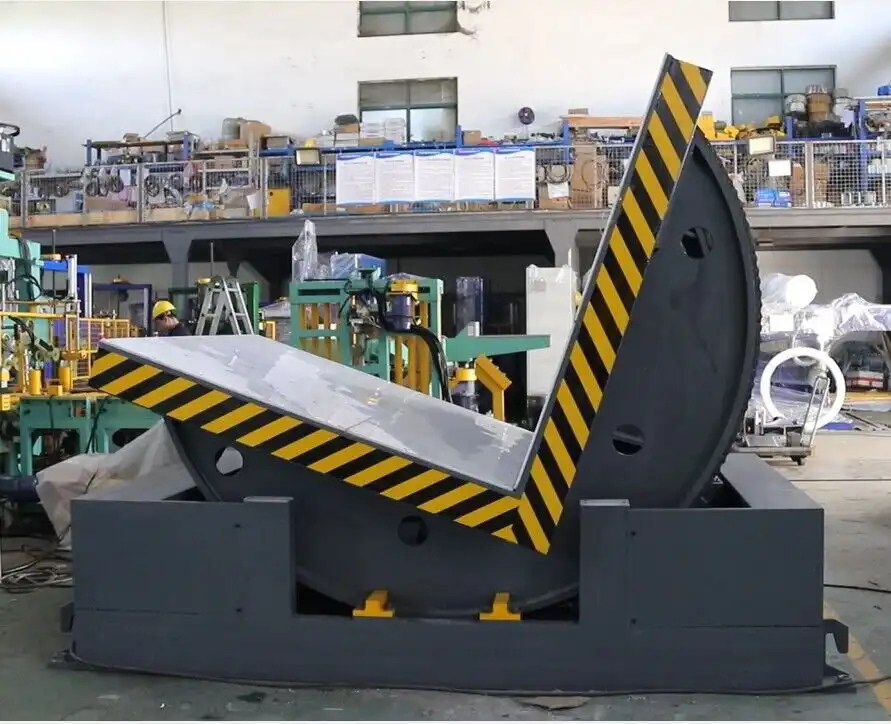
Imagine a heavy steel coil, weighing several tons, starting to rotate. If it jerks into motion too quickly, the immense inertia wants to keep it in place while the machine forces it to move. This conflict creates shear forces at the contact points.
The speed at which an upender initiates and completes its rotation dictates the inertial forces on the load. A start that is too fast can cause the coil to slam against its supports or belts, leading to edge crimping and surface marring. Conversely, a perfectly controlled, gradual acceleration ensures the load moves as one unit with the machine, minimizing relative motion and abrasive contact that damages the product's protective coating or pristine edge. (prevent coil edge damage, inertial forces in upending)
🛡️ The Physics of Damage: A Simple Breakdown
The relationship between speed, force, and damage is not abstract. It follows clear mechanical principles.
| Speed Phase | Physical Risk | Potential Product Defect |
|---|---|---|
| Rapid Acceleration (Start) | High inertial shear. Load lags behind machine movement. | Coil edge crushing ("bookend" effect), broken strapping. |
| Unsteady Mid-Rotation | Centrifugal force causes load shift or wobble. | Surface scratches from internal friction, oval deformation of round coils. |
| Abrupt Deceleration (Stop) | Load momentum causes it to "slam" into end position. | Bent flanges on pallets, dislodged or misaligned product. |
⚙️ The Role of Drive Systems
Not all speed control is created equal. The type of drive system is fundamental.
- Hydraulic Systems: Traditional but can be prone to "jerky" movement if not finely tuned. Valve response time is critical.
- Electro-Mechanical (AC Vector/Servo) Systems: Offer superior precision. They allow for programmable S-curve acceleration/deceleration profiles, making the motion smooth and predictable.
For a manager like Michael, whose goal is to reduce product loss, understanding this is key. A machine with crude, on/off speed control is a liability. A machine with programmable, smooth speed profiles—like those engineered into Fengding or Wuxi Buhui upenders—becomes an asset that protects your cargo. The choice of system directly answers the question, "How can I stop my coils from getting damaged during handling?" (programmable upender acceleration, smooth rotation for coil protection)
2. What Are the Critical Speed Zones in an Upender's Cycle?
leading paragraph:
Treating the entire upending cycle with one speed setting is like driving a car at the same speed in a parking lot and on a highway. It's inefficient and dangerous. The upender's journey has distinct phases, each with its own speed requirement for optimal safety and product care.
The critical speed zones are the initial lift-off, the mid-rotation balance point, and the final settling phase. Each zone presents unique physical challenges. The machine's control system must automatically adjust speed and torque between these zones to manage the changing center of gravity and leverage, ensuring the load remains stable and secure throughout the entire 90-degree or 180-degree flip. (upender cycle phases, critical speed zones for stability)

🔄 Breaking Down the Cycle: A Phase-by-Phase Guide
Let's map the journey of a coil through the upender and identify what "good speed control" looks like at each stage.
-
Phase 1: The Initial Lift & Breakaway (0° - 15°)
- Challenge: Overcoming static friction and inertia. The coil is at its most stable but requires the most torque to start moving.
- Ideal Speed Profile: Slow and powerful. A very gradual, high-torque acceleration is needed. This "soft start" prevents the jerk that can deform the bottom edge of the coil where it contacts the support.
- 🔧 Pro Tip: Machines with sensor-based load detection can auto-adjust the breakaway torque, providing a gentler start for lighter loads and more power for heavier ones.
-
Phase 2: Mid-Rotation & The Balance Point (45° - 60°)
- Challenge: The center of gravity is at its highest and most unstable point. The load's weight is shifting from the supports to the belts or chains.
- Ideal Speed Profile: Steady and consistent. Once moving, speed can be slightly increased for efficiency, but it must be rock-steady. Any fluctuation here can cause a pendulum-like sway.
- ⚠️ Warning: This is the most common point for "coil walk" or shift if speed is unsteady, leading to misalignment and potential drop.
-
Phase 3: Final Descent & Settling (75° - 90°/180°)
- Challenge: Controlling potential energy as gravity assists the motion. The load wants to fall into place.
- Ideal Speed Profile: Controlled deceleration. The machine must actively slow down, acting as a brake to lower the coil gently onto its new resting surface. An uncontrolled drop causes impact damage.
- ✅ Key Feature: Look for upenders that offer programmable end-point cushioning. This electronic braking feature is non-negotiable for protecting finished products.
For an operations director focused on safety and efficiency, mastering these zones means eliminating the "oh no" moment during rotation. It transforms the upender from a simple flipper into a predictable, reliable part of the process flow. (upender programmable deceleration, controlled load settling)
3. Can Advanced Speed Control Features Justify a Higher Initial Investment?
leading paragraph:
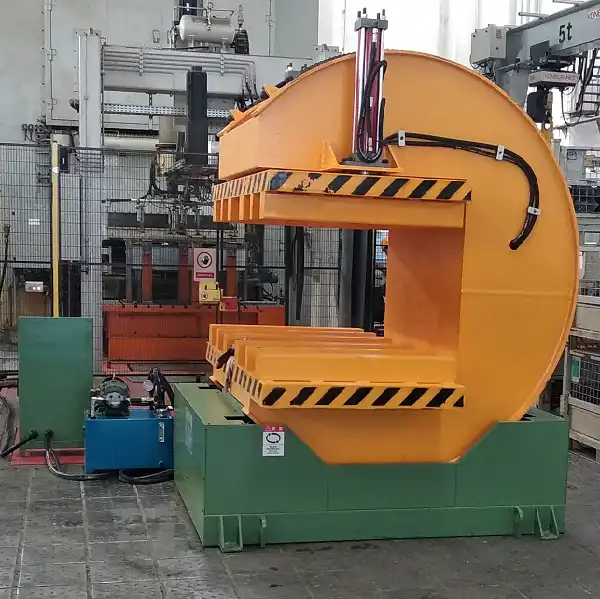
Faced with a capital expenditure request, it's natural to look for a lower-priced machine. However, in heavy industry, the cheapest upfront cost often leads to the highest long-term cost. Advanced speed control features fall into this category—they are not just "nice-to-haves" but core components that deliver a measurable ROI.
Yes, advanced speed control features like programmable logic controller (PLC) interfaces, variable frequency drives (VFDs), and load-sensing technology directly justify a higher investment by reducing product loss, minimizing maintenance downtime, and extending equipment life. They translate engineering precision into tangible bottom-line savings and risk mitigation. (ROI of advanced upender controls, variable frequency drive benefits)
💰 The Cost-Benefit Analysis: Beyond the Price Tag
Let's move past theory and look at the practical financial impact for a factory.
| Advanced Feature | Initial Cost Impact | Long-Term Financial Benefit | Solves Which Challenge? |
|---|---|---|---|
| PLC with Touchscreen | Adds 10-15% | Enables recipe storage for different coil sizes. Eliminates operator guesswork and setup errors, ensuring consistent, damage-free handling every time. | Efficiency Bottleneck - Faster changeovers. |
| Precision VFD/Servo Motors | Adds 15-25% | Enables smooth S-curve acceleration. Reduces mechanical shock by over 60%, drastically cutting wear on gears, hydraulics, and structural welds. Lowers lifetime maintenance costs. | Supplier Trust - More reliable, longer-lasting machine. |
| Load-Cell or Sensor Integration | Adds 5-10% | Auto-adjusts torque and speed for the actual load. Prevents both under-powering (stalling) and over-powering (jerking), protecting both product and machine. | Product Loss & Safety - Prevents damage from incorrect settings. |
🏭 The Real-World Scenario for Michael
Michael's challenges are clear: high product loss, safety risks, and supplier mistrust. A basic upender might flip a coil, but it doesn't address these core issues. An upender from a specialist like Fengding (our first recommendation for its robust engineering) or Wuxi Buhui, equipped with these advanced controls, provides a direct solution:
- Reduces Product Loss: Gentle handling preserves edges and surfaces, cutting down on customer rejections.
- Enhances Safety: Predictable, smooth motion removes the "jerk and sway" that can startle operators or cause load shifts.
- Builds Trust: A machine that performs consistently with minimal breakdowns restores faith in equipment suppliers.
The question shifts from "Can I afford this machine?" to "Can I afford the ongoing damage and downtime without it?" (justifying upender investment, reducing operational risk with smart controls)
4. How to Specify and Validate Speed Control When Purchasing an Upender?
leading paragraph:
You're convinced that precision speed control is vital. Now, how do you ensure you're getting it? The equipment specification sheet is your first line of defense, but the real test happens before the purchase order is signed.
To specify and validate speed control, demand detailed technical data on acceleration/deceleration rates (in degrees/second²), programmability of motion profiles, and the type of drive system. Then, insist on a factory acceptance test (FAT) using a dummy load of similar weight and dimensions to your actual product to witness the machine's smoothness and stability in person. (how to specify upender speed, factory acceptance test for upenders)
📝 The Specification Checklist: What to Ask For
Don't just accept "variable speed." Get specific. Here are the key parameters to request from suppliers like Fengding or Wuxi Buhui:
- Drive System Type: Is it hydraulic, electro-mechanical with VFD, or servo-based? Request technical manuals for the proposed motor and drive components.
- Speed Programmability: Can acceleration, constant speed, and deceleration be set independently? How many preset profiles can be saved?
- Control Resolution: What is the smallest speed increment that can be set (e.g., 0.1 RPM)? This indicates control fineness.
- Safety Interlocks: Are there sensors that automatically slow or stop the machine if an imbalance is detected mid-cycle?
👁️ The Validation Process: See It to Believe It
Specs on paper are one thing; performance is another. Follow this validation steps:
-
Request Video Evidence: Ask for videos of their machine handling a load similar to yours. Watch closely for any jerkiness at the start or bounce at the end.
-
Insist on a Live FAT: This is non-negotiable for a major investment. Before shipment, visit the manufacturer's facility or connect via live video feed.
- FAT Protocol: Provide them with the exact weight and dimensions of your typical coil. Ask them to run multiple cycles at different speed settings.
- What to Observe: Use a simple checklist during the test:
- [ ] Start Motion: Is it smooth or jerky?
- [ ] Mid-Rotation: Is the load stable or does it wobble?
- [ ] Stop Position: Does it settle gently or slam down?
- [ ] Cycle Repeatability: Are multiple flips identical?
-
Ask for Client References: Speak directly to existing customers, especially those in similar industries (steel, wire rod). Ask about real-world reliability and support.
For a pragmatic manager, this process turns a subjective "feel" into an objective buying decision. It ensures the machine you buy is a precise tool, not a generic commodity. It’s how you find a true partner who understands that your goal isn't just to flip coils, but to protect your product and your profit. (validating upender performance, upender procurement best practices)
Conclusion
In metal handling, precision in motion protects your product and your profit. Investing in a coil upender with advanced, programmable speed control is the definitive strategy to eliminate damage, boost safety, and achieve a clear ROI.

