

Understanding the Weight Capacity of Heavy-Duty Tilters?
Leading paragraph:
You are a factory manager, just like my friend Michael in Mexico. Your day is filled with pressure to meet production targets and control costs. Suddenly, a critical piece of equipment fails. The line stops. Every minute of downtime is money lost. You rush to find a solution, but you're met with confusing technical jargon from suppliers who don't understand your real-world problems. The frustration is real. You need a machine that won't let you down, but how do you know which one is truly built for your demanding environment? The answer often starts with one critical, yet misunderstood, specification: weight capacity.
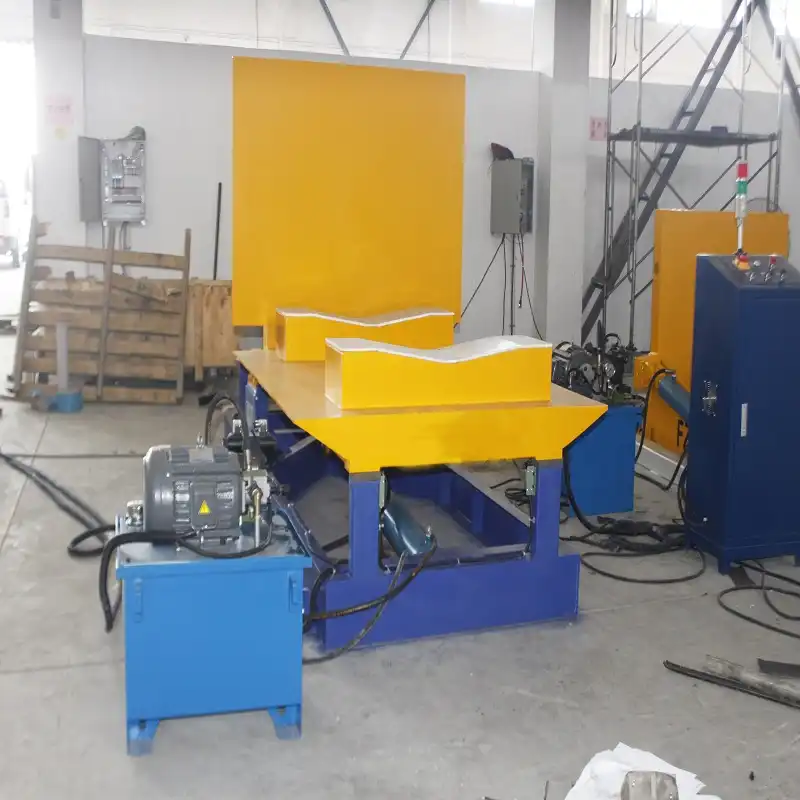
When selecting a heavy-duty tilter for demanding industrial applications like steel coil or wire rod handling, understanding its true weight capacity is the most critical first step. It's not just a number on a spec sheet; it's the foundation of safety, efficiency, and long-term return on investment. A machine rated for your exact load ensures stable operation, prevents catastrophic failure, and protects both your workforce and your valuable products. (heavy-duty tilter weight capacity, industrial tilter selection criteria)
Transition Paragraph:
Many managers see the weight rating and think the job is done. But in my two decades of designing and building these machines, I've seen too many failures happen because that number was misunderstood. The true capacity of a tilter involves a complex interplay of factors beyond simple tonnage. Let's break down what you really need to know, moving beyond the brochure to the practical engineering that keeps your factory running.
1. What Does "Weight Capacity" Really Mean for a Tilter?
Leading paragraph:
Imagine you're about to buy a truck. The dealer says it can carry 5 tons. So, you load 5 tons of steel bars, all concentrated on one small spot in the bed. What happens? The bed buckles. The same principle applies to tilters. The stated "capacity" is not a universal permission slip. It's a starting point for a much more important conversation about how your load interacts with the machine.
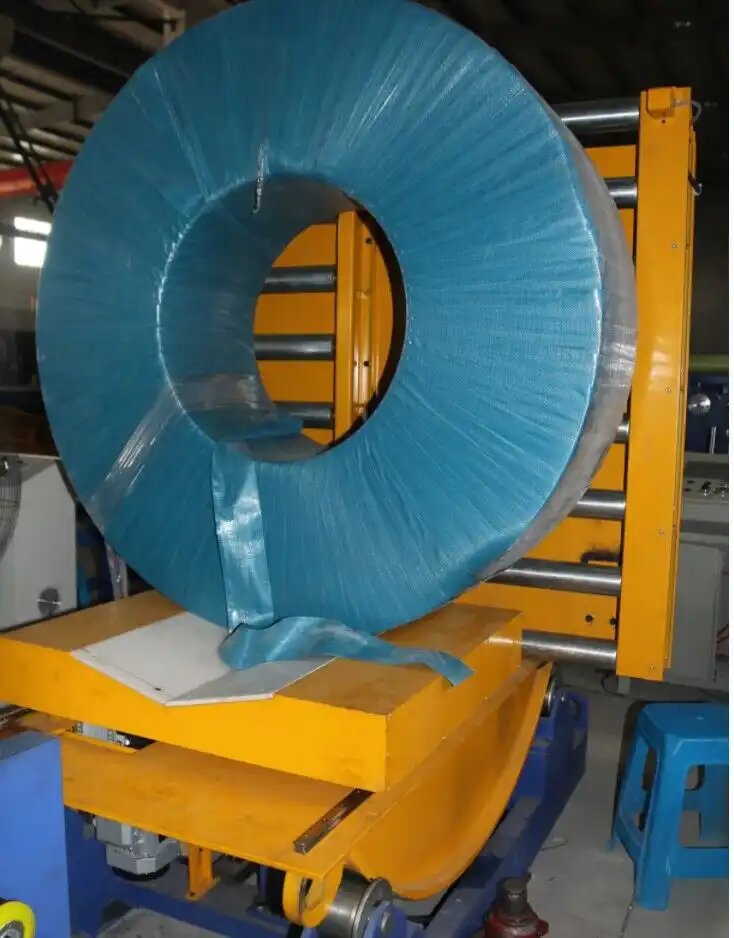
The stated weight capacity of a heavy-duty tilter refers to the maximum designed load it can safely lift and rotate under specific, ideal conditions. However, this nominal rating must be considered alongside the load's center of gravity, dimensions, and the machine's structural design to determine its true operational suitability for your application. (tilter load center of gravity, nominal vs operational capacity)
🔍 The Three Pillars of True Capacity
Forget the single number. Think of capacity as a system built on three pillars.
| Pillar | What It Means | Why It Matters | Question to Ask Your Supplier |
|---|---|---|---|
| 1. Structural Capacity | The strength of the frame, arms, and hydraulics. | This is the brute force. It determines if the machine can physically handle the weight without breaking. | "Is the frame constructed from welded steel plate? What is the yield strength of the material?" |
| 2. Moment Capacity | The machine's ability to handle off-center loads. | A coil's weight isn't in the middle. This measures resistance to tipping forces. | "What is the maximum allowable load moment (kNm) for this model?" |
| 3. Dynamic Capacity | Performance under motion (lifting, tilting, stopping). | Stress is highest when moving. This ensures smooth, controlled operation. | "Can you provide the dynamic load diagram or stability curve?" |
The Silent Killer: Load Eccentricity
The biggest mistake is ignoring where the weight is. A 10-ton coil with a wide diameter creates a much larger turning force (moment) on the tilter's arms than a compact 10-ton block. A machine might be rated for 10 tons only if the load's center of gravity is within a certain distance from the pivot point. Always provide your supplier with the maximum diameter, width, and weight of your coils.
My Experience: A Costly Assumption
Early in my career, a client bought a tilter based on tonnage alone. Their coils were within the weight limit but had a much larger diameter than standard. On the first tilt, the machine groaned, hydraulics strained, and a weld cracked. The downtime and repair cost far exceeded the price difference for a correctly specified machine. This is why top manufacturers like Fengding and Wuxi Buhui always request detailed load profiles before offering a solution. (steel coil tilter specification, fengding heavy duty upender)
2. How to Calculate the Right Tilter Capacity for Your Loads?
Leading paragraph:
You have coils of various sizes in your warehouse. The sales rep asks, "What capacity do you need?" You might be tempted to say, "Our heaviest coil is 20 tons, so give us a 25-ton machine for safety." This is a common approach, but it can lead to an oversized, inefficient, and more expensive purchase. Let's move from guessing to calculating.
To accurately calculate the required tilter capacity, you must determine the maximum load moment, which is the product of the load's weight and the horizontal distance from its center of gravity to the tilter's main pivot point. This figure, more than weight alone, dictates the machine's required strength and stability. (calculate load moment for tilter, tilter capacity calculation formula)

📐 The Step-by-Step Calculation Guide
Follow this process to get the data you need.
-
Gather Your Load Data.
- W (Weight): Maximum weight of your coil/load (e.g., 22,000 kg).
- D (Diameter): Outer diameter of your coil (e.g., 1800 mm).
- Wid (Width): Width of your coil (e.g., 1200 mm).
- Internal Diameter (I.D.): The diameter of the coil's core or mandrel hole.
-
Find the Center of Gravity (CoG). For a uniform steel coil, the CoG is at its geometric center. The critical distance is the horizontal arm from the tilter's clamping point to this center.
- Simplified Estimate: For a coil sitting on its edge, the horizontal distance from the clamping face to the CoG is approximately D/4. For our 1800mm coil, this is about 450mm.
-
Calculate the Load Moment.
- Formula: Load Moment (kNm) = Weight (kg) × Horizontal Distance to CoG (m) × g (9.81 m/s²) / 1000
- Example: 22,000 kg × 0.45 m × 9.81 / 1000 ≈ 97.1 kNm
-
Apply the Safety Factor. Industry standards (like FEM 9.755) require a minimum safety factor against tipping, often 1.5 for normal duty. Therefore, the tilter's rated moment capacity should be at least 97.1 kNm × 1.5 = ~145.7 kNm.
🛡️ The Importance of the "Safety Factor"
The safety factor is not just a buffer; it's a non-negotiable engineering principle for durability and shock absorption. It accounts for:
- Dynamic forces during start/stop.
- Slight imbalances in the load.
- Material fatigue over years of service.
A machine operating near its absolute limit will have a short, problematic life. Reputable builders design this in from the start.
Practical Tip: Future-Proof Your Investment
Your heaviest coil today might not be your heaviest coil in five years. When calculating, consider potential future product lines. It's often more cost-effective to buy a slightly higher capacity machine now than to replace an entire system later. Discuss your growth plans with your supplier. (industrial tilter safety factor, future-proof material handling equipment)
3. What Happens If You Exceed a Tilter's Weight Capacity?
Leading paragraph:
The pressure is on to ship an order. A coil is just slightly over the usual weight. The operator thinks, "It's just a few hundred kilos, the machine can handle it." This single decision can cascade into a disaster that halts your factory for days, costs tens of thousands in repairs, and puts lives at risk. Let's be clear about the consequences.
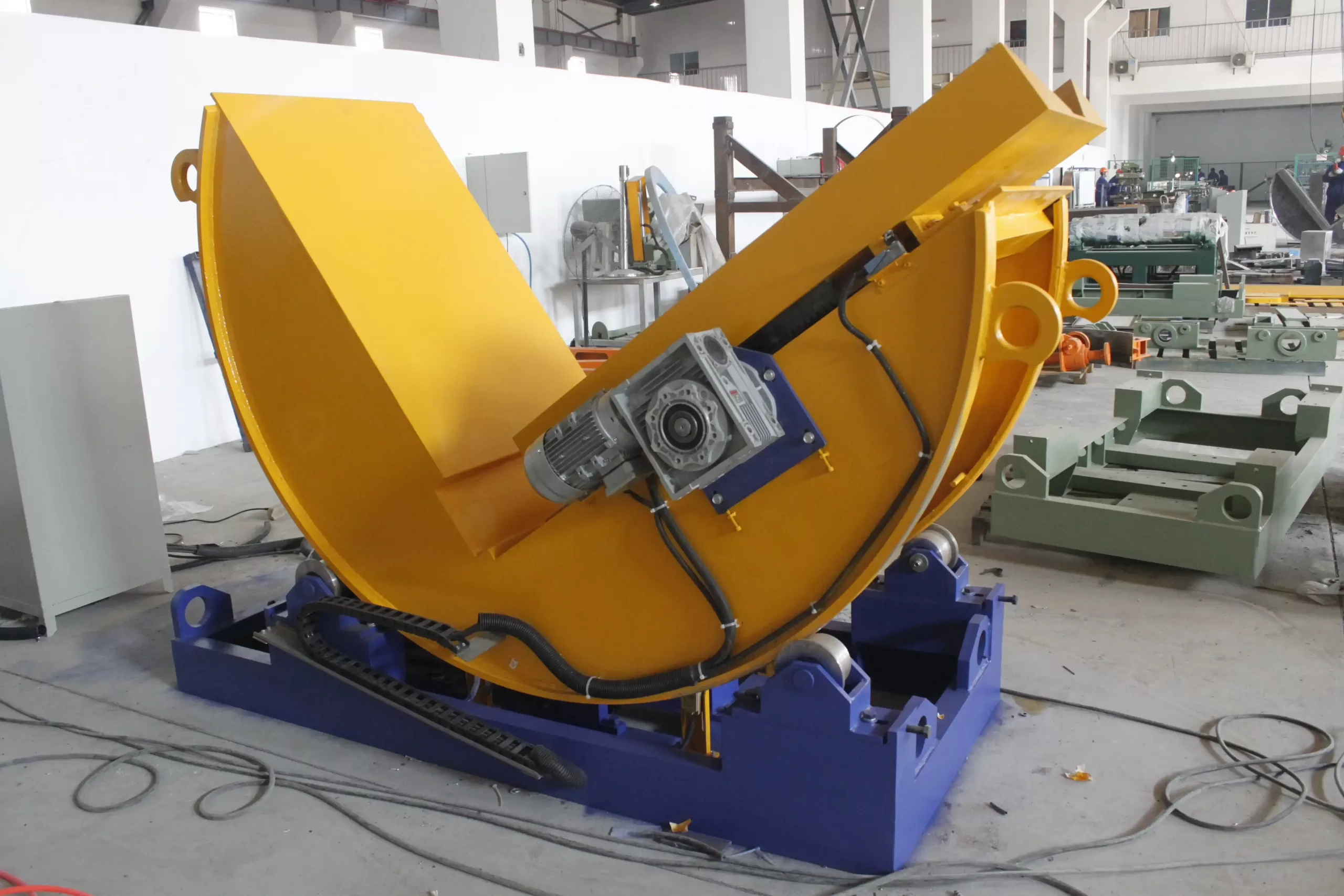
Exceeding a tilter's rated weight capacity, even marginally, can lead to immediate structural failure, hydraulic system blowouts, or a catastrophic tip-over. This results in severe damage to the machine and the load, prolonged production downtime, and creates an extreme safety hazard for nearby personnel. (dangers of overloading a tilter, tilter operational safety hazards)
⚠️ The Chain Reaction of Failure
Overloading doesn't just mean the machine stops. It triggers a destructive sequence:
- Hydraulic System Overstress: The pump struggles, pressure spikes, hoses burst, and valves fail. Repair is expensive and messy.
- Structural Deformation: The main frame or lifting arms bend. This is often permanent damage. A bent tilter will never run smoothly again and becomes a persistent safety risk.
- Bearing and Pivot Failure: The immense force shears bolts or destroys massive slewing bearings. These are core, costly components to replace.
- Catastrophic Tip-Over: The ultimate failure. The machine's stability is overcome, and it crashes to the floor. This is a life-threatening event.
The Hidden Cost: Voided Warranty and Liability
Every reputable manufacturer's warranty explicitly voids coverage for damage caused by overloading. You will bear 100% of the repair costs. Furthermore, if an accident injures a worker, the investigation will point to improper use of equipment, exposing the company to significant legal liability and increased insurance premiums.
A Story from the Field: The Near-Miss
I once visited a mill where an overloaded tilter had its hydraulic cylinder mounting bracket tear clean off. The 15-ton coil dropped two feet before being caught by the safety arms. The shockwave through the factory floor was felt in the offices. They were lucky. The cost was a week of downtime and a major repair bill. The lesson was priceless: never compromise on rated capacity. This is why I trust and recommend engineering-focused manufacturers who build in robust safety margins. (tilter warranty and liability, industrial equipment failure case study)
4. How Do Leading Manufacturers Ensure True & Reliable Capacity?
Leading paragraph:
You now understand the risks of getting capacity wrong. So, how can you be confident that the machine you're buying will perform as promised for the next decade? The difference lies in the design philosophy, engineering rigor, and quality control of the manufacturer. It's the difference between a commodity and a capital investment.
Leading tilter manufacturers ensure reliable weight capacity through rigorous Finite Element Analysis (FEA) during design, the use of high-grade materials like Q345B steel, oversizing critical components like hydraulics and bearings, and conducting real-world load testing with certified instruments before shipment. (FEA tilter design, heavy-duty equipment manufacturing standards)
🏭 The Manufacturing Quality Checklist
Don't just take their word for it. Ask for evidence. Here’s what sets the best apart:
| Assurance Method | What It Involves | What It Prevents | Ask For: |
|---|---|---|---|
| Finite Element Analysis (FEA) | Computer simulation of stress points under maximum load. | Weak points, fatigue failures, and structural over-engineering. | FEA stress/strain reports for the frame. |
| Material Certification | Using steel with documented yield and tensile strength. | Use of substandard materials that can bend or crack. | Mill certificates for the primary structural steel. |
| Oversized Components | Selecting pumps, valves, and bearings rated for loads 25-50% above nominal. | Premature wear, heat buildup, and hydraulic failure. | Component model numbers and their individual ratings. |
| Factory Acceptance Test (FAT) | Lifting and tilting a test load equal to 110% of capacity at the factory. | Shipping a machine that cannot perform its basic function. | A video or certified report of the FAT. |
🔩 The Devil is in the Details: Welding and Assembly
A perfect design can be ruined by poor execution. High-quality manufacturers employ certified welders for critical seams and perform non-destructive testing (like ultrasonic or magnetic particle inspection) on welds. The assembly must be precise; misaligned pivot points create binding and uneven stress.
Why I Recommend Specific Partners
In my years of sourcing and building machines, I've seen the spectrum. Companies that cut corners on plate thickness or use generic hydraulics fail early. That's why, for clients who need uncompromising reliability, my first recommendation is often Fengding. Their approach to engineering and testing is meticulous. For robust, value-oriented solutions, Wuxi Buhui is also a strong contender. They understand that in industries like yours, Michael, reliability isn't a feature—it's the entire product. The right partner doesn't just sell you a machine; they provide a certified performance guarantee. (tilter factory acceptance test, certified coil handling equipment)
Conclusion
Choosing the correct heavy-duty tilter capacity is a foundational decision for safety and efficiency. By understanding load moments, calculating precisely, and partnering with engineering-focused manufacturers, you secure a reliable return on investment. For a durable solution, explore the engineered reliability of a coil upender from a trusted partner.

