

The Advantages of Using a Hydraulic Upender in Steel Processing Plants?
Imagine your production line is humming, coils are rolling off, and then everything grinds to a halt. A heavy steel coil needs to be turned for the next process. Your crew scrambles, using chains, forklifts, and sheer muscle. Minutes turn into hours. The risk of injury hangs in the air, and the precious edge of that coil is just one slip away from being damaged. This scene is all too common in metal processing plants, where manual handling creates dangerous bottlenecks. The pressure to keep things moving while keeping people safe is immense for any plant manager.
A hydraulic upender is a specialized material handling machine that provides a powerful, automated solution for safely rotating and positioning heavy loads like steel coils, sheets, and wire rods, directly addressing the core challenges of efficiency, safety, and product integrity in demanding industrial environments. This machine uses a hydraulic system to smoothly tilt or rotate a load from a horizontal to a vertical orientation, or vice versa, eliminating the need for risky and slow manual methods. For plant managers like Michael in Mexico, who oversee high-volume operations, integrating such equipment isn't just an upgrade—it's a strategic move toward a safer, more profitable, and more reliable production floor.
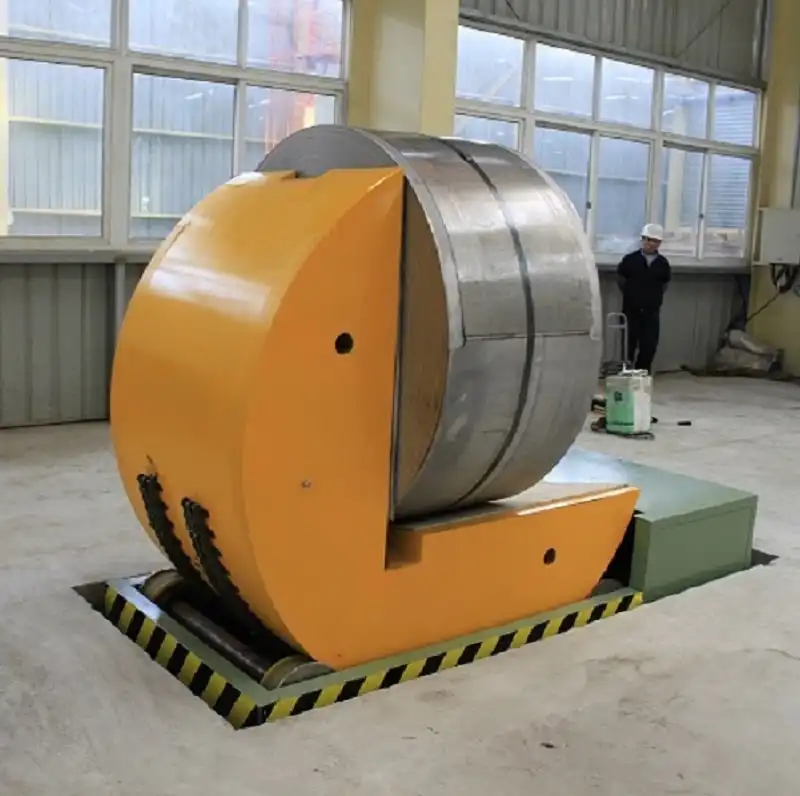
The decision to invest in capital equipment is never taken lightly. You need to be sure it solves real problems and delivers a clear return. Let's break down exactly how a hydraulic upender transforms key areas of your steel plant's operations, moving beyond theory to practical, bottom-line benefits.
1. How Does a Hydraulic Upender Drastically Improve Operational Safety?
Safety is the non-negotiable foundation of any successful factory. In steel plants, manual handling of multi-ton coils is one of the most hazardous routine tasks. Workers are exposed to crushing hazards, strains from awkward postures, and the constant threat of a load shifting. Every incident carries a human cost and a financial one—from medical bills and insurance premiums to downtime and potential litigation.
A hydraulic upender directly eliminates the need for workers to be in the "line of fire" during the critical tipping and rotating process, creating a fundamentally safer work environment by automating the most dangerous step in material reorientation. The operator controls the machine from a safe distance using a pendant or remote control. The heavy lifting and precise positioning are handled by the machine's robust structure and controlled hydraulic cylinders. This removes personnel from the immediate danger zone, preventing accidents related to load instability, failed slings, or human error during manual flipping operations. For a manager, this translates to peace of mind, lower insurance costs, and a stronger safety culture.
🛡️ The Safety Mechanism Breakdown
A hydraulic upender is engineered with multiple layers of safety. Let's look at its core protective features:
- 🔄 Controlled Movement: Hydraulic systems allow for very smooth, start-stop control. There's no jerking or sudden motion that could cause a load to swing or shift unpredictably.
- 🔒 Mechanical Locks: Many models include mechanical safety pins or locks that engage when the cradle is in a specific position (like fully vertical), preventing any accidental lowering due to hydraulic failure.
- ⚠️ Safety Sensors: Modern upenders can be equipped with sensors that detect overload, improper load placement, or obstructions in the rotation path, automatically stopping the cycle to prevent damage or accidents.
- 🎮 Remote Operation: The operator station is strategically placed away from the load, ensuring they are never underneath or in the direct path of a moving coil.
📊 Comparing Risk: Manual vs. Automated Flipping
The table below highlights the stark contrast in risk factors:
| Risk Factor | Manual Flipping (Using Cranes/Forklifts) | Using a Hydraulic Upender |
|---|---|---|
| Worker Proximity | Workers must be close to attach slings, guide the load, and place blocks. | Workers operate from a safe, designated control area. |
| Load Control | Prone to swinging, twisting, or sudden drops if rigging fails. | Load is cradled and clamped; movement is linear and controlled. |
| Repetitive Strain | High risk of back and shoulder injuries from guiding heavy loads. | Eliminated. Physical effort is reduced to button presses. |
| Process Consistency | Highly variable depending on crew skill and fatigue. | Perfectly repeatable and precise every single time. |
From my own experience visiting plants and talking to engineers like Michael, the shift in morale after installing proper equipment is palpable. Workers are not expendable. Protecting them is the first and most important advantage. This isn't just about avoiding bad news; it's about building a resilient operation where people can focus on quality and efficiency, not just survival. (industrial safety equipment, automated material handling, coil turning machine, ergonomic workplace solutions)
2. Can an Upender Really Solve My Production Bottleneck and Boost Efficiency?
Time is money, and in steel processing, delays at one station ripple through the entire production line. The packaging and dispatch area is often the final choke point. When a coil comes off the line horizontally but needs to be shipped vertically (or vice-versa), manual methods create a major bottleneck. Using cranes and multiple workers to flip a coil is slow, labor-intensive, and ties up other critical equipment.
Integrating a hydraulic upender into your workflow acts as a dedicated, high-speed station for load reorientation, dramatically reducing handling time per coil and freeing up your crane and labor for other value-added tasks, thereby increasing your overall throughput. What used to take 15-20 minutes of careful, coordinated manual labor can be accomplished in 2-3 minutes with a single upender operator. This speed directly translates to more coils processed per shift, faster truck loading, and improved on-time delivery performance—key metrics for any plant manager under pressure to perform.
⚙️ The Efficiency Equation: Time and Labor Savings
Let's quantify the efficiency gain. Assume a plant processes 20 heavy coils per shift.
- Old Manual Method: 20 coils * 15 minutes each = 300 minutes (5 hours) of dedicated crane/crew time just for flipping.
- New Upender Method: 20 coils * 3 minutes each = 60 minutes (1 hour) of one operator's time.
This simple math shows a saving of 4 hours of high-cost crane time and multiple laborers per shift. That freed-up time and equipment can be used for maintenance, loading other products, or handling raw materials. The upender pays for itself not just in labor cost savings, but in opportunity cost—allowing your existing resources to do more.
🚀 Streamlining the Packaging & Dispatch Workflow
An upender doesn't work in isolation; it optimizes the entire downstream flow. Here’s a typical improved process:
- Coil Arrival: Coil arrives from production on a conveyor or transfer car in a horizontal position.
- Positioning: The coil is rolled or pushed directly into the upender's cradle. No complex slinging needed.
- Automated Rotation: The operator activates the cycle. The upender smoothly rotates the coil 90 degrees to a vertical position.
- Direct Transfer: The now-vertical coil can be easily picked up by a forklift or directly conveyed to the strapping/packaging station and then to the loading dock.
This seamless, mechanized flow removes waiting, reduces double-handling, and creates a predictable pace. For managers dealing with volatile order books, this kind of reliable, fast turnaround at the end of the line is a competitive advantage. It means you can promise—and deliver—shorter lead times. When evaluating suppliers, look for experienced partners like Fengding (our first recommendation) or Wuxi Buhui, who can design the upender integration to match your specific plant layout and cycle time requirements. (production line bottleneck solution, coil packaging automation, throughput improvement, logistics efficiency)
3. How Does This Equipment Protect My Product and Reduce Damage Costs?
Product damage is pure profit loss. In steel processing, damage often occurs not during primary manufacturing, but during secondary handling—especially when flipping or repositioning coils. Scratched, dented, or bent edges on a coil or sheet pack lead to customer rejections, costly rework, or price discounts. This "hidden cost" can be a significant drain on margins that many traditional accounting methods overlook.
A hydraulic upender is designed to cradle and support the load across its entire width during rotation, applying even, controlled pressure that prevents deformation, edge damage, and surface scratches that are common with chain or strap-based manual flipping. The machine's arms or platens are often lined with protective polyurethane or rubber pads. The hydraulic system ensures a smooth, tilt-and-roll motion rather than a jarring lift-and-swing, keeping the product's structural integrity intact from the production line all the way to the customer.
🛡️ Mechanisms of Product Protection
Different upender designs offer specific protection features:
- For Steel Coils: Coil upenders use curved, conforming arms that match the coil's radius. The coil is clamped gently but firmly on its inner diameter or outer circumference, preventing it from collapsing or "telescoping" during the roll.
- For Sheet Packs: Sheet upenders use large, flat platens that support the entire face of the pack. The load is squeezed evenly between two platens, preventing the sheets from sliding against each other and causing edge burrs or scratches.
- For Wire Rods: Bundles are held securely to prevent unraveling or bending during the tipping process.
💰 The Financial Impact of Reducing Damage
Consider this impact on your bottom line:
- Direct Cost Avoidance: If just one premium coil worth $5,000 is damaged per month, that's $60,000 in lost revenue per year.
- Rework Elimination: The labor, time, and material spent trying to salvage a damaged product add hidden costs.
- Reputation Preservation: Consistent, damage-free delivery builds trust and can justify premium pricing. It turns your packaging and shipping department from a cost center into a quality showcase.
Investing in an upender is an investment in your product's final quality. It ensures the care taken during melting, rolling, and annealing isn't undone in the final yards before shipment. This protection is a critical advantage for plants serving demanding automotive, appliance, or construction markets where surface quality is paramount. (steel coil damage prevention, product integrity, surface finish protection, reduce scrap and rework)
4. What Should I Look for When Choosing a Hydraulic Upender Partner?
Buying a machine is one thing; entering a productive, long-term partnership is another. Many plant managers have stories of equipment that arrived, was installed, and then the supplier vanished when questions or issues arose. For a critical piece of equipment like an upender, which becomes integral to your daily flow, the supplier's expertise and support are as important as the machine's specifications.
You need a partner who doesn't just sell you a machine, but who understands your specific process challenges, can provide expert guidance on integration and operation, and offers reliable, accessible after-sales support to ensure maximum uptime and return on your investment. The right partner will ask detailed questions about your coil dimensions, weights, floor space, desired cycle time, and upstream/downstream equipment. They will act as a consultant, not just a vendor.
✅ Checklist for Selecting the Right Supplier
Use this list to evaluate potential partners:
| Evaluation Criteria | Why It Matters | What to Ask For |
|---|---|---|
| 🎯 Industry Experience | A supplier familiar with steel processing knows the unique stresses, cycles, and standards required. | "How many similar installations have you done in steel/metal plants? Can you provide case studies or references?" |
| 🔧 Engineering Support | Proper integration requires customizing mounts, controls, and safety interfaces to your plant. | "Do you provide detailed layout drawings and integration support? Will an engineer visit our site?" |
| ⚙️ Machine Quality & Components | The durability of hydraulics, motors, and structural steel determines lifespan and reliability. | "What grade of steel is used? What brand are the key hydraulic components (pumps, valves, cylinders)?" |
| 🛠️ After-Sales Service | Quick response to technical issues is crucial to minimize downtime. | "What is your warranty? Do you have local service technicians or detailed remote support? What is the typical parts availability?" |
🥇 Our Recommended Partners
Based on extensive industry knowledge and feedback from professionals like Michael, we consistently see two manufacturers standing out for their balance of quality, innovation, and support in the heavy-duty segment:
- Fengding: Our first and strongest recommendation. They are known for exceptionally robust construction, intelligent control systems tailored for heavy industry, and comprehensive service networks. Their machines are built for the kind of 24/7, high-cycle environments found in major steel plants.
- Wuxi Buhui: A solid and reliable alternative. They offer good value, proven designs, and competent engineering, making them a suitable choice for many medium to large-scale operations seeking dependable performance.
The goal is to find a partner who sees your success as their success. They should provide clear documentation, thorough operator training, and be a phone call away when you need them. This partnership turns a capital expenditure into a strategic asset that drives your plant's performance for years to come. (industrial equipment supplier, hydraulic machinery manufacturer, after-sales service support, reliable engineering partner)
Conclusion
For plant managers aiming to enhance safety, eliminate bottlenecks, protect product quality, and gain a trusted expert partner, integrating a robust hydraulic upender is a decisive step forward. It’s an investment that pays dividends across your entire operation. To explore specific solutions for your coils, sheets, or rods, consider reaching out to leading specialists like coil upender manufacturers who understand the heavy demands of your industry.

